
I didn't expect Ayden to publicly admit to being a bad actor. -- John Laprise Consulting Scholar
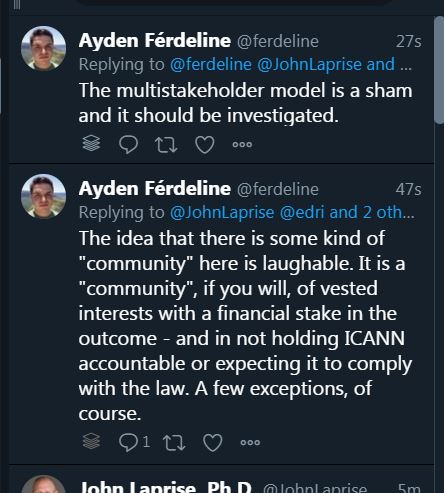

For some, its that way of thinking, for others, their still remains hope. Depends on the mindset. On Thu, Feb 28, 2019 at 7:37 PM John Laprise <jlaprise@gmail.com> wrote:
I didn't expect Ayden to publicly admit to being a bad actor.
-- John Laprise Consulting Scholar _______________________________________________ ALAC mailing list ALAC@atlarge-lists.icann.org https://atlarge-lists.icann.org/mailman/listinfo/alac
At-Large Online: http://www.atlarge.icann.org ALAC Working Wiki: https://community.icann.org/display/atlarge/At-Large+Advisory+Committee+(ALA...)
-- Regards. -------------------------- Fouad Bajwa Public Policy Analyst Follow my Tweets: http://twitter.com/fouadbajwa My Blog: Internet's Governance: http://internetsgovernance.blogspot.com/

Thanks, John - interesting Just to make it a bit easier to see what this is about: https://twitter.com/ferdeline/status/1101040922995949569 Which is in response to https://edri.org/icann-and-gdpr-nowhere-near-compliance/ regards Bastiaan *** Please note that this communication is confidential, legally privileged, and subject to a disclaimer: https://www.ams-ix.net/ams/email-disclaimer ***
On 28 Feb 2019, at 15:36, John Laprise <jlaprise@gmail.com> wrote:
I didn't expect Ayden to publicly admit to being a bad actor.
-- John Laprise Consulting Scholar <Capture.JPG>_______________________________________________ ALAC mailing list ALAC@atlarge-lists.icann.org https://atlarge-lists.icann.org/mailman/listinfo/alac
At-Large Online: http://www.atlarge.icann.org ALAC Working Wiki: https://community.icann.org/display/atlarge/At-Large+Advisory+Committee+(ALA...)

I'm not so sure that I see the controversy, as I generally agree with Ayden's view of ICANN. I was at the first-ever Canadian IGF yesterday, whose keynote was Elliot Noss triumphantly glowing over the power of multistakeholderism to put governments in their place. It was all I could do to break out laughing. The raw sense of entitlement, and the assertion that the "community" that shows up at ICANN meetings is the only one that matters in Internet decision making is ludicrous, and is maintained at high risk. What ICANN calls governance can best be described not as multistakeholderism so much as "the inmates are running the asylum". In a later Canadian IGF session on disinfirmation, the head of policy at Facebook Canada went into the "trust us, we're doing all we can" mantra that many of us have heard so many times. The pattern is unambiguous, whether it's Facebook, Tucows or anyone else in the "community". Left to govern themselves, the Internet is becoming less safe in its content and less safe in its infrastructure. So, again,. please indicate what's so shocking in what Ayden said. I may not share the common view of who the "bad actors" are. - Evan On Thu, 28 Feb 2019 at 09:55, Bastiaan Goslings < bastiaan.goslings@ams-ix.net> wrote:
Thanks, John - interesting
Just to make it a bit easier to see what this is about:
https://twitter.com/ferdeline/status/1101040922995949569
Which is in response to https://edri.org/icann-and-gdpr-nowhere-near-compliance/
regards Bastiaan
*** Please note that this communication is confidential, legally privileged, and subject to a disclaimer: https://www.ams-ix.net/ams/email-disclaimer ***
On 28 Feb 2019, at 15:36, John Laprise <jlaprise@gmail.com> wrote:
I didn't expect Ayden to publicly admit to being a bad actor.
-- John Laprise Consulting Scholar <Capture.JPG>_______________________________________________ ALAC mailing list ALAC@atlarge-lists.icann.org https://atlarge-lists.icann.org/mailman/listinfo/alac
At-Large Online: http://www.atlarge.icann.org ALAC Working Wiki: https://community.icann.org/display/atlarge/At-Large+Advisory+Committee+(ALA...)
_______________________________________________ ALAC mailing list ALAC@atlarge-lists.icann.org https://atlarge-lists.icann.org/mailman/listinfo/alac
At-Large Online: http://www.atlarge.icann.org ALAC Working Wiki: https://community.icann.org/display/atlarge/At-Large+Advisory+Committee+(ALA...)
-- Evan Leibovitch, Toronto Canada @evanleibovitch or @el56
Evan, It's one thing to hold such opinions. It's quite another to shout them out when you hold a position at the organization you are decrying. I'm aware of the power of government and commercial interests too. I also recognize that when you look around the world at similar organizations, few if any create as much space and allocate as much power to noncommercial interests. We're not in a position to be tearing ourselves down/cutting off our nose to spite our face. Sent from my Pixel 3XL John Laprise, Ph.D. On Thu, Feb 28, 2019, 10:34 AM Evan Leibovitch <evan@telly.org> wrote:
I'm not so sure that I see the controversy, as I generally agree with Ayden's view of ICANN.
I was at the first-ever Canadian IGF yesterday, whose keynote was Elliot Noss triumphantly glowing over the power of multistakeholderism to put governments in their place. It was all I could do to break out laughing. The raw sense of entitlement, and the assertion that the "community" that shows up at ICANN meetings is the only one that matters in Internet decision making is ludicrous, and is maintained at high risk.
What ICANN calls governance can best be described not as multistakeholderism so much as "the inmates are running the asylum". In a later Canadian IGF session on disinfirmation, the head of policy at Facebook Canada went into the "trust us, we're doing all we can" mantra that many of us have heard so many times. The pattern is unambiguous, whether it's Facebook, Tucows or anyone else in the "community". Left to govern themselves, the Internet is becoming less safe in its content and less safe in its infrastructure.
So, again,. please indicate what's so shocking in what Ayden said. I may not share the common view of who the "bad actors" are.
- Evan
On Thu, 28 Feb 2019 at 09:55, Bastiaan Goslings < bastiaan.goslings@ams-ix.net> wrote:
Thanks, John - interesting
Just to make it a bit easier to see what this is about:
https://twitter.com/ferdeline/status/1101040922995949569
Which is in response to https://edri.org/icann-and-gdpr-nowhere-near-compliance/
regards Bastiaan
*** Please note that this communication is confidential, legally privileged, and subject to a disclaimer: https://www.ams-ix.net/ams/email-disclaimer ***
On 28 Feb 2019, at 15:36, John Laprise <jlaprise@gmail.com> wrote:
I didn't expect Ayden to publicly admit to being a bad actor.
-- John Laprise Consulting Scholar <Capture.JPG>_______________________________________________ ALAC mailing list ALAC@atlarge-lists.icann.org https://atlarge-lists.icann.org/mailman/listinfo/alac
At-Large Online: http://www.atlarge.icann.org ALAC Working Wiki: https://community.icann.org/display/atlarge/At-Large+Advisory+Committee+(ALA...)
_______________________________________________ ALAC mailing list ALAC@atlarge-lists.icann.org https://atlarge-lists.icann.org/mailman/listinfo/alac
At-Large Online: http://www.atlarge.icann.org ALAC Working Wiki: https://community.icann.org/display/atlarge/At-Large+Advisory+Committee+(ALA...)
-- Evan Leibovitch, Toronto Canada @evanleibovitch or @el56

Hi Evan and all, thank you for sharing your thoughts. I'm wondering if this implies we should get rid of ICANN/multistakeholderism? Is there a better alternative to governing the global network? If so, what is it? I am well aware that governments (some more than others) are just waiting for ICANN to fail and are eager to take over where we leave it off. Is that what you're referring to? Should we just give up, cos MS is a faulty model in itself? I'm genuinely interested. Thank you, Joanna czw., 28 lut 2019 o 17:34 Evan Leibovitch <evan@telly.org> napisał(a):
I'm not so sure that I see the controversy, as I generally agree with Ayden's view of ICANN.
I was at the first-ever Canadian IGF yesterday, whose keynote was Elliot Noss triumphantly glowing over the power of multistakeholderism to put governments in their place. It was all I could do to break out laughing. The raw sense of entitlement, and the assertion that the "community" that shows up at ICANN meetings is the only one that matters in Internet decision making is ludicrous, and is maintained at high risk.
What ICANN calls governance can best be described not as multistakeholderism so much as "the inmates are running the asylum". In a later Canadian IGF session on disinfirmation, the head of policy at Facebook Canada went into the "trust us, we're doing all we can" mantra that many of us have heard so many times. The pattern is unambiguous, whether it's Facebook, Tucows or anyone else in the "community". Left to govern themselves, the Internet is becoming less safe in its content and less safe in its infrastructure.
So, again,. please indicate what's so shocking in what Ayden said. I may not share the common view of who the "bad actors" are.
- Evan
On Thu, 28 Feb 2019 at 09:55, Bastiaan Goslings < bastiaan.goslings@ams-ix.net> wrote:
Thanks, John - interesting
Just to make it a bit easier to see what this is about:
https://twitter.com/ferdeline/status/1101040922995949569
Which is in response to https://edri.org/icann-and-gdpr-nowhere-near-compliance/
regards Bastiaan
*** Please note that this communication is confidential, legally privileged, and subject to a disclaimer: https://www.ams-ix.net/ams/email-disclaimer ***
On 28 Feb 2019, at 15:36, John Laprise <jlaprise@gmail.com> wrote:
I didn't expect Ayden to publicly admit to being a bad actor.
-- John Laprise Consulting Scholar <Capture.JPG>_______________________________________________ ALAC mailing list ALAC@atlarge-lists.icann.org https://atlarge-lists.icann.org/mailman/listinfo/alac
At-Large Online: http://www.atlarge.icann.org ALAC Working Wiki: https://community.icann.org/display/atlarge/At-Large+Advisory+Committee+(ALA...)
_______________________________________________ ALAC mailing list ALAC@atlarge-lists.icann.org https://atlarge-lists.icann.org/mailman/listinfo/alac
At-Large Online: http://www.atlarge.icann.org ALAC Working Wiki: https://community.icann.org/display/atlarge/At-Large+Advisory+Committee+(ALA...)
-- Evan Leibovitch, Toronto Canada @evanleibovitch or @el56 _______________________________________________ ALAC mailing list ALAC@atlarge-lists.icann.org https://atlarge-lists.icann.org/mailman/listinfo/alac
At-Large Online: http://www.atlarge.icann.org ALAC Working Wiki: https://community.icann.org/display/atlarge/At-Large+Advisory+Committee+(ALA...)

Hello all, interesting discussion, as usual. I think that the problem is not whether the multistakeholder model is better or worse than the multilateral model. The problem is that the multistakeholder model needs to be balanced. In my view, the ICANN multistakeholder model is not balanced - it puts too much power in contracted and commercial parties that have DNS-related business and not enough in end users and governments - both of which are advisory committees. The CCWG Accountability process has reinforced the power of SOs at the expense of ACs - since the Board has less power to balance out stakeholder points. As a result we are at a risk that Thomas Schneider, previous GAC Chair, once said in the discussions on CCWG Accountability, which was that from time to time, you need to let the GAC have its way otherwise governments will find that this is not the location for them to be involved in DNS policy. Instead they'll leave and go to the ITU or the UN or elsewhere and ICANN will lose its multistakeholder status. When he said that he was accused of spreading FUD by contracted parties and NCSG. Oh, the venom that poor Thomas collected for saying this... :-) What happens next is anyone's guess. Olivier On 01/03/2019 08:03, Joanna Kulesza wrote:
Hi Evan and all,
thank you for sharing your thoughts. I'm wondering if this implies we should get rid of ICANN/multistakeholderism? Is there a better alternative to governing the global network? If so, what is it? I am well aware that governments (some more than others) are just waiting for ICANN to fail and are eager to take over where we leave it off. Is that what you're referring to? Should we just give up, cos MS is a faulty model in itself? I'm genuinely interested.
Thank you, Joanna
czw., 28 lut 2019 o 17:34 Evan Leibovitch <evan@telly.org <mailto:evan@telly.org>> napisał(a):
I'm not so sure that I see the controversy, as I generally agree with Ayden's view of ICANN.
I was at the first-ever Canadian IGF yesterday, whose keynote was Elliot Noss triumphantly glowing over the power of multistakeholderism to put governments in their place. It was all I could do to break out laughing. The raw sense of entitlement, and the assertion that the "community" that shows up at ICANN meetings is the only one that matters in Internet decision making is ludicrous, and is maintained at high risk.
What ICANN calls governance can best be described not as multistakeholderism so much as "the inmates are running the asylum". In a later Canadian IGF session on disinfirmation, the head of policy at Facebook Canada went into the "trust us, we're doing all we can" mantra that many of us have heard so many times. The pattern is unambiguous, whether it's Facebook, Tucows or anyone else in the "community". Left to govern themselves, the Internet is becoming less safe in its content and less safe in its infrastructure.
So, again,. please indicate what's so shocking in what Ayden said. I may not share the common view of who the "bad actors" are.
- Evan
On Thu, 28 Feb 2019 at 09:55, Bastiaan Goslings <bastiaan.goslings@ams-ix.net <mailto:bastiaan.goslings@ams-ix.net>> wrote:
Thanks, John - interesting
Just to make it a bit easier to see what this is about:
https://twitter.com/ferdeline/status/1101040922995949569
Which is in response to https://edri.org/icann-and-gdpr-nowhere-near-compliance/
regards Bastiaan
*** Please note that this communication is confidential, legally privileged, and subject to a disclaimer: https://www.ams-ix.net/ams/email-disclaimer ***
> On 28 Feb 2019, at 15:36, John Laprise <jlaprise@gmail.com <mailto:jlaprise@gmail.com>> wrote: > > I didn't expect Ayden to publicly admit to being a bad actor. > > -- > John Laprise > Consulting Scholar > <Capture.JPG>_______________________________________________ > ALAC mailing list > ALAC@atlarge-lists.icann.org <mailto:ALAC@atlarge-lists.icann.org> > https://atlarge-lists.icann.org/mailman/listinfo/alac > > At-Large Online: http://www.atlarge.icann.org > ALAC Working Wiki: https://community.icann.org/display/atlarge/At-Large+Advisory+Committee+(ALA...)
_______________________________________________ ALAC mailing list ALAC@atlarge-lists.icann.org <mailto:ALAC@atlarge-lists.icann.org> https://atlarge-lists.icann.org/mailman/listinfo/alac
At-Large Online: http://www.atlarge.icann.org ALAC Working Wiki: https://community.icann.org/display/atlarge/At-Large+Advisory+Committee+(ALA...)
-- Evan Leibovitch, Toronto Canada @evanleibovitch or @el56 _______________________________________________ ALAC mailing list ALAC@atlarge-lists.icann.org <mailto:ALAC@atlarge-lists.icann.org> https://atlarge-lists.icann.org/mailman/listinfo/alac
At-Large Online: http://www.atlarge.icann.org ALAC Working Wiki: https://community.icann.org/display/atlarge/At-Large+Advisory+Committee+(ALA...)
_______________________________________________ ALAC mailing list ALAC@atlarge-lists.icann.org https://atlarge-lists.icann.org/mailman/listinfo/alac
At-Large Online: http://www.atlarge.icann.org ALAC Working Wiki: https://community.icann.org/display/atlarge/At-Large+Advisory+Committee+(ALA...)
-- Olivier MJ Crépin-Leblond, PhD http://www.gih.com/ocl.html

Spot on Olivier. Regards On Fri, 1 Mar 2019 12:35 Olivier MJ Crépin-Leblond <ocl@gih.com wrote:
Hello all,
interesting discussion, as usual. I think that the problem is not whether the multistakeholder model is better or worse than the multilateral model. The problem is that the multistakeholder model needs to be balanced. In my view, the ICANN multistakeholder model is not balanced - it puts too much power in contracted and commercial parties that have DNS-related business and not enough in end users and governments - both of which are advisory committees. The CCWG Accountability process has reinforced the power of SOs at the expense of ACs - since the Board has less power to balance out stakeholder points. As a result we are at a risk that Thomas Schneider, previous GAC Chair, once said in the discussions on CCWG Accountability, which was that from time to time, you need to let the GAC have its way otherwise governments will find that this is not the location for them to be involved in DNS policy. Instead they'll leave and go to the ITU or the UN or elsewhere and ICANN will lose its multistakeholder status. When he said that he was accused of spreading FUD by contracted parties and NCSG. Oh, the venom that poor Thomas collected for saying this... :-)
What happens next is anyone's guess.
Olivier
On 01/03/2019 08:03, Joanna Kulesza wrote:
Hi Evan and all,
thank you for sharing your thoughts. I'm wondering if this implies we should get rid of ICANN/multistakeholderism? Is there a better alternative to governing the global network? If so, what is it? I am well aware that governments (some more than others) are just waiting for ICANN to fail and are eager to take over where we leave it off. Is that what you're referring to? Should we just give up, cos MS is a faulty model in itself? I'm genuinely interested.
Thank you, Joanna
czw., 28 lut 2019 o 17:34 Evan Leibovitch <evan@telly.org> napisał(a):
I'm not so sure that I see the controversy, as I generally agree with Ayden's view of ICANN.
I was at the first-ever Canadian IGF yesterday, whose keynote was Elliot Noss triumphantly glowing over the power of multistakeholderism to put governments in their place. It was all I could do to break out laughing. The raw sense of entitlement, and the assertion that the "community" that shows up at ICANN meetings is the only one that matters in Internet decision making is ludicrous, and is maintained at high risk.
What ICANN calls governance can best be described not as multistakeholderism so much as "the inmates are running the asylum". In a later Canadian IGF session on disinfirmation, the head of policy at Facebook Canada went into the "trust us, we're doing all we can" mantra that many of us have heard so many times. The pattern is unambiguous, whether it's Facebook, Tucows or anyone else in the "community". Left to govern themselves, the Internet is becoming less safe in its content and less safe in its infrastructure.
So, again,. please indicate what's so shocking in what Ayden said. I may not share the common view of who the "bad actors" are.
- Evan
On Thu, 28 Feb 2019 at 09:55, Bastiaan Goslings < bastiaan.goslings@ams-ix.net> wrote:
Thanks, John - interesting
Just to make it a bit easier to see what this is about:
https://twitter.com/ferdeline/status/1101040922995949569
Which is in response to https://edri.org/icann-and-gdpr-nowhere-near-compliance/
regards Bastiaan
*** Please note that this communication is confidential, legally privileged, and subject to a disclaimer: https://www.ams-ix.net/ams/email-disclaimer ***
On 28 Feb 2019, at 15:36, John Laprise <jlaprise@gmail.com> wrote:
I didn't expect Ayden to publicly admit to being a bad actor.
-- John Laprise Consulting Scholar <Capture.JPG>_______________________________________________ ALAC mailing list ALAC@atlarge-lists.icann.org https://atlarge-lists.icann.org/mailman/listinfo/alac
At-Large Online: http://www.atlarge.icann.org ALAC Working Wiki: https://community.icann.org/display/atlarge/At-Large+Advisory+Committee+(ALA...)
_______________________________________________ ALAC mailing list ALAC@atlarge-lists.icann.org https://atlarge-lists.icann.org/mailman/listinfo/alac
At-Large Online: http://www.atlarge.icann.org ALAC Working Wiki: https://community.icann.org/display/atlarge/At-Large+Advisory+Committee+(ALA...)
-- Evan Leibovitch, Toronto Canada @evanleibovitch or @el56 _______________________________________________ ALAC mailing list ALAC@atlarge-lists.icann.org https://atlarge-lists.icann.org/mailman/listinfo/alac
At-Large Online: http://www.atlarge.icann.org ALAC Working Wiki: https://community.icann.org/display/atlarge/At-Large+Advisory+Committee+(ALA...)
_______________________________________________ ALAC mailing listALAC@atlarge-lists.icann.orghttps://atlarge-lists.icann.org/mailman/listinfo/alac
At-Large Online: http://www.atlarge.icann.org ALAC Working Wiki: https://community.icann.org/display/atlarge/At-Large+Advisory+Committee+(ALA...)
-- Olivier MJ Crépin-Leblond, PhDhttp://www.gih.com/ocl.html
_______________________________________________ ALAC mailing list ALAC@atlarge-lists.icann.org https://atlarge-lists.icann.org/mailman/listinfo/alac
At-Large Online: http://www.atlarge.icann.org ALAC Working Wiki: https://community.icann.org/display/atlarge/At-Large+Advisory+Committee+(ALA...)
On Fri, 1 Mar 2019 at 02:04, Joanna Kulesza <jkuleszaicann@gmail.com> wrote:
thank you for sharing your thoughts. I'm wondering if this implies we should get rid of ICANN/multistakeholderism? Is there a better alternative to governing the global network? If so, what is it? I am well aware that governments (some more than others) are just waiting for ICANN to fail and are eager to take over where we leave it off. Is that what you're referring to? Should we just give up, cos MS is a faulty model in itself? I'm genuinely interested.
Hi Joanna, The concept of MSM is splendid, ICANN's implementation of it is awful. As Olivier said, it's about balance. In ICANN, control is in the hands of the cartel of domain sellers and domain buyers. By its own rules ICANN is *obligated* to implement what this cartel wants, and to heck with the rest of us. The bodies charged with protecting the public interest at ICANN -- governments, technology experts and At-Large -- are relegated to the sidelines, in advisory capacity with barely an obligation to be heard let alone heeded. How ICANN has operated, and the results of its decisions, clearly demonstrate the dominance of the will of the industry that ICANN is supposed charged with overseeing. The inmates truly are running the asylum, and the monied interests like it that way. In a way it's not very different than the way that Google, Facebook and other large tech firms have resisted public oversight and insist their self-regulation is sufficient to serve the public interest. There are other models of MS which I have liked better than ICANN's. The IETF does IMO a good job keeping corporate interests heard but not forced upon it. The model used at the Netmundial conference in 2014 struck a better balance between business, government and public interest, and deserves consideration. There may be other models of which I am not aware. Meanwhile ... the current status quo is propped up by never-ending FUD that the only alternative to ICANN's model of industry capture is the ITU model of government capture. Of course, the ITU does its part to support ICANN by periodically holding meetings so incompetently run so to justify the fear. What is not spoken about is the fact that genuine options exist beyond these two undesirable extremes. Once upon a time I believed that the Internet Governance Forum was the perfect place in which alternative models could be designed and proposed. That belief has diminished as I have found the IGF over time to revel in its own insignificance, and contents itself to fret over the situation without considering real change. I have no idea where true innovation in this field will come, and this realization is a major source of my current cynicism. If a sane alternative does not arise, we will continue to be presented with nothing more than choice between the ICANN or ITU ways of doing things. Eventually the ITU will win this binary duel because ultimately governments will tire of the unwillingness of ICANN to truly incorporate the public interest into its decision-making. And I remind once again that there is no international treaty requiring the countries of the world to acknowledge ICANN as manager of the global DNS; ICANN's mandate is maintained through inertia and (ever-diminishing) goodwill. I hope I have addressed your interest, at least a little bit. - Evan
Well said Evan and I share your concerns. If memory serves, so does the Board as MSM threats is a strategic planning issue. Musing upon waking I was wondering whether it would help if we could implement a mechanism whereby ICANN org could ask the empowered community to implement a pdp? This might've avoided the current epdp issue. Sent from my Pixel 3XL John Laprise, Ph.D. On Fri, Mar 1, 2019, 4:38 AM Evan Leibovitch <evan@telly.org> wrote:
On Fri, 1 Mar 2019 at 02:04, Joanna Kulesza <jkuleszaicann@gmail.com> wrote:
thank you for sharing your thoughts. I'm wondering if this implies we should get rid of ICANN/multistakeholderism? Is there a better alternative to governing the global network? If so, what is it? I am well aware that governments (some more than others) are just waiting for ICANN to fail and are eager to take over where we leave it off. Is that what you're referring to? Should we just give up, cos MS is a faulty model in itself? I'm genuinely interested.
Hi Joanna,
The concept of MSM is splendid, ICANN's implementation of it is awful.
As Olivier said, it's about balance. In ICANN, control is in the hands of the cartel of domain sellers and domain buyers. By its own rules ICANN is *obligated* to implement what this cartel wants, and to heck with the rest of us. The bodies charged with protecting the public interest at ICANN -- governments, technology experts and At-Large -- are relegated to the sidelines, in advisory capacity with barely an obligation to be heard let alone heeded. How ICANN has operated, and the results of its decisions, clearly demonstrate the dominance of the will of the industry that ICANN is supposed charged with overseeing. The inmates truly are running the asylum, and the monied interests like it that way. In a way it's not very different than the way that Google, Facebook and other large tech firms have resisted public oversight and insist their self-regulation is sufficient to serve the public interest.
There are other models of MS which I have liked better than ICANN's. The IETF does IMO a good job keeping corporate interests heard but not forced upon it. The model used at the Netmundial conference in 2014 struck a better balance between business, government and public interest, and deserves consideration. There may be other models of which I am not aware.
Meanwhile ... the current status quo is propped up by never-ending FUD that the only alternative to ICANN's model of industry capture is the ITU model of government capture. Of course, the ITU does its part to support ICANN by periodically holding meetings so incompetently run so to justify the fear. What is not spoken about is the fact that genuine options exist beyond these two undesirable extremes.
Once upon a time I believed that the Internet Governance Forum was the perfect place in which alternative models could be designed and proposed. That belief has diminished as I have found the IGF over time to revel in its own insignificance, and contents itself to fret over the situation without considering real change. I have no idea where true innovation in this field will come, and this realization is a major source of my current cynicism.
If a sane alternative does not arise, we will continue to be presented with nothing more than choice between the ICANN or ITU ways of doing things. Eventually the ITU will win this binary duel because ultimately governments will tire of the unwillingness of ICANN to truly incorporate the public interest into its decision-making. And I remind once again that there is no international treaty requiring the countries of the world to acknowledge ICANN as manager of the global DNS; ICANN's mandate is maintained through inertia and (ever-diminishing) goodwill.
I hope I have addressed your interest, at least a little bit.
- Evan
_______________________________________________ ALAC mailing list ALAC@atlarge-lists.icann.org https://atlarge-lists.icann.org/mailman/listinfo/alac
At-Large Online: http://www.atlarge.icann.org ALAC Working Wiki: https://community.icann.org/display/atlarge/At-Large+Advisory+Committee+(ALA...)
Dear John, please be so kind to find my response below: On 01/03/2019 13:31, John Laprise wrote:
Well said Evan and I share your concerns. If memory serves, so does the Board as MSM threats is a strategic planning issue. Musing upon waking I was wondering whether it would help if we could implement a mechanism whereby ICANN org could ask the empowered community to implement a pdp? This might've avoided the current epdp issue.
The ICANN Board and the Empowered Community cannot implement or launch PDPs relating to gTLDs. The "PDP" as such is a defined term for "Policy Development Process" and in the context of the Generic Names, only the GNSO can launch a PDP. In the context of Country Codes Names, when it relates to global policy, the ccNSO can launch a PDP. The Board can ask the GNSO to launch a PDP on a gTLD related issue, but the GNSO can refuse. The Board can also ask the ICANN communities, SOs/ACs to launch a Cross Community Working Group (CCWG). However, there are doubts expressed in the GNSO that CCWGs should *not* be the basis for policy making for gTLDs as all policy making for gTLDs should go through a PDP. It's a power game and the bottom line is who has the control of policy processes on gTLDs. Kindest regards, Olivier
Hi and thanks Olivier, My apologies for not being clear. I was suggesting a possible bylaws change where in ICANN org can ask the community to initiate policy development when it sees an urgent/important need that the community has not noticed. Sent from my Pixel 3XL John Laprise, Ph.D. On Fri, Mar 1, 2019, 7:07 AM Olivier MJ Crépin-Leblond <ocl@gih.com> wrote:
Dear John,
please be so kind to find my response below:
On 01/03/2019 13:31, John Laprise wrote:
Well said Evan and I share your concerns. If memory serves, so does the Board as MSM threats is a strategic planning issue. Musing upon waking I was wondering whether it would help if we could implement a mechanism whereby ICANN org could ask the empowered community to implement a pdp? This might've avoided the current epdp issue.
The ICANN Board and the Empowered Community cannot implement or launch PDPs relating to gTLDs. The "PDP" as such is a defined term for "Policy Development Process" and in the context of the Generic Names, only the GNSO can launch a PDP. In the context of Country Codes Names, when it relates to global policy, the ccNSO can launch a PDP. The Board can ask the GNSO to launch a PDP on a gTLD related issue, but the GNSO can refuse.
The Board can also ask the ICANN communities, SOs/ACs to launch a Cross Community Working Group (CCWG). However, there are doubts expressed in the GNSO that CCWGs should *not* be the basis for policy making for gTLDs as all policy making for gTLDs should go through a PDP.
It's a power game and the bottom line is who has the control of policy processes on gTLDs. Kindest regards,
Olivier

John, do you really mean "ICANN org", ie staff, to make that decision? Alan -- Sent from my mobile. Please excuse brevity and typos. On March 1, 2019 9:00:50 AM EST, John Laprise <jlaprise@gmail.com> wrote: Hi and thanks Olivier, My apologies for not being clear. I was suggesting a possible bylaws change where in ICANN org can ask the community to initiate policy development when it sees an urgent/important need that the community has not noticed. Sent from my Pixel 3XL John Laprise, Ph.D. On Fri, Mar 1, 2019, 7:07 AM Olivier MJ Crépin-Leblond <ocl@gih.com<mailto:ocl@gih.com>> wrote: Dear John, please be so kind to find my response below: On 01/03/2019 13:31, John Laprise wrote: Well said Evan and I share your concerns. If memory serves, so does the Board as MSM threats is a strategic planning issue. Musing upon waking I was wondering whether it would help if we could implement a mechanism whereby ICANN org could ask the empowered community to implement a pdp? This might've avoided the current epdp issue. The ICANN Board and the Empowered Community cannot implement or launch PDPs relating to gTLDs. The "PDP" as such is a defined term for "Policy Development Process" and in the context of the Generic Names, only the GNSO can launch a PDP. In the context of Country Codes Names, when it relates to global policy, the ccNSO can launch a PDP. The Board can ask the GNSO to launch a PDP on a gTLD related issue, but the GNSO can refuse. The Board can also ask the ICANN communities, SOs/ACs to launch a Cross Community Working Group (CCWG). However, there are doubts expressed in the GNSO that CCWGs should *not* be the basis for policy making for gTLDs as all policy making for gTLDs should go through a PDP. It's a power game and the bottom line is who has the control of policy processes on gTLDs. Kindest regards, Olivier
Not just staff...I was thinking ICANN org leadership...needs authority Sent from my Pixel 3XL John Laprise, Ph.D. On Fri, Mar 1, 2019, 9:02 AM Alan Greenberg <alan.greenberg@mcgill.ca> wrote:
John, do you really mean "ICANN org", ie staff, to make that decision?
Alan -- Sent from my mobile. Please excuse brevity and typos.
On March 1, 2019 9:00:50 AM EST, John Laprise <jlaprise@gmail.com> wrote:
Hi and thanks Olivier,
My apologies for not being clear. I was suggesting a possible bylaws change where in ICANN org can ask the community to initiate policy development when it sees an urgent/important need that the community has not noticed.
Sent from my Pixel 3XL
John Laprise, Ph.D.
On Fri, Mar 1, 2019, 7:07 AM Olivier MJ Crépin-Leblond <ocl@gih.com> wrote:
Dear John,
please be so kind to find my response below:
On 01/03/2019 13:31, John Laprise wrote:
Well said Evan and I share your concerns. If memory serves, so does the Board as MSM threats is a strategic planning issue. Musing upon waking I was wondering whether it would help if we could implement a mechanism whereby ICANN org could ask the empowered community to implement a pdp? This might've avoided the current epdp issue.
The ICANN Board and the Empowered Community cannot implement or launch PDPs relating to gTLDs. The "PDP" as such is a defined term for "Policy Development Process" and in the context of the Generic Names, only the GNSO can launch a PDP. In the context of Country Codes Names, when it relates to global policy, the ccNSO can launch a PDP. The Board can ask the GNSO to launch a PDP on a gTLD related issue, but the GNSO can refuse.
The Board can also ask the ICANN communities, SOs/ACs to launch a Cross Community Working Group (CCWG). However, there are doubts expressed in the GNSO that CCWGs should *not* be the basis for policy making for gTLDs as all policy making for gTLDs should go through a PDP.
It's a power game and the bottom line is who has the control of policy processes on gTLDs. Kindest regards,
Olivier
So one of the complaints I saw online is that ICANN org legal which presumably saw the GDPR train coming down the track had limited options beyond waving a flag despite it's material impact. ICANN org spends a lot of resources to stay abreast of international law but can only do something at the last minute. (Epdp) The more I think about it, the more giving ICANN org (pres?) the right to ask the community to initiate a PDP has a kind of symmetry with the powers of the enhanced community. Essentially, if the community and the board fail to address an operational, material threat, ICANN org can hold the board and the community to account. Sent from my Pixel 3XL John Laprise, Ph.D. On Fri, Mar 1, 2019, 11:45 AM John Laprise <jlaprise@gmail.com> wrote:
Not just staff...I was thinking ICANN org leadership...needs authority
Sent from my Pixel 3XL
John Laprise, Ph.D.
On Fri, Mar 1, 2019, 9:02 AM Alan Greenberg <alan.greenberg@mcgill.ca> wrote:
John, do you really mean "ICANN org", ie staff, to make that decision?
Alan -- Sent from my mobile. Please excuse brevity and typos.
On March 1, 2019 9:00:50 AM EST, John Laprise <jlaprise@gmail.com> wrote:
Hi and thanks Olivier,
My apologies for not being clear. I was suggesting a possible bylaws change where in ICANN org can ask the community to initiate policy development when it sees an urgent/important need that the community has not noticed.
Sent from my Pixel 3XL
John Laprise, Ph.D.
On Fri, Mar 1, 2019, 7:07 AM Olivier MJ Crépin-Leblond <ocl@gih.com> wrote:
Dear John,
please be so kind to find my response below:
On 01/03/2019 13:31, John Laprise wrote:
Well said Evan and I share your concerns. If memory serves, so does the Board as MSM threats is a strategic planning issue. Musing upon waking I was wondering whether it would help if we could implement a mechanism whereby ICANN org could ask the empowered community to implement a pdp? This might've avoided the current epdp issue.
The ICANN Board and the Empowered Community cannot implement or launch PDPs relating to gTLDs. The "PDP" as such is a defined term for "Policy Development Process" and in the context of the Generic Names, only the GNSO can launch a PDP. In the context of Country Codes Names, when it relates to global policy, the ccNSO can launch a PDP. The Board can ask the GNSO to launch a PDP on a gTLD related issue, but the GNSO can refuse.
The Board can also ask the ICANN communities, SOs/ACs to launch a Cross Community Working Group (CCWG). However, there are doubts expressed in the GNSO that CCWGs should *not* be the basis for policy making for gTLDs as all policy making for gTLDs should go through a PDP.
It's a power game and the bottom line is who has the control of policy processes on gTLDs. Kindest regards,
Olivier

Hello John Sent from my mobile Kindly excuse brevity and typos On Fri, 1 Mar 2019, 15:01 John Laprise, <jlaprise@gmail.com> wrote:
Hi and thanks Olivier,
My apologies for not being clear. I was suggesting a possible bylaws change where in ICANN org can ask the community to initiate policy development when it sees an urgent/important need that the community has not noticed.
SO: This suggest that the Board can't initiate this at the moment? Isn't the ccwg-stewardship, icann accountability, and the ongoing ePDP good examples of such? Regards
Sent from my Pixel 3XL
John Laprise, Ph.D.
On Fri, Mar 1, 2019, 7:07 AM Olivier MJ Crépin-Leblond <ocl@gih.com> wrote:
Dear John,
please be so kind to find my response below:
On 01/03/2019 13:31, John Laprise wrote:
Well said Evan and I share your concerns. If memory serves, so does the Board as MSM threats is a strategic planning issue. Musing upon waking I was wondering whether it would help if we could implement a mechanism whereby ICANN org could ask the empowered community to implement a pdp? This might've avoided the current epdp issue.
The ICANN Board and the Empowered Community cannot implement or launch PDPs relating to gTLDs. The "PDP" as such is a defined term for "Policy Development Process" and in the context of the Generic Names, only the GNSO can launch a PDP. In the context of Country Codes Names, when it relates to global policy, the ccNSO can launch a PDP. The Board can ask the GNSO to launch a PDP on a gTLD related issue, but the GNSO can refuse.
The Board can also ask the ICANN communities, SOs/ACs to launch a Cross Community Working Group (CCWG). However, there are doubts expressed in the GNSO that CCWGs should *not* be the basis for policy making for gTLDs as all policy making for gTLDs should go through a PDP.
It's a power game and the bottom line is who has the control of policy processes on gTLDs. Kindest regards,
Olivier
_______________________________________________ ALAC mailing list ALAC@atlarge-lists.icann.org https://atlarge-lists.icann.org/mailman/listinfo/alac
At-Large Online: http://www.atlarge.icann.org ALAC Working Wiki: https://community.icann.org/display/atlarge/At-Large+Advisory+Committee+(ALA...)
Olivier, I generally agree with your post, but to correct a few errors, the Board can request that the GNSO initiate a PDP and the GNSO must act (that is how the Next-Generation RDS PDP was initiated), and it is not just a belief of the GNSO that a PDP must be used to create gTLD policy recommendations - that is what the Bylaws dictate. HOWEVER, there is nothing to stop the GNSO using a CCWG structure for a PDP if it chose to. In fact, the EPDP could be viewed as a variant of the CCWG format. Alan At 01/03/2019 08:07 AM, Olivier MJ Crépin-Leblond wrote: Dear John, please be so kind to find my response below: On 01/03/2019 13:31, John Laprise wrote: Well said Evan and I share your concerns. If memory serves, so does the Board as MSM threats is a strategic planning issue. Musing upon waking I was wondering whether it would help if we could implement a mechanism whereby ICANN org could ask the empowered community to implement a pdp? This might've avoided the current epdp issue. The ICANN Board and the Empowered Community cannot implement or launch PDPs relating to gTLDs. The "PDP" as such is a defined term for "Policy Development Process" and in the context of the Generic Names, only the GNSO can launch a PDP. In the context of Country Codes Names, when it relates to global policy, the ccNSO can launch a PDP. The Board can ask the GNSO to launch a PDP on a gTLD related issue, but the GNSO can refuse. The Board can also ask the ICANN communities, SOs/ACs to launch a Cross Community Working Group (CCWG). However, there are doubts expressed in the GNSO that CCWGs should *not* be the basis for policy making for gTLDs as all policy making for gTLDs should go through a PDP. It's a power game and the bottom line is who has the control of policy processes on gTLDs. Kindest regards, Olivier _______________________________________________ ALAC mailing list ALAC@atlarge-lists.icann.org https://atlarge-lists.icann.org/mailman/listinfo/alac At-Large Online: http://www.atlarge.icann.org<http://www.atlarge.icann.org/> ALAC Working Wiki: https://community.icann.org/display/atlarge/At-Large+Advisory+Committee+(ALA... )
Dear Evan, please be so kind to find my responses interspersed in your text: On 01/03/2019 11:39, Evan Leibovitch wrote:
There are other models of MS which I have liked better than ICANN's. The IETF does IMO a good job keeping corporate interests heard but not forced upon it. The model used at the Netmundial conference in 2014 struck a better balance between business, government and public interest, and deserves consideration. There may be other models of which I am not aware.
Of course some will dispute the IETF as being expensive for participants since one has to pay to register to attend an IETF meeting and it is nearly impossible to get a standard through the IETF process without physically attending an IETF meeting - or more than one. Others, primarily from Civil Society, will tell you that NetMundial was a complete failure. Remember how Civil Society withdrew its support at the end? So your balance may not be the balance that others see as being balanced. And that's already the first problem of MS models.
Meanwhile ... the current status quo is propped up by never-ending FUD that the only alternative to ICANN's model of industry capture is the ITU model of government capture. Of course, the ITU does its part to support ICANN by periodically holding meetings so incompetently run so to justify the fear. What is not spoken about is the fact that genuine options exist beyond these two undesirable extremes.
Please elaborate on these options. I remember when ICANN was created there were several alternative options on the table. I wonder what would have happened, had we followed these options rather than ICANN.
Once upon a time I believed that the Internet Governance Forum was the perfect place in which alternative models could be designed and proposed. That belief has diminished as I have found the IGF over time to revel in its own insignificance, and contents itself to fret over the situation without considering real change. I have no idea where true innovation in this field will come, and this realization is a major source of my current cynicism.
Recently the MAG Chair has attempted to address the deficit of (a) funding and (b) involvement from the Private Sector by holding discussions with the World Economic Forum (WEF). The pushback from Civil Society was vigorous. With such parochial outlook I cannot see the IGF being able to evolve into a true multi-stakeholder dialogue... let alone being able to actually run anything operationally.
If a sane alternative does not arise, we will continue to be presented with nothing more than choice between the ICANN or ITU ways of doing things. Eventually the ITU will win this binary duel because ultimately governments will tire of the unwillingness of ICANN to truly incorporate the public interest into its decision-making. And I remind once again that there is no international treaty requiring the countries of the world to acknowledge ICANN as manager of the global DNS; ICANN's mandate is maintained through inertia and (ever-diminishing) goodwill.
That is the only point which I do not agree with you. I am not so sure that the ITU will win because it is so incredibly inefficient, political and clueless when it comes to anything operational. The ITU sustains development and negotiates standards. It is totally incapable of managing resources operationally. Second, regarding international treaties: the Internet sits outside international treaties full stop. It would have never existed had it required any kind of international treaty. Networks that had previously been build with the mandate of an international treaty failed commercially. The Internet is a network of networks where all networks participating strike agreements with others to carry their traffic and their interlocutors strike agreements with others to carry their and your traffic - and this is all based on trust and peering contracts. Nothing stops any network from losing trust in the Internet and pulling out. That's indeed what several countries keep on threatening and they forget that in the 90s, they were the ones that asked to get connected to the Internet to start with. I know that first hand as I helped connect some of them. The Internet runs on a circle of trust. The 13 root servers are trusted to be a stable and reliable source of top level domain data that's amended in the A root, itself trusted to be a stable and reliable database of a stable addressing tree of generic top level domains and country code top level domains. ICANN is trusted by all parties to be the right location to issue orders regarding this database, using clearly laid out and stable procedures. It is also trusted by all parties to be the location for discussing the policy related to generic top level domains and to take decisions about these. So if one or more of the parties loses that trust, then they are welcome to leave. And that's the fragile world that ICANN lives in. If the GAC gets fed up that it is completely ignored, it can leave. It could look to find a home within ITU for example - a dream that Richard Hill has had for some time. If the ASO, doing so little in ICANN and most of its work within the RIRs decides to leave, it could do. Ultimately if these organisations were to leave, it would weaken ICANN's multistakeholder model as without governments, ICANN's model is no longer multistakeholder. ICANN would also lose a lot of legitimacy in the face of governments without an incumbent forum for governments within its ranks. So where does this take us? Well the question I periodically ask is "Are we ready, we, as in the wider ICANN community that includes all stakeholders, for an ICANN Version 3.0"? - ICANN 1.0: ICANN as it was set-up with a caretaker Board, and then a global direct At-Large election process to fill at least half of the ICANN Board seats. Deemed to have failed. - ICANN 2.0: in 2002/2003 creation of ALAC, stripping Board director. SOs/ACs structure that we know today, with reduced power for ACs and increased powers for SOs, especially the GNSO. - ICANN 2.5: ICANN 2.0 with the US government contract replaced by an empowered community that has powers to keep the ICANN Board under control. - ICANN 3.0: a new structure with a core public interest mandate. Recently I held long discussions with some old timers in the UK and elsewhere. Whilst I lived the transition from ICANN 1.0 to ICANN 2.0 from the fringes, I was not part of the core group then, and I wanted to understand what was the overwhelming force that came upon ICANN to go from version 1.0 to version 2.0. I was told this was complex but it involved some of the very big players out there, that drove it forward, not necessarily players that knew the consequences of what the changes were going to be, but there apparently was a real will to improve ICANN then. I am a rather pragmatic player when it comes to such things, with sometimes a sense of immobility that betrays my age. Right now, I do not see the overwhelming force out there to evolve ICANN from 2.0 to 3.0. I do not see enough big players adhering to this scenario. I do not see matters being so bad as to warrant an emergency summit to "save ICANN" - because only then, would the huge commercial forces currently holding ICANN into its current state because it serves their purposes, bow down as for them it would be a choice between reluctantly accepting a new ICANN 3.0 or losing it all. Now I might be completely wrong too. I infamously told Larry Strickling during dinner at an ATRT2 meeting that if he wanted to be remembered for his action, he could take the unprecedented step of relinquishing the US Government control on the Root but that if he was to launch such a process, he would face the biggest hurdle in the US Congress -- and that I was therefore convinced that it could not be done within less than 5 years. Well, Larry had the courage and determination to do it much faster and although it was not without its dramas, it worked. Perhaps should we follow the motto "Who Dares Wins". But as I have said it in the past, this is likely to be a high stakes, high power, particularly treacherous path which would need a lot of allies. It could be very dangerous for ICANN itself. But then the world has never advanced by sticking to the status quo. Kindest regards, Olivier
Thanks for the thoughtful response, Olivier. [ much cut ] Of course some will dispute the IETF as being expensive for participants
since one has to pay to register to attend an IETF meeting and it is nearly impossible to get a standard through the IETF process without physically attending an IETF meeting - or more than one.
The state of virtual meeting technology makes this problem addressable should the will exist. Vote-by-humming will have to be adapted but it's doable. Others, primarily from Civil Society, will tell you that NetMundial was a
complete failure. Remember how Civil Society withdrew its support at the end?
They were upset that government got more say than they did, what they wanted was not likely to be acceptable to anyone else. Still, that model had plenty of room to adapt -- again, should the will exist. Meanwhile ... the current status quo is propped up by never-ending FUD that
the only alternative to ICANN's model of industry capture is the ITU model of government capture. Of course, the ITU does its part to support ICANN by periodically holding meetings so incompetently run so to justify the fear. What is not spoken about is the fact that genuine options exist beyond these two undesirable extremes.
Please elaborate on these options.
One that I have personally liked flips the AC/SO model, so it is the public interest bodies whose consensus binds ICANN (governments, at-large/civil society, technical community) while the commercial interests are in the advisory role. And it sounds like you are yourself aware of alternate ways to go
If a sane alternative does not arise, we will continue to be presented with nothing more than choice between the ICANN or ITU ways of doing things. Eventually the ITU will win this binary duel because ultimately governments will tire of the unwillingness of ICANN to truly incorporate the public interest into its decision-making. And I remind once again that there is no international treaty requiring the countries of the world to acknowledge ICANN as manager of the global DNS; ICANN's mandate is maintained through inertia and (ever-diminishing) goodwill.
That is the only point which I do not agree with you.
I really hope you are right. Because ICANN is not treaty-supported, it only takes one major scandal or major misfunction at ICANN to bring "plan B" to the forefront. I agree that government capture -- especially with the participation of countries who see the Internet as a way to force direction of social behavior -- is inferior to the status quo. But I truly believe that the current ICANN model is unsustainable, and without a credible middle path there may be no alternative once ICANN runs out of steam (and friends). Consider that ICANN is part of a much bigger picture unfolding globally. Governments around the world have become fed up with unregulated Internet companies which have stifled consumer competition (Amazon), facilitated disinformation on a global scale (Facebook), made the trade of people's private data their core revenue model (Google) and locked consumers into closed technical ecosystems (Apple). I personally see a changing mood of the public that is increasingly calling on governments to regulate these companies. The world is tired of Mark Zuckerberg endlessly saying "we're doing our best, leave us alone". What broad form the inevitable backlash will take is unknown but is already happening country by country, from the Chinese social credit system or the massive EU fines on Google. Even the regulatory-light USA still has its own very clear and heavily enforced limits (ie, online gambling). My point here is that whatever direction these global moves go, ICANN is going to get caught up in them. In its own way ICANN's embedded industry entitlement attitude exhibits exactly the same kind of "we're doing our best, leave us alone" mentality that the world sees from GAFA. If ICANN refuses the role of regulator, something else is inevitably destined to take that role. But what? ICANN, unlike GAFA, has the means to reform itself. But post-IANA I posit that its situation is worse. The "empowered community" further entrenches the "inmates are running the asylum" model that resists oversight (let alone regulation) from outside the cartel. ICANN's community, collectively, appears to the outside world no less arrogant than GAFA -- and no less worthy of reaction. What role will we in the public interest community play in that reaction? Time will tell if we press for real reform or are satisfied with the current industry capture with a little tinkering. - Evan

Well said! Big +1. -Carlton ============================== *Carlton A Samuels* *Mobile: 876-818-1799Strategy, Process, Governance, Assessment & Turnaround* ============================= On Fri, Mar 1, 2019 at 5:38 AM Evan Leibovitch <evan@telly.org> wrote:
On Fri, 1 Mar 2019 at 02:04, Joanna Kulesza <jkuleszaicann@gmail.com> wrote:
thank you for sharing your thoughts. I'm wondering if this implies we should get rid of ICANN/multistakeholderism? Is there a better alternative to governing the global network? If so, what is it? I am well aware that governments (some more than others) are just waiting for ICANN to fail and are eager to take over where we leave it off. Is that what you're referring to? Should we just give up, cos MS is a faulty model in itself? I'm genuinely interested.
Hi Joanna,
The concept of MSM is splendid, ICANN's implementation of it is awful.
As Olivier said, it's about balance. In ICANN, control is in the hands of the cartel of domain sellers and domain buyers. By its own rules ICANN is *obligated* to implement what this cartel wants, and to heck with the rest of us. The bodies charged with protecting the public interest at ICANN -- governments, technology experts and At-Large -- are relegated to the sidelines, in advisory capacity with barely an obligation to be heard let alone heeded. How ICANN has operated, and the results of its decisions, clearly demonstrate the dominance of the will of the industry that ICANN is supposed charged with overseeing. The inmates truly are running the asylum, and the monied interests like it that way. In a way it's not very different than the way that Google, Facebook and other large tech firms have resisted public oversight and insist their self-regulation is sufficient to serve the public interest.
There are other models of MS which I have liked better than ICANN's. The IETF does IMO a good job keeping corporate interests heard but not forced upon it. The model used at the Netmundial conference in 2014 struck a better balance between business, government and public interest, and deserves consideration. There may be other models of which I am not aware.
Meanwhile ... the current status quo is propped up by never-ending FUD that the only alternative to ICANN's model of industry capture is the ITU model of government capture. Of course, the ITU does its part to support ICANN by periodically holding meetings so incompetently run so to justify the fear. What is not spoken about is the fact that genuine options exist beyond these two undesirable extremes.
Once upon a time I believed that the Internet Governance Forum was the perfect place in which alternative models could be designed and proposed. That belief has diminished as I have found the IGF over time to revel in its own insignificance, and contents itself to fret over the situation without considering real change. I have no idea where true innovation in this field will come, and this realization is a major source of my current cynicism.
If a sane alternative does not arise, we will continue to be presented with nothing more than choice between the ICANN or ITU ways of doing things. Eventually the ITU will win this binary duel because ultimately governments will tire of the unwillingness of ICANN to truly incorporate the public interest into its decision-making. And I remind once again that there is no international treaty requiring the countries of the world to acknowledge ICANN as manager of the global DNS; ICANN's mandate is maintained through inertia and (ever-diminishing) goodwill.
I hope I have addressed your interest, at least a little bit.
- Evan
_______________________________________________ ALAC mailing list ALAC@atlarge-lists.icann.org https://atlarge-lists.icann.org/mailman/listinfo/alac
At-Large Online: http://www.atlarge.icann.org ALAC Working Wiki: https://community.icann.org/display/atlarge/At-Large+Advisory+Committee+(ALA...)

Thank you for the link, Bastiaan. It is in fact good to read both sides of the argument as it has progressed. There are some aspects of Ayden's view which I think we all agree with. I guess the issue is that he is not afraid to speak up, even if it rankles. But maybe that's why he does it and he's good at it :) M On Thu, Feb 28, 2019 at 11:54 PM Bastiaan Goslings < bastiaan.goslings@ams-ix.net> wrote:
Thanks, John - interesting
Just to make it a bit easier to see what this is about:
https://twitter.com/ferdeline/status/1101040922995949569
Which is in response to https://edri.org/icann-and-gdpr-nowhere-near-compliance/
regards Bastiaan
*** Please note that this communication is confidential, legally privileged, and subject to a disclaimer: https://www.ams-ix.net/ams/email-disclaimer ***
On 28 Feb 2019, at 15:36, John Laprise <jlaprise@gmail.com> wrote:
I didn't expect Ayden to publicly admit to being a bad actor.
-- John Laprise Consulting Scholar <Capture.JPG>_______________________________________________ ALAC mailing list ALAC@atlarge-lists.icann.org https://atlarge-lists.icann.org/mailman/listinfo/alac
At-Large Online: http://www.atlarge.icann.org ALAC Working Wiki: https://community.icann.org/display/atlarge/At-Large+Advisory+Committee+(ALA...)
_______________________________________________ ALAC mailing list ALAC@atlarge-lists.icann.org https://atlarge-lists.icann.org/mailman/listinfo/alac
At-Large Online: http://www.atlarge.icann.org ALAC Working Wiki: https://community.icann.org/display/atlarge/At-Large+Advisory+Committee+(ALA...)
Hi Colleagues, I agree with Fouad. That said, Multistakeholderism is like a chick, full of a promising future but always at risk because of eagles circling the sky and all sorts of predators. When all is said and done and coming from a developing Region, we have seen the benefits of the multistakeholder model but as the wise men said in olden days, one mans meat is another mans poison. Regards On Thu, 28 Feb 2019 22:26 Maureen Hilyard <maureen.hilyard@gmail.com wrote:
Thank you for the link, Bastiaan. It is in fact good to read both sides of the argument as it has progressed. There are some aspects of Ayden's view which I think we all agree with. I guess the issue is that he is not afraid to speak up, even if it rankles. But maybe that's why he does it and he's good at it :)
M
On Thu, Feb 28, 2019 at 11:54 PM Bastiaan Goslings < bastiaan.goslings@ams-ix.net> wrote:
Thanks, John - interesting
Just to make it a bit easier to see what this is about:
https://twitter.com/ferdeline/status/1101040922995949569
Which is in response to https://edri.org/icann-and-gdpr-nowhere-near-compliance/
regards Bastiaan
*** Please note that this communication is confidential, legally privileged, and subject to a disclaimer: https://www.ams-ix.net/ams/email-disclaimer ***
On 28 Feb 2019, at 15:36, John Laprise <jlaprise@gmail.com> wrote:
I didn't expect Ayden to publicly admit to being a bad actor.
-- John Laprise Consulting Scholar <Capture.JPG>_______________________________________________ ALAC mailing list ALAC@atlarge-lists.icann.org https://atlarge-lists.icann.org/mailman/listinfo/alac
At-Large Online: http://www.atlarge.icann.org ALAC Working Wiki: https://community.icann.org/display/atlarge/At-Large+Advisory+Committee+(ALA...)
_______________________________________________ ALAC mailing list ALAC@atlarge-lists.icann.org https://atlarge-lists.icann.org/mailman/listinfo/alac
At-Large Online: http://www.atlarge.icann.org ALAC Working Wiki: https://community.icann.org/display/atlarge/At-Large+Advisory+Committee+(ALA...)
_______________________________________________ ALAC mailing list ALAC@atlarge-lists.icann.org https://atlarge-lists.icann.org/mailman/listinfo/alac
At-Large Online: http://www.atlarge.icann.org ALAC Working Wiki: https://community.icann.org/display/atlarge/At-Large+Advisory+Committee+(ALA...)
participants (11)
-
 Alan Greenberg
 -
 Barrack Otieno
 -
 Bastiaan Goslings
 -
 Carlton Samuels
 -
 Evan Leibovitch
 -
 Fouad Bajwa
 -
 Joanna Kulesza
 -
 John Laprise
 -
 Maureen Hilyard
 -
 Olivier MJ Crépin-Leblond
 -
 Seun Ojedeji