[Comments-idn-guidelines-19oct17] JPRS comment on the Internationalised Domain Name Implementation Guidelines

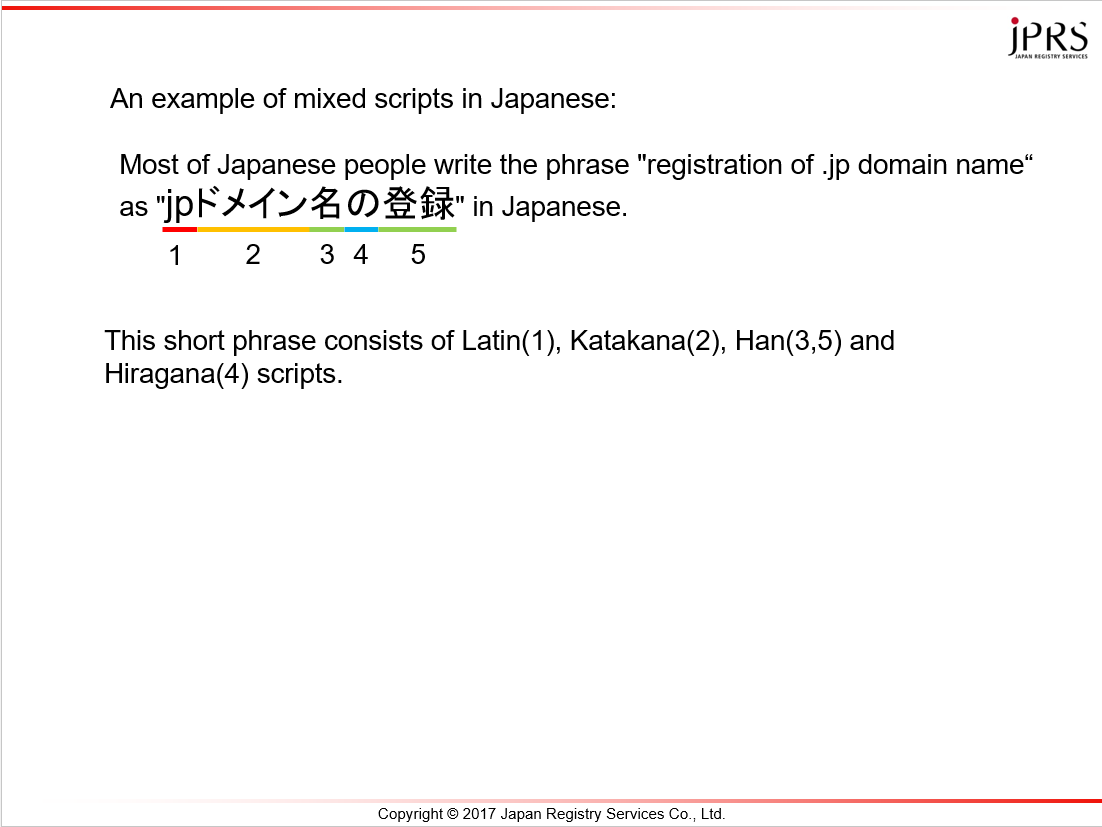
Dear ICANN, Thank you for giving us the oppotunity to submit the comments on the Guidelines for the Implementation of Internationalized Domain Names 4.0. Please find our comments as follows. Comments to paragraph 15 and 16, "2.5.2 Commingling of cross-script code points in a single label": As you describe about the exemption about the commingled use of multiple scripts in these paragraphs, it is an important point of view whether such multiple scripts are used exclusively in relevant linguistic area or not. For example, while Japanese characters are technically devided into 3 scripts (Han, Hiragana and Katakana), the official language of Japan is only Japanese and these 3 scripts are not the exclusive with each other. An example of mixed scripts in Japanese: Most of Japanese people write the phrase "registration of .jp domain name" as "jpドメイン名の登録" in Japanese. <><------><><><--> 1 2 3 4 5 This short phrase consists of Latin(1), Katakana(2), Han(3,5) and Hiragana(4) scripts. #If you can not display it, please see the attached file. That is, Japanese language user always uses Han, Hiragana and Katakana all together in the strings that configure the words in Japanese writing system, and Japanese characters are actually treated as 1 script in Japanese daily life. In fact, people in Japan are allowed to use Han, Hiragana, Katakana and ASCII characters all together as the person's names, the trademarks(*1), the trade names(*2), and/or the words including noun. (*1) The list of standard characters for trademarks (Japan Patent Office, written in Japanese) http://www.jpo.go.jp/shiryou/kijun/kijun2/pdf/syouhyoubin/shiryou_1_1.pdf (*2) About using ASCII characters for the trade names (Ministry of Justice, written in Japanese) http://www.moj.go.jp/MINJI/minji44.html In other words, the actual conditions of Japanese characters are treated as 1 script, but they are only devided into 3 scripts technically. We think that they have completely different degrees of risk between commingling Japanese characters (Han, Hiragana and Katakana) and commingling other scripts that must be used exclusively. Therefore, the Guidelines should clearly express that "the case of any exceptions made allowing mixing of scripts" means the case of commingling the scripts that are used exclusively. Best regards, -- Yoshitaka Okuno Manager, Services Development Department Japan Registry Services Co., Ltd.
participants (1)
-
 yoshitaka@jprs.co.jp