FW: Conversation Wrap-Up & Next Steps

All, In discussion with Beth Novek and colleagues from the Governance Lab last week, a suggestion emerged that we could potentially narrow down the list of MSI Panel proposals for more detailed discussion. It is not yet 100% clear to me as to whether or not we will be able to meet with one or more of the team from the Gov Lab in Singapore but it seems likely and, in any event, it's useful to consider how we might respond to the output of the panel, in particular where it seems to link most closely with our own work. We discussed condensing their work into a most relevant sub-set for further discussion
From their perspective and having made themselves aware of the work of the GNSO, the suggested sub-set (from them) for further condensation is as follows:
1. Move from "Stakeholder" engagement to Global Engagement: <http://bit.ly/1k7FDNj> http://bit.ly/1k7FDNj 2. Use expert networking: <http://bit.ly/1lof1c5> http://bit.ly/1lof1c5 3. Get Broad-based input/crowdsource at each stage of decision-making: <http://bit.ly/1czpNXn> http://bit.ly/1czpNXn 4. Use Open Data and open contracting: <http://bit.ly/1jcv3Rt> http://bit.ly/1jcv3Rt 5. Experiment with Innovative Voting Techniques: <http://bit.ly/1nwta2H> http://bit.ly/1nwta2H 6. Impose Rotating Term Limits: <http://bit.ly/1nUmkEr> http://bit.ly/1nUmkEr I also talked with the Gov Lab people about considering the above proposals through a (non-exhaustive) list of criteria as follows: A. Is the proposal relevant to us? B. Is it currently applicable to our work? C. How could the proposal be modified/amended/advanced to be applicable or more applicable to our work? D. How might we pilot/test these proposals in order to determine whether and how the proposal could be a useful amendment or reform for ICANN? None of this pre-supposes that this work was commissioned, initiated or executed in a way which we consider optimal. It simply takes a "we are where we are" view of the work and recognises that we have the opportunity to potentially engage with the team that undertook the work. In addition, we will still have the opportunity to provide formal public comment on this and engage through any other applicable forums at the ICANN meeting in Singapore. Thoughts or input welcome. Jonathan

hi Jonathan, thanks for this extensive update and your leadership on this topic. the key distinction i’ve been trying to make, in many fora, is the two really different kinds of work that happen within the GNSO. they are: - SG/Constituency — stakeholder-focused homes for participants in the GNSO. these organizations are the focal point for outreach, the “staircase of engagement.” this is where new people are welcomed, acquire the skills and knowledge they need to effectively participate in and lead working groups and in turn help others join the process. these are “functions” - they last forever and continuously improve their work. - Working Groups and the PDP — policy/issue focused “projects” that have a beginning, middle and end. in my view these working groups are the “customers” of the SG/Constituencies and they look to the SG/Constituencies for effective participants in the PDPs we supervise. the point i’ve been trying to make to the MSI folks, and others, is that the needs of those two parts of the GNSO mission are *really different* and introducing changes without a clear understanding of that difference can lead to a tremendous tangle. i am quite relaxed, in fact enthusiastic, about some of the recommendations when i stand with my Constituency-member hat on. i think a lot of the things described in the report would be tremendously helpful to us in the ISPCP. i’m much more cautious about some of these ideas in the PDP context — the notion of “crowdsourced” PDPs makes my blood run cold. clearly these are only my ideas and they undoubtedly need refinement — but i think if we can continue to inform this effort with ideas like those, we stand a chance of getting a lot of good ideas from it. i think that we the Council, as the stewards of the PDP, need to keep a close eye on improving the pool of *qualified* participants in working groups, and not accidentally causing more harm than good. my two cents. thanks again Jonathan, a really helpful post. mikey On Mar 5, 2014, at 5:11 AM, Jonathan Robinson <jrobinson@afilias.info> wrote:
All,
In discussion with Beth Novek and colleagues from the Governance Lab last week, a suggestion emerged that we could potentially narrow down the list of MSI Panel proposals for more detailed discussion.
It is not yet 100% clear to me as to whether or not we will be able to meet with one or more of the team from the Gov Lab in Singapore but it seems likely and, in any event, it’s useful to consider how we might respond to the output of the panel, in particular where it seems to link most closely with our own work. We discussed condensing their work into a most relevant sub-set for further discussion
From their perspective and having made themselves aware of the work of the GNSO, the suggested sub-set (from them) for further condensation is as follows: 1. Move from "Stakeholder" engagement to Global Engagement: http://bit.ly/1k7FDNj 2. Use expert networking: http://bit.ly/1lof1c5 3. Get Broad-based input/crowdsource at each stage of decision-making: http://bit.ly/1czpNXn 4. Use Open Data and open contracting: http://bit.ly/1jcv3Rt 5. Experiment with Innovative Voting Techniques: http://bit.ly/1nwta2H 6. Impose Rotating Term Limits: http://bit.ly/1nUmkEr I also talked with the Gov Lab people about considering the above proposals through a (non-exhaustive) list of criteria as follows:
A. Is the proposal relevant to us? B. Is it currently applicable to our work? C. How could the proposal be modified/amended/advanced to be applicable or more applicable to our work? D. How might we pilot/test these proposals in order to determine whether and how the proposal could be a useful amendment or reform for ICANN?
None of this pre-supposes that this work was commissioned, initiated or executed in a way which we consider optimal. It simply takes a “we are where we are” view of the work and recognises that we have the opportunity to potentially engage with the team that undertook the work.
In addition, we will still have the opportunity to provide formal public comment on this and engage through any other applicable forums at the ICANN meeting in Singapore.
Thoughts or input welcome.
Jonathan
PHONE: 651-647-6109, FAX: 866-280-2356, WEB: www.haven2.com, HANDLE: OConnorStP (ID for Twitter, Facebook, LinkedIn, etc.)

Hello Mike,

The distinction below I think is very helpful.

Regards,
Bruce Tonkin


From: owner-council@gnso.icann.org [mailto:owner-council@gnso.icann.org] On Behalf Of Mike O'Connor
Sent: Thursday, 6 March 2014 8:01 AM
To: jrobinson@afilias.info
Cc: council@gnso.icann.org
Subject: Re: [council] Conversation Wrap-Up & Next Steps

hi Jonathan,

thanks for this extensive update and your leadership on this topic.

the key distinction i've been trying to make, in many fora, is the two really different kinds of work that happen within the GNSO.  they are:

- SG/Constituency - stakeholder-focused homes for participants in the GNSO.  these organizations are the focal point for outreach, the "staircase of engagement."  this is where new people are welcomed, acquire the skills and knowledge they need to effectively participate in and lead working groups and in turn help others join the process.  these are "functions" - they last forever and continuously improve their work.

- Working Groups and the PDP - policy/issue focused "projects" that have a beginning, middle and end.  in my view these working groups are the "customers" of the SG/Constituencies and they look to the SG/Constituencies for effective participants in the PDPs we supervise.

the point i've been trying to make to the MSI folks, and others, is that the needs of those two parts of the GNSO mission are *really different* and introducing changes without a clear understanding of that difference can lead to a tremendous tangle.  i am quite relaxed, in fact enthusiastic, about some of the recommendations when i stand with my Constituency-member hat on.  i think a lot of the things described in the report would be tremendously helpful to us in the ISPCP.  i'm much more cautious about some of these ideas in the PDP context - the notion of "crowdsourced" PDPs makes my blood run cold.

clearly these are only my ideas and they undoubtedly need refinement - but i think if we can continue to inform this effort with ideas like those, we stand a chance of getting a lot of good ideas from it.  i think that we the Council, as the stewards of the PDP, need to keep a close eye on improving the pool of *qualified* participants in working groups, and not accidentally causing more harm than good.

my two cents.  thanks again Jonathan, a really helpful post.

mikey


On Mar 5, 2014, at 5:11 AM, Jonathan Robinson <jrobinson@afilias.info<mailto:jrobinson@afilias.info>> wrote:


All,

In discussion with Beth Novek and colleagues from the Governance Lab last week, a suggestion emerged that we could potentially narrow down the list of MSI Panel proposals for more detailed discussion.

It is not yet 100% clear to me as to whether or not we will be able to meet with one or more of the team from the Gov Lab in Singapore but it seems likely and, in any event, it's useful to consider how we might respond to the output of the panel, in particular where it seems to link most closely with our own work.  We discussed condensing their work into a most relevant sub-set for further discussion

>From their perspective and having made themselves aware of the work of the GNSO, the suggested sub-set (from them) for further condensation is as follows:
1.      Move from "Stakeholder" engagement to Global Engagement: http://bit.ly/1k7FDNj
2.      Use expert networking: http://bit.ly/1lof1c5
3.      Get Broad-based input/crowdsource at each stage of decision-making: http://bit.ly/1czpNXn
4.      Use Open Data and open contracting: http://bit.ly/1jcv3Rt
5.      Experiment with Innovative Voting Techniques: http://bit.ly/1nwta2H
6.      Impose Rotating Term Limits: http://bit.ly/1nUmkEr
I also talked with the Gov Lab people about considering the above proposals through a (non-exhaustive) list of criteria as follows:


A.    Is the proposal relevant to us?

B.     Is it currently applicable to our work?

C.     How could the proposal be modified/amended/advanced to be applicable or more applicable to our work?

D.    How might we pilot/test these proposals in order to determine whether and how the proposal could be a useful amendment or reform for ICANN?

None of this pre-supposes that this work was commissioned, initiated or executed in a way which we consider optimal.
It simply takes a "we are where we are" view of the work and recognises that we have the opportunity to potentially engage with the team that undertook the work.

In addition, we will still have the opportunity to provide formal public comment on this and engage through any other applicable forums at the ICANN meeting in Singapore.

Thoughts or input welcome.


Jonathan


PHONE: 651-647-6109, FAX: 866-280-2356, WEB: www.haven2.com<http://www.haven2.com>, HANDLE: OConnorStP (ID for Twitter, Facebook, LinkedIn, etc.)
Agreed and thanks from me too. Good points Mikey. The issues Mikey raises and related points were some of the concerns I felt with regard to the work of the MSI panel. Indeed, whilst my original mail below referred to the GNSO in parts, when I have used "we", I mean the Council. A couple of other background remarks in that may help here: 1. The MSI Panel based used a couple of primers to inform and normalise their understanding a. The ICANN Primer http://www.icann.org/en/about/planning/strategic-engagement/multistakeholder -innovation/primer-20nov13-en.pdf b. The ICANN Primer - Technical & Business Functions http://www.icann.org/en/about/planning/strategic-engagement/multistakeholder -innovation/primer-tech-business-20nov13-en.pdf 2. I gathered from my conversations with the Gov Lab people that they had made particular efforts and felt that one or more staff had made good steps forward in understanding the GNSO. Thanks again, Jonathan From: Bruce Tonkin [mailto:Bruce.Tonkin@melbourneit.com.au] Sent: 05 March 2014 22:11 To: Mike O'Connor; jrobinson@afilias.info Cc: council@gnso.icann.org Subject: RE: [council] Conversation Wrap-Up & Next Steps Hello Mike, The distinction below I think is very helpful. Regards, Bruce Tonkin From: owner-council@gnso.icann.org [mailto:owner-council@gnso.icann.org] On Behalf Of Mike O'Connor Sent: Thursday, 6 March 2014 8:01 AM To: jrobinson@afilias.info Cc: council@gnso.icann.org Subject: Re: [council] Conversation Wrap-Up & Next Steps hi Jonathan, thanks for this extensive update and your leadership on this topic. the key distinction i've been trying to make, in many fora, is the two really different kinds of work that happen within the GNSO. they are: - SG/Constituency - stakeholder-focused homes for participants in the GNSO. these organizations are the focal point for outreach, the "staircase of engagement." this is where new people are welcomed, acquire the skills and knowledge they need to effectively participate in and lead working groups and in turn help others join the process. these are "functions" - they last forever and continuously improve their work. - Working Groups and the PDP - policy/issue focused "projects" that have a beginning, middle and end. in my view these working groups are the "customers" of the SG/Constituencies and they look to the SG/Constituencies for effective participants in the PDPs we supervise. the point i've been trying to make to the MSI folks, and others, is that the needs of those two parts of the GNSO mission are *really different* and introducing changes without a clear understanding of that difference can lead to a tremendous tangle. i am quite relaxed, in fact enthusiastic, about some of the recommendations when i stand with my Constituency-member hat on. i think a lot of the things described in the report would be tremendously helpful to us in the ISPCP. i'm much more cautious about some of these ideas in the PDP context - the notion of "crowdsourced" PDPs makes my blood run cold. clearly these are only my ideas and they undoubtedly need refinement - but i think if we can continue to inform this effort with ideas like those, we stand a chance of getting a lot of good ideas from it. i think that we the Council, as the stewards of the PDP, need to keep a close eye on improving the pool of *qualified* participants in working groups, and not accidentally causing more harm than good. my two cents. thanks again Jonathan, a really helpful post. mikey On Mar 5, 2014, at 5:11 AM, Jonathan Robinson <jrobinson@afilias.info> wrote: All, In discussion with Beth Novek and colleagues from the Governance Lab last week, a suggestion emerged that we could potentially narrow down the list of MSI Panel proposals for more detailed discussion. It is not yet 100% clear to me as to whether or not we will be able to meet with one or more of the team from the Gov Lab in Singapore but it seems likely and, in any event, it's useful to consider how we might respond to the output of the panel, in particular where it seems to link most closely with our own work. We discussed condensing their work into a most relevant sub-set for further discussion
From their perspective and having made themselves aware of the work of the GNSO, the suggested sub-set (from them) for further condensation is as follows:
1. Move from "Stakeholder" engagement to Global Engagement: <http://bit.ly/1k7FDNj> http://bit.ly/1k7FDNj 2. Use expert networking: <http://bit.ly/1lof1c5> http://bit.ly/1lof1c5 3. Get Broad-based input/crowdsource at each stage of decision-making: <http://bit.ly/1czpNXn> http://bit.ly/1czpNXn 4. Use Open Data and open contracting: <http://bit.ly/1jcv3Rt> http://bit.ly/1jcv3Rt 5. Experiment with Innovative Voting Techniques: <http://bit.ly/1nwta2H> http://bit.ly/1nwta2H 6. Impose Rotating Term Limits: <http://bit.ly/1nUmkEr> http://bit.ly/1nUmkEr I also talked with the Gov Lab people about considering the above proposals through a (non-exhaustive) list of criteria as follows: A. Is the proposal relevant to us? B. Is it currently applicable to our work? C. How could the proposal be modified/amended/advanced to be applicable or more applicable to our work? D. How might we pilot/test these proposals in order to determine whether and how the proposal could be a useful amendment or reform for ICANN? None of this pre-supposes that this work was commissioned, initiated or executed in a way which we consider optimal. It simply takes a "we are where we are" view of the work and recognises that we have the opportunity to potentially engage with the team that undertook the work. In addition, we will still have the opportunity to provide formal public comment on this and engage through any other applicable forums at the ICANN meeting in Singapore. Thoughts or input welcome. Jonathan PHONE: 651-647-6109, FAX: 866-280-2356, WEB: www.haven2.com, HANDLE: OConnorStP (ID for Twitter, Facebook, LinkedIn, etc.)
i’ve just scanned these primers and… they look really good. i think we (GNSO and GNSO Council) should give these a careful review and, once they pass muster, give them wider distribution. maybe on the “Basics” page of the GNSO website? thanks for those links Jonathan. m On Mar 6, 2014, at 5:38 AM, Jonathan Robinson <jrobinson@afilias.info> wrote:
Agreed and thanks from me too. Good points Mikey.
The issues Mikey raises and related points were some of the concerns I felt with regard to the work of the MSI panel. Indeed, whilst my original mail below referred to the GNSO in parts, when I have used “we”, I mean the Council.
A couple of other background remarks in that may help here:
1. The MSI Panel based used a couple of primers to inform and normalise their understanding a. The ICANN Primer http://www.icann.org/en/about/planning/strategic-engagement/multistakeholder... b. The ICANN Primer – Technical & Business Functions http://www.icann.org/en/about/planning/strategic-engagement/multistakeholder... 2. I gathered from my conversations with the Gov Lab people that they had made particular efforts and felt that one or more staff had made good steps forward in understanding the GNSO.
Thanks again,
Jonathan
From: Bruce Tonkin [mailto:Bruce.Tonkin@melbourneit.com.au] Sent: 05 March 2014 22:11 To: Mike O'Connor; jrobinson@afilias.info Cc: council@gnso.icann.org Subject: RE: [council] Conversation Wrap-Up & Next Steps
Hello Mike,
The distinction below I think is very helpful.
Regards, Bruce Tonkin
From: owner-council@gnso.icann.org [mailto:owner-council@gnso.icann.org] On Behalf Of Mike O'Connor Sent: Thursday, 6 March 2014 8:01 AM To: jrobinson@afilias.info Cc: council@gnso.icann.org Subject: Re: [council] Conversation Wrap-Up & Next Steps
hi Jonathan,
thanks for this extensive update and your leadership on this topic.
the key distinction i’ve been trying to make, in many fora, is the two really different kinds of work that happen within the GNSO. they are:
- SG/Constituency — stakeholder-focused homes for participants in the GNSO. these organizations are the focal point for outreach, the “staircase of engagement.” this is where new people are welcomed, acquire the skills and knowledge they need to effectively participate in and lead working groups and in turn help others join the process. these are “functions” - they last forever and continuously improve their work.
- Working Groups and the PDP — policy/issue focused “projects” that have a beginning, middle and end. in my view these working groups are the “customers” of the SG/Constituencies and they look to the SG/Constituencies for effective participants in the PDPs we supervise.
the point i’ve been trying to make to the MSI folks, and others, is that the needs of those two parts of the GNSO mission are *really different* and introducing changes without a clear understanding of that difference can lead to a tremendous tangle. i am quite relaxed, in fact enthusiastic, about some of the recommendations when i stand with my Constituency-member hat on. i think a lot of the things described in the report would be tremendously helpful to us in the ISPCP. i’m much more cautious about some of these ideas in the PDP context — the notion of “crowdsourced” PDPs makes my blood run cold.
clearly these are only my ideas and they undoubtedly need refinement — but i think if we can continue to inform this effort with ideas like those, we stand a chance of getting a lot of good ideas from it. i think that we the Council, as the stewards of the PDP, need to keep a close eye on improving the pool of *qualified* participants in working groups, and not accidentally causing more harm than good.
my two cents. thanks again Jonathan, a really helpful post.
mikey
On Mar 5, 2014, at 5:11 AM, Jonathan Robinson <jrobinson@afilias.info> wrote:
All,
In discussion with Beth Novek and colleagues from the Governance Lab last week, a suggestion emerged that we could potentially narrow down the list of MSI Panel proposals for more detailed discussion.
It is not yet 100% clear to me as to whether or not we will be able to meet with one or more of the team from the Gov Lab in Singapore but it seems likely and, in any event, it’s useful to consider how we might respond to the output of the panel, in particular where it seems to link most closely with our own work. We discussed condensing their work into a most relevant sub-set for further discussion
From their perspective and having made themselves aware of the work of the GNSO, the suggested sub-set (from them) for further condensation is as follows: 1. Move from "Stakeholder" engagement to Global Engagement: http://bit.ly/1k7FDNj 2. Use expert networking: http://bit.ly/1lof1c5 3. Get Broad-based input/crowdsource at each stage of decision-making: http://bit.ly/1czpNXn 4. Use Open Data and open contracting: http://bit.ly/1jcv3Rt 5. Experiment with Innovative Voting Techniques: http://bit.ly/1nwta2H 6. Impose Rotating Term Limits: http://bit.ly/1nUmkEr I also talked with the Gov Lab people about considering the above proposals through a (non-exhaustive) list of criteria as follows:
A. Is the proposal relevant to us? B. Is it currently applicable to our work? C. How could the proposal be modified/amended/advanced to be applicable or more applicable to our work? D. How might we pilot/test these proposals in order to determine whether and how the proposal could be a useful amendment or reform for ICANN?
None of this pre-supposes that this work was commissioned, initiated or executed in a way which we consider optimal. It simply takes a “we are where we are” view of the work and recognises that we have the opportunity to potentially engage with the team that undertook the work.
In addition, we will still have the opportunity to provide formal public comment on this and engage through any other applicable forums at the ICANN meeting in Singapore.
Thoughts or input welcome.
Jonathan
PHONE: 651-647-6109, FAX: 866-280-2356, WEB: www.haven2.com, HANDLE: OConnorStP (ID for Twitter, Facebook, LinkedIn, etc.)
PHONE: 651-647-6109, FAX: 866-280-2356, WEB: www.haven2.com, HANDLE: OConnorStP (ID for Twitter, Facebook, LinkedIn, etc.)

Mikey, at the time of publication Mary and I actually went through the document that was prepared by GovLabs and made some proposed edits / additions (see attached). As the primer had already been distributed to the panel, it was decided not to post a revised version at that stage. However, if you are now considering posting these on the GNSO web-site, you may want to consider including the proposed edits which aimed to provide some further clarifications and details especially in relation to the GNSO PDP. Best regards, Marika From: Mike O'Connor <mike@haven2.com> Date: Thursday 6 March 2014 14:17 To: Jonathan Robinson <jrobinson@afilias.info> Cc: "bruce.tonkin@melbourneit.com.au" <bruce.tonkin@melbourneit.com.au>, "council@gnso.icann.org" <council@gnso.icann.org> Subject: Re: [council] Conversation Wrap-Up & Next Steps i¹ve just scanned these primers and they look really good. i think we (GNSO and GNSO Council) should give these a careful review and, once they pass muster, give them wider distribution. maybe on the ³Basics² page of the GNSO website? thanks for those links Jonathan. m On Mar 6, 2014, at 5:38 AM, Jonathan Robinson <jrobinson@afilias.info> wrote:
Agreed and thanks from me too. Good points Mikey.
The issues Mikey raises and related points were some of the concerns I felt with regard to the work of the MSI panel. Indeed, whilst my original mail below referred to the GNSO in parts, when I have used ³we², I mean the Council.
A couple of other background remarks in that may help here:
1. The MSI Panel based used a couple of primers to inform and normalise their understanding
a. The ICANN Primer http://www.icann.org/en/about/planning/strategic-engagement/multistakeholder... nnovation/primer-20nov13-en.pdf
b. The ICANN Primer Technical & Business Functions http://www.icann.org/en/about/planning/strategic-engagement/multistakeholder... nnovation/primer-tech-business-20nov13-en.pdf
2. I gathered from my conversations with the Gov Lab people that they had made particular efforts and felt that one or more staff had made good steps forward in understanding the GNSO.
Thanks again,
Jonathan
From: Bruce Tonkin [mailto:Bruce.Tonkin@melbourneit.com.au] Sent: 05 March 2014 22:11 To: Mike O'Connor; jrobinson@afilias.info Cc: council@gnso.icann.org Subject: RE: [council] Conversation Wrap-Up & Next Steps
Hello Mike,
The distinction below I think is very helpful.
Regards, Bruce Tonkin
From:owner-council@gnso.icann.org [mailto:owner-council@gnso.icann.org] On Behalf Of Mike O'Connor Sent: Thursday, 6 March 2014 8:01 AM To: jrobinson@afilias.info Cc: council@gnso.icann.org Subject: Re: [council] Conversation Wrap-Up & Next Steps
hi Jonathan,
thanks for this extensive update and your leadership on this topic.
the key distinction i¹ve been trying to make, in many fora, is the two really different kinds of work that happen within the GNSO. they are:
- SG/Constituency stakeholder-focused homes for participants in the GNSO. these organizations are the focal point for outreach, the ³staircase of engagement.² this is where new people are welcomed, acquire the skills and knowledge they need to effectively participate in and lead working groups and in turn help others join the process. these are ³functions² - they last forever and continuously improve their work.
- Working Groups and the PDP policy/issue focused ³projects² that have a beginning, middle and end. in my view these working groups are the ³customers² of the SG/Constituencies and they look to the SG/Constituencies for effective participants in the PDPs we supervise.
the point i¹ve been trying to make to the MSI folks, and others, is that the needs of those two parts of the GNSO mission are *really different* and introducing changes without a clear understanding of that difference can lead to a tremendous tangle. i am quite relaxed, in fact enthusiastic, about some of the recommendations when i stand with my Constituency-member hat on. i think a lot of the things described in the report would be tremendously helpful to us in the ISPCP. i¹m much more cautious about some of these ideas in the PDP context the notion of ³crowdsourced² PDPs makes my blood run cold.
clearly these are only my ideas and they undoubtedly need refinement but i think if we can continue to inform this effort with ideas like those, we stand a chance of getting a lot of good ideas from it. i think that we the Council, as the stewards of the PDP, need to keep a close eye on improving the pool of *qualified* participants in working groups, and not accidentally causing more harm than good.
my two cents. thanks again Jonathan, a really helpful post.
mikey
On Mar 5, 2014, at 5:11 AM, Jonathan Robinson <jrobinson@afilias.info> wrote:
All,
In discussion with Beth Novek and colleagues from the Governance Lab last week, a suggestion emerged that we could potentially narrow down the list of MSI Panel proposals for more detailed discussion.
It is not yet 100% clear to me as to whether or not we will be able to meet with one or more of the team from the Gov Lab in Singapore but it seems likely and, in any event, it¹s useful to consider how we might respond to the output of the panel, in particular where it seems to link most closely with our own work. We discussed condensing their work into a most relevant sub-set for further discussion
From their perspective and having made themselves aware of the work of the GNSO, the suggested sub-set (from them) for further condensation is as follows:
1. Move from "Stakeholder" engagement to Global Engagement: http://bit.ly/1k7FDNj <http://bit.ly/1k7FDNj> 2. Use expert networking: http://bit.ly/1lof1c5 <http://bit.ly/1lof1c5> 3. Get Broad-based input/crowdsource at each stage of decision-making: http://bit.ly/1czpNXn <http://bit.ly/1czpNXn> 4. Use Open Data and open contracting: http://bit.ly/1jcv3Rt <http://bit.ly/1jcv3Rt> 5. Experiment with Innovative Voting Techniques: http://bit.ly/1nwta2H <http://bit.ly/1nwta2H> 6. Impose Rotating Term Limits: http://bit.ly/1nUmkEr <http://bit.ly/1nUmkEr>
I also talked with the Gov Lab people about considering the above proposals through a (non-exhaustive) list of criteria as follows:
A. Is the proposal relevant to us?
B. Is it currently applicable to our work?
C. How could the proposal be modified/amended/advanced to be applicable or more applicable to our work?
D. How might we pilot/test these proposals in order to determine whether and how the proposal could be a useful amendment or reform for ICANN?
None of this pre-supposes that this work was commissioned, initiated or executed in a way which we consider optimal.
It simply takes a ³we are where we are² view of the work and recognises that we have the opportunity to potentially engage with the team that undertook the work.
In addition, we will still have the opportunity to provide formal public comment on this and engage through any other applicable forums at the ICANN meeting in Singapore.
Thoughts or input welcome.
Jonathan
PHONE: 651-647-6109, FAX: 866-280-2356, WEB: www.haven2.com <http://www.haven2.com/> , HANDLE: OConnorStP (ID for Twitter, Facebook, LinkedIn, etc.)
PHONE: 651-647-6109, FAX: 866-280-2356, WEB: www.haven2.com <http://www.haven2.com> , HANDLE: OConnorStP (ID for Twitter, Facebook, LinkedIn, etc.)
hi Marika, thanks to you and Mary for your review. those look better! we’re all sortof in the flood at the moment, but maybe we can add an action item to send a nudge-note out to the GNSO lists post-Singapore to encourage community members to have a look — and post the result to the GNSO page. mikey On Mar 6, 2014, at 7:53 AM, Marika Konings <marika.konings@icann.org> wrote:
Mikey, at the time of publication Mary and I actually went through the document that was prepared by GovLabs and made some proposed edits / additions (see attached). As the primer had already been distributed to the panel, it was decided not to post a revised version at that stage. However, if you are now considering posting these on the GNSO web-site, you may want to consider including the proposed edits which aimed to provide some further clarifications and details especially in relation to the GNSO PDP.
Best regards,
Marika
From: Mike O'Connor <mike@haven2.com> Date: Thursday 6 March 2014 14:17 To: Jonathan Robinson <jrobinson@afilias.info> Cc: "bruce.tonkin@melbourneit.com.au" <bruce.tonkin@melbourneit.com.au>, "council@gnso.icann.org" <council@gnso.icann.org> Subject: Re: [council] Conversation Wrap-Up & Next Steps
i’ve just scanned these primers and…
they look really good. i think we (GNSO and GNSO Council) should give these a careful review and, once they pass muster, give them wider distribution. maybe on the “Basics” page of the GNSO website?
thanks for those links Jonathan.
m
On Mar 6, 2014, at 5:38 AM, Jonathan Robinson <jrobinson@afilias.info> wrote:
Agreed and thanks from me too. Good points Mikey.
The issues Mikey raises and related points were some of the concerns I felt with regard to the work of the MSI panel. Indeed, whilst my original mail below referred to the GNSO in parts, when I have used “we”, I mean the Council.
A couple of other background remarks in that may help here:
1. The MSI Panel based used a couple of primers to inform and normalise their understanding a. The ICANN Primer http://www.icann.org/en/about/planning/strategic-engagement/multistakeholder... b. The ICANN Primer – Technical & Business Functions http://www.icann.org/en/about/planning/strategic-engagement/multistakeholder... 2. I gathered from my conversations with the Gov Lab people that they had made particular efforts and felt that one or more staff had made good steps forward in understanding the GNSO.
Thanks again,
Jonathan
From: Bruce Tonkin [mailto:Bruce.Tonkin@melbourneit.com.au] Sent: 05 March 2014 22:11 To: Mike O'Connor; jrobinson@afilias.info Cc: council@gnso.icann.org Subject: RE: [council] Conversation Wrap-Up & Next Steps
Hello Mike,
The distinction below I think is very helpful.
Regards, Bruce Tonkin
From:owner-council@gnso.icann.org [mailto:owner-council@gnso.icann.org] On Behalf Of Mike O'Connor Sent: Thursday, 6 March 2014 8:01 AM To: jrobinson@afilias.info Cc: council@gnso.icann.org Subject: Re: [council] Conversation Wrap-Up & Next Steps
hi Jonathan,
thanks for this extensive update and your leadership on this topic.
the key distinction i’ve been trying to make, in many fora, is the two really different kinds of work that happen within the GNSO. they are:
- SG/Constituency — stakeholder-focused homes for participants in the GNSO. these organizations are the focal point for outreach, the “staircase of engagement.” this is where new people are welcomed, acquire the skills and knowledge they need to effectively participate in and lead working groups and in turn help others join the process. these are “functions” - they last forever and continuously improve their work.
- Working Groups and the PDP — policy/issue focused “projects” that have a beginning, middle and end. in my view these working groups are the “customers” of the SG/Constituencies and they look to the SG/Constituencies for effective participants in the PDPs we supervise.
the point i’ve been trying to make to the MSI folks, and others, is that the needs of those two parts of the GNSO mission are *really different* and introducing changes without a clear understanding of that difference can lead to a tremendous tangle. i am quite relaxed, in fact enthusiastic, about some of the recommendations when i stand with my Constituency-member hat on. i think a lot of the things described in the report would be tremendously helpful to us in the ISPCP. i’m much more cautious about some of these ideas in the PDP context — the notion of “crowdsourced” PDPs makes my blood run cold.
clearly these are only my ideas and they undoubtedly need refinement — but i think if we can continue to inform this effort with ideas like those, we stand a chance of getting a lot of good ideas from it. i think that we the Council, as the stewards of the PDP, need to keep a close eye on improving the pool of *qualified* participants in working groups, and not accidentally causing more harm than good.
my two cents. thanks again Jonathan, a really helpful post.
mikey
On Mar 5, 2014, at 5:11 AM, Jonathan Robinson <jrobinson@afilias.info> wrote:
All,
In discussion with Beth Novek and colleagues from the Governance Lab last week, a suggestion emerged that we could potentially narrow down the list of MSI Panel proposals for more detailed discussion.
It is not yet 100% clear to me as to whether or not we will be able to meet with one or more of the team from the Gov Lab in Singapore but it seems likely and, in any event, it’s useful to consider how we might respond to the output of the panel, in particular where it seems to link most closely with our own work. We discussed condensing their work into a most relevant sub-set for further discussion
From their perspective and having made themselves aware of the work of the GNSO, the suggested sub-set (from them) for further condensation is as follows: 1. Move from "Stakeholder" engagement to Global Engagement: http://bit.ly/1k7FDNj 2. Use expert networking: http://bit.ly/1lof1c5 3. Get Broad-based input/crowdsource at each stage of decision-making: http://bit.ly/1czpNXn 4. Use Open Data and open contracting: http://bit.ly/1jcv3Rt 5. Experiment with Innovative Voting Techniques: http://bit.ly/1nwta2H 6. Impose Rotating Term Limits: http://bit.ly/1nUmkEr I also talked with the Gov Lab people about considering the above proposals through a (non-exhaustive) list of criteria as follows:
A. Is the proposal relevant to us? B. Is it currently applicable to our work? C. How could the proposal be modified/amended/advanced to be applicable or more applicable to our work? D. How might we pilot/test these proposals in order to determine whether and how the proposal could be a useful amendment or reform for ICANN?
None of this pre-supposes that this work was commissioned, initiated or executed in a way which we consider optimal. It simply takes a “we are where we are” view of the work and recognises that we have the opportunity to potentially engage with the team that undertook the work.
In addition, we will still have the opportunity to provide formal public comment on this and engage through any other applicable forums at the ICANN meeting in Singapore.
Thoughts or input welcome.
Jonathan
PHONE: 651-647-6109, FAX: 866-280-2356, WEB: www.haven2.com, HANDLE: OConnorStP (ID for Twitter, Facebook, LinkedIn, etc.)
PHONE: 651-647-6109, FAX: 866-280-2356, WEB: www.haven2.com, HANDLE: OConnorStP (ID for Twitter, Facebook, LinkedIn, etc.)
<ICANN Primer-MW MK markup.doc>
PHONE: 651-647-6109, FAX: 866-280-2356, WEB: www.haven2.com, HANDLE: OConnorStP (ID for Twitter, Facebook, LinkedIn, etc.)

Dear Jonathan, Dear fellow council members Greetings and Thanks for the update Jonathan!. I do not know how the other Councillors feel, but I find the developments and the attitudes displayed by this Panel quite alarming as it just simply rides roughshod over the role and function of the GNSO at least as far as I understand them. My simple question is: "Should the GNSO not take stronger measures in order to ensure that the GNSO and the multi stakeholder model is not undermined and replaced by "expert" panels. I think we should go to extraordinary measures to defend the multi stakeholder model, imperfect as it is. We owe it to our constituencies and those who voted for us. Talking to the Board about it, participating in meetings with the Panel whose outcome is pre determined and nobody really listening, does not seem enough to me at this moment. They just will do what they want to do if they are not forced to listen. It might be time to man and women and barricades against the expert panel hordes? Is the GNSO such a push over that it takes just some ill informed, but well funded, academics to render it impotent? I hope not! Our position should be: either everything that is recommended and implemented by any of the panels goes through the full GNSO procedures, or the GNSO steps down as it has lost his function. I know some say that the recommendations will go through the GNSO pdp, but the words, attitudes and actions of the panels clearly indicate otherwise. I sincerely hope that it is the case that I am completely wrong and over reacting at this point, because that would mean one huge problem less. Yours Klaus On 3/5/2014 12:11 PM, Jonathan Robinson wrote:
All,
In discussion with Beth Novek and colleagues from the Governance Lab last week, a suggestion emerged that we could potentially narrow down the list of MSI Panel proposals for more detailed discussion.
It is not yet 100% clear to me as to whether or not we will be able to meet with one or more of the team from the Gov Lab in Singapore but it seems likely and, in any event, it's useful to consider how we might respond to the output of the panel, in particular where it seems to link most closely with our own work. We discussed condensing their work into a most relevant sub-set for further discussion
From their perspective and having made themselves aware of the work of the GNSO, the suggested sub-set (from them) for further condensation is as follows:
1.Move from "Stakeholder" engagement to Global Engagement: http://bit.ly/1k7FDNj
2.Use expert networking: http://bit.ly/1lof1c5
3.Get Broad-based input/crowdsource at each stage of decision-making: http://bit.ly/1czpNXn
4.Use Open Data and open contracting: http://bit.ly/1jcv3Rt
5.Experiment with Innovative Voting Techniques: http://bit.ly/1nwta2H
6.Impose Rotating Term Limits: http://bit.ly/1nUmkEr
I also talked with the Gov Lab people about considering the above proposals through a (non-exhaustive) list of criteria as follows:
A.Is the proposal relevant to us?
B.Is it currently applicable to our work?
C.How could the proposal be modified/amended/advanced to be applicable or more applicable to our work?
D.How might we pilot/test these proposals in order to determine whether and how the proposal could be a useful amendment or reform for ICANN?
None of this pre-supposes that this work was commissioned, initiated or executed in a way which we consider optimal.
It simply takes a "we are where we are" view of the work and recognises that we have the opportunity to potentially engage with the team that undertook the work.
In addition, we will still have the opportunity to provide formal public comment on this and engage through any other applicable forums at the ICANN meeting in Singapore.
Thoughts or input welcome.
Jonathan

Thank you Klaus, you aptly summarized many of my concers as well.
I do not know how the other Councillors feel, but I find the developments and the attitudes displayed by this Panel quite alarming as it just simply rides roughshod over the role and function of the GNSO at least as far as I understand them. My simple question is: "Should the GNSO not take stronger measures in order to ensure that the GNSO and the multi stakeholder model is not undermined and replaced by "expert" panels. I think we should go to extraordinary measures to defend the multi stakeholder model, imperfect as it is. We owe it to our constituencies and those who voted for us. Talking to the Board about it, participating in meetings with the Panel whose outcome is pre determined and nobody really listening, does not seem enough to me at this moment. They just will do what they want to do if they are not forced to listen. It might be time to man and women and barricades against the expert panel hordes? Is the GNSO such a push over that it takes just some ill informed, but well funded, academics to render it impotent? I hope not! Our position should be: either everything that is recommended and implemented by any of the panels goes through the full GNSO procedures, or the GNSO steps down as it has lost his function. I know some say that the recommendations will go through the GNSO pdp, but the words, attitudes and actions of the panels clearly indicate otherwise.
I sincerely hope that it is the case that I am completely wrong and over reacting at this point, because that would mean one huge problem less.
Yours
Klaus With regard to the various recommendations:
From their perspective and having made themselves aware of the work of the GNSO, the suggested sub-set (from them) for further condensation is as follows:
1.Move from "Stakeholder" engagement to Global Engagement: http://bit.ly/1k7FDNj The current stakeholder engagement model provides some form of balance of interests and promotes cooperation and compromise solutions. Global engagement carries the danger of blurring the lines and favoring those who have the funds or time to contribute most and drowning out "lesser" voices. As a matter of fact, the public comment phases already provide a forum for global engagement and for parties independant of the existing stakeholder groups to make their voices heard.
2.Use expert networking: http://bit.ly/1lof1c5 This is one I am actually more inclined to support than others, mostly because this is something the ICANN community has already been saying for ages. ICANN needs to be more inclusive of expert opinion. The most recent example is the failure of ICANN staff to grasp the concept of European data protection law and their attempts to negotiate what the law actually means. That said, as we knew this already, this recommendation is not really news, but if it helps ICANN understand, I am all for it. 3.Get Broad-based input/crowdsource at each stage of decision-making: http://bit.ly/1czpNXn Last I heard the public comment forums, ICANN participation and PDP participation were not exclusive to ICANN stakeholder groups.
4.Use Open Data and open contracting: http://bit.ly/1jcv3Rt Is this not already in place? 5.Experiment with Innovative Voting Techniques: http://bit.ly/1nwta2H This would be a topic for GNSO reform/innovation. 6.Impose Rotating Term Limits: http://bit.ly/1nUmkEr
- This reminds me of the Russian shuffle: Putin-Medvedev-Putin While I agree that ICANN needs to be more inclusive and outreach remains one of its weak points, I am not sure Rotating Term Limits are the solution. All in all, I still think that reform of ICANN should come from within. Volker
On 3/5/2014 12:11 PM, Jonathan Robinson wrote:
All,
In discussion with Beth Novek and colleagues from the Governance Lab last week, a suggestion emerged that we could potentially narrow down the list of MSI Panel proposals for more detailed discussion.
It is not yet 100% clear to me as to whether or not we will be able to meet with one or more of the team from the Gov Lab in Singapore but it seems likely and, in any event, it's useful to consider how we might respond to the output of the panel, in particular where it seems to link most closely with our own work. We discussed condensing their work into a most relevant sub-set for further discussion
From their perspective and having made themselves aware of the work of the GNSO, the suggested sub-set (from them) for further condensation is as follows:
1.Move from "Stakeholder" engagement to Global Engagement: http://bit.ly/1k7FDNj
2.Use expert networking: http://bit.ly/1lof1c5
3.Get Broad-based input/crowdsource at each stage of decision-making: http://bit.ly/1czpNXn
4.Use Open Data and open contracting: http://bit.ly/1jcv3Rt
5.Experiment with Innovative Voting Techniques: http://bit.ly/1nwta2H
6.Impose Rotating Term Limits: http://bit.ly/1nUmkEr
I also talked with the Gov Lab people about considering the above proposals through a (non-exhaustive) list of criteria as follows:
A.Is the proposal relevant to us?
B.Is it currently applicable to our work?
C.How could the proposal be modified/amended/advanced to be applicable or more applicable to our work?
D.How might we pilot/test these proposals in order to determine whether and how the proposal could be a useful amendment or reform for ICANN?
None of this pre-supposes that this work was commissioned, initiated or executed in a way which we consider optimal.
It simply takes a "we are where we are" view of the work and recognises that we have the opportunity to potentially engage with the team that undertook the work.
In addition, we will still have the opportunity to provide formal public comment on this and engage through any other applicable forums at the ICANN meeting in Singapore.
Thoughts or input welcome.
Jonathan
-- Bei weiteren Fragen stehen wir Ihnen gerne zur Verfügung. Mit freundlichen Grüßen, Volker A. Greimann - Rechtsabteilung - Key-Systems GmbH Im Oberen Werk 1 66386 St. Ingbert Tel.: +49 (0) 6894 - 9396 901 Fax.: +49 (0) 6894 - 9396 851 Email: vgreimann@key-systems.net Web: www.key-systems.net / www.RRPproxy.net www.domaindiscount24.com / www.BrandShelter.com Folgen Sie uns bei Twitter oder werden Sie unser Fan bei Facebook: www.facebook.com/KeySystems www.twitter.com/key_systems Geschäftsführer: Alexander Siffrin Handelsregister Nr.: HR B 18835 - Saarbruecken Umsatzsteuer ID.: DE211006534 Member of the KEYDRIVE GROUP www.keydrive.lu Der Inhalt dieser Nachricht ist vertraulich und nur für den angegebenen Empfänger bestimmt. Jede Form der Kenntnisgabe, Veröffentlichung oder Weitergabe an Dritte durch den Empfänger ist unzulässig. Sollte diese Nachricht nicht für Sie bestimmt sein, so bitten wir Sie, sich mit uns per E-Mail oder telefonisch in Verbindung zu setzen. -------------------------------------------- Should you have any further questions, please do not hesitate to contact us. Best regards, Volker A. Greimann - legal department - Key-Systems GmbH Im Oberen Werk 1 66386 St. Ingbert Tel.: +49 (0) 6894 - 9396 901 Fax.: +49 (0) 6894 - 9396 851 Email: vgreimann@key-systems.net Web: www.key-systems.net / www.RRPproxy.net www.domaindiscount24.com / www.BrandShelter.com Follow us on Twitter or join our fan community on Facebook and stay updated: www.facebook.com/KeySystems www.twitter.com/key_systems CEO: Alexander Siffrin Registration No.: HR B 18835 - Saarbruecken V.A.T. ID.: DE211006534 Member of the KEYDRIVE GROUP www.keydrive.lu This e-mail and its attachments is intended only for the person to whom it is addressed. Furthermore it is not permitted to publish any content of this email. You must not use, disclose, copy, print or rely on this e-mail. If an addressing or transmission error has misdirected this e-mail, kindly notify the author by replying to this e-mail or contacting us by telephone.

Hi,

For some reason, I just don’t understand the danger this panel is posing. It reads a lot to me like the opinion of someone who is largely uninformed on the nature of the multistakeholder bottom-up consensus building nature of the GNSO processes, and what it takes to make changes to them. Does anyone here actually believe that radical changes in GNSO operating procedures can be unilaterally imposed by Fadi or the ICANN BoDs because the GovLab said so??

I really would like to hear concerns based on concrete actions you all feel might actually take place. Better yet…, instead of speculating, why not ask the ICANN BoDs to clear this up once and for all? In BA, the phrase “non-binding Board action” was floated around, and I have no idea what a non-binding Board action is.

I certainly feel that we, the GNSO Council, should do our duty of managing the GNSO's PDP in accordance with the ICANN by-laws, the PDP manual and the WG guidelines. We’ve been elected by our stakeholder groups and constituencies to do just that, and so far, I don’t see an impending assault. I’ve gone through the MSI Panel report and some of the proposals (not all of them), and I am lead to believe that the authors are in no way experts. In fact, ICANN aside, they seem to have a great deal of misguided assumptions on the principles of the ethnography of multistakeholder organisations, and how the introduction of collaborative tools influences them.

Volker makes some very logical observations:

On Mar 12, 2014, at 3:41 PM, Volker Greimann <vgreimann@key-Systems.net> wrote:

[SNIP]

> With regard to the various recommendations:
>
> > From their perspective and having made themselves aware of the work of the GNSO, the suggested sub-set (from them) for further condensation is as follows:
> > 1.       Move from "Stakeholder" engagement to Global Engagement: http://bit.ly/1k7FDNj
> The current stakeholder engagement model provides some form of balance of interests and promotes cooperation and compromise solutions. Global engagement carries the danger of blurring the lines and favoring those who have the funds or time to contribute most and drowning out "lesser" voices. As a matter of fact, the public comment phases already provide a forum for global engagement and for parties independant of the existing stakeholder groups to make their voices heard.

Exactly…, and they make that completely unfounded assumption that the introduction of more collaborative tools will achieve more global engagement. Perfectly ridiculous.

> > 2.       Use expert networking: http://bit.ly/1lof1c5
> This is one I am actually more inclined to support than others, mostly because this is something the ICANN community has already been saying for ages. ICANN needs to be more inclusive of expert opinion. The most recent example is the failure of ICANN staff to grasp the concept of European data protection law and their attempts to negotiate what the law actually means. That said, as we knew this already, this recommendation is not really news, but if it helps ICANN understand, I am all for it.

No way I’m going to argue with you on that one!! :) I would also add to that - encouraging the trend of commissioning studies such as the recent WHOIS studies provided that the community sets the terms of reference.

> > 3.       Get Broad-based input/crowdsource at each stage of decision-making: http://bit.ly/1czpNXn
> Last I heard the public comment forums, ICANN participation and PDP participation were not exclusive to ICANN stakeholder groups.

True…, but apparently the “experts” haven’t heard what you’ve heard.

> > 4.       Use Open Data and open contracting: http://bit.ly/1jcv3Rt
> Is this not already in place?

Yes again, but the “experts” don’t seem to know how to find the contracts ICANN has with its contracted parties, nor understand how they came to be.

> > 5.       Experiment with Innovative Voting Techniques: http://bit.ly/1nwta2H
> This would be a topic for GNSO reform/innovation.

If you mean how the GNSO is structured, maybe. But my understanding was that they not only recommend that the GNSO’s decision-making guidelines be changed, but also decision-making guidelines on the stakeholder group and constituency levels currently defined in their respective charters/by-laws. I just don’t see that happening because they said so.

> >6.       Impose Rotating Term Limits: http://bit.ly/1nUmkEr
> - This reminds me of the Russian shuffle: Putin-Medvedev-Putin
> While I agree that ICANN needs to be more inclusive and outreach remains one of its weak points, I am not sure Rotating Term Limits are the solution.
>
> All in all, I still think that reform of ICANN should come from within.

Sure, but by definition, that means public comment and everyone is entitled to express an opinion.

I feel that if we want to take a serious step to settle the issue of (specifically) this panel, we need a clear answer from Fadi and the ICANN Board on what their intentions are regarding the proposals being made. For example, if they are in any way related to the work of the SIC and the forthcoming GNSO review, I would like to know about it. My understanding is that the last GNSO review was initiated by the GNSO Council as opposed to the upcoming one, which will be a Board-initiated review. Getting some answers would provide the context we need to decide the appropriate position we need to take.

Thanks.

Amr

>
>
> Volker
>
>>
>> On 3/5/2014 12:11 PM, Jonathan Robinson wrote:
>>> All,
>>>
>>> In discussion with Beth Novek and colleagues from the Governance Lab last week, a suggestion emerged that we could potentially narrow down the list of MSI Panel proposals for more detailed discussion.
>>>
>>> It is not yet 100% clear to me as to whether or not we will be able to meet with one or more of the team from the Gov Lab in Singapore but it seems likely and, in any event, it’s useful to consider how we might respond to the output of the panel, in particular where it seems to link most closely with our own work.  We discussed condensing their work into a most relevant sub-set for further discussion
>>>
>>> From their perspective and having made themselves aware of the work of the GNSO, the suggested sub-set (from them) for further condensation is as follows:
>>> 1.       Move from "Stakeholder" engagement to Global Engagement: http://bit.ly/1k7FDNj
>>> 2.       Use expert networking: http://bit.ly/1lof1c5
>>> 3.       Get Broad-based input/crowdsource at each stage of decision-making: http://bit.ly/1czpNXn
>>> 4.       Use Open Data and open contracting: http://bit.ly/1jcv3Rt
>>> 5.       Experiment with Innovative Voting Techniques: http://bit.ly/1nwta2H
>>> 6.       Impose Rotating Term Limits: http://bit.ly/1nUmkEr
>>> I also talked with the Gov Lab people about considering the above proposals through a (non-exhaustive) list of criteria as follows:
>>>
>>> A.      Is the proposal relevant to us?
>>> B.      Is it currently applicable to our work?
>>> C.      How could the proposal be modified/amended/advanced to be applicable or more applicable to our work?
>>> D.      How might we pilot/test these proposals in order to determine whether and how the proposal could be a useful amendment or reform for ICANN?
>>>
>>> None of this pre-supposes that this work was commissioned, initiated or executed in a way which we consider optimal.
>>> It simply takes a “we are where we are” view of the work and recognises that we have the opportunity to potentially engage with the team that undertook the work.
>>>
>>> In addition, we will still have the opportunity to provide formal public comment on this and engage through any other applicable forums at the ICANN meeting in Singapore.
>>>
>>> Thoughts or input welcome.
>>>
>>>
>>> Jonathan
>>
>
> --
> Bei weiteren Fragen stehen wir Ihnen gerne zur Verfügung.
>
> Mit freundlichen Grüßen,
>
> Volker A. Greimann
> - Rechtsabteilung -
>
> Key-Systems GmbH
> Im Oberen Werk 1
> 66386 St. Ingbert
> Tel.: +49 (0) 6894 - 9396 901
> Fax.: +49 (0) 6894 - 9396 851
> Email: vgreimann@key-systems.net
>
> Web: www.key-systems.net / www.RRPproxy.net
> www.domaindiscount24.com / www.BrandShelter.com
>
> Folgen Sie uns bei Twitter oder werden Sie unser Fan bei Facebook:
> www.facebook.com/KeySystems
> www.twitter.com/key_systems
>
> Geschäftsführer: Alexander Siffrin
> Handelsregister Nr.: HR B 18835 - Saarbruecken
> Umsatzsteuer ID.: DE211006534
>
> Member of the KEYDRIVE GROUP
> www.keydrive.lu
>
> Der Inhalt dieser Nachricht ist vertraulich und nur für den angegebenen Empfänger bestimmt. Jede Form der Kenntnisgabe, Veröffentlichung oder Weitergabe an Dritte durch den Empfänger ist unzulässig. Sollte diese Nachricht nicht für Sie bestimmt sein, so bitten wir Sie, sich mit uns per E-Mail oder telefonisch in Verbindung zu setzen.
>
> --------------------------------------------
>
> Should you have any further questions, please do not hesitate to contact us.
>
> Best regards,
>
> Volker A. Greimann
> - legal department -
>
> Key-Systems GmbH
> Im Oberen Werk 1
> 66386 St. Ingbert
> Tel.: +49 (0) 6894 - 9396 901
> Fax.: +49 (0) 6894 - 9396 851
> Email: vgreimann@key-systems.net
>
> Web: www.key-systems.net / www.RRPproxy.net
> www.domaindiscount24.com / www.BrandShelter.com
>
> Follow us on Twitter or join our fan community on Facebook and stay updated:
> www.facebook.com/KeySystems
> www.twitter.com/key_systems
>
> CEO: Alexander Siffrin
> Registration No.: HR B 18835 - Saarbruecken
> V.A.T. ID.: DE211006534
>
> Member of the KEYDRIVE GROUP
> www.keydrive.lu
>
> This e-mail and its attachments is intended only for the person to whom it is addressed. Furthermore it is not permitted to publish any content of this email. You must not use, disclose, copy, print or rely on this e-mail. If an addressing or transmission error has misdirected this e-mail, kindly notify the author by replying to this e-mail or contacting us by telephone.
>
>
>
>
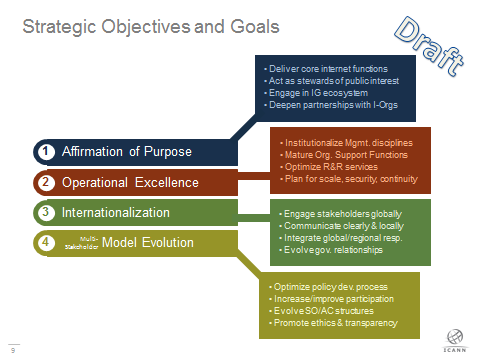
All, The strategy panels are (as I understand it) intended to inform or potentially inform the further development of the 5 year strategic plan http://www.icann.org/en/news/public-comment/strategic-29oct13-en.htm which will lead into the associated operating plans. Therefore, I think that a key issue for us will be separating our thinking and responses into two distinct areas: a. Any issues with the formation and execution of the strategy panels b. Any issues with the output of one or more of the strategy panels in so far as they may impact the 5 yr strategic plan The more I hear, the more it seems appropriate for us to feed structured (written) comment from the Council in relation to the strategy panels, in particular responding to the specific output/s of the MSI panel. Jonathan -- Note: In the current (draft) operating plan for FY15, it already envisages optimisation of the policy development process although I have to say, I am not sure what this means See bullet 1 under item 4. Slide 9, FY15 Draft Operating plan and budget process From: Amr Elsadr [mailto:aelsadr@egyptig.org] Sent: 12 March 2014 20:58 To: Volker Greimann Cc: Klaus Stoll; jrobinson@afilias.info; council@gnso.icann.org Subject: Re: [council] Conversation Wrap-Up & Next Steps Hi, For some reason, I just dont understand the danger this panel is posing. It reads a lot to me like the opinion of someone who is largely uninformed on the nature of the multistakeholder bottom-up consensus building nature of the GNSO processes, and what it takes to make changes to them. Does anyone here actually believe that radical changes in GNSO operating procedures can be unilaterally imposed by Fadi or the ICANN BoDs because the GovLab said so?? I really would like to hear concerns based on concrete actions you all feel might actually take place. Better yet , instead of speculating, why not ask the ICANN BoDs to clear this up once and for all? In BA, the phrase non-binding Board action was floated around, and I have no idea what a non-binding Board action is. I certainly feel that we, the GNSO Council, should do our duty of managing the GNSO's PDP in accordance with the ICANN by-laws, the PDP manual and the WG guidelines. Weve been elected by our stakeholder groups and constituencies to do just that, and so far, I dont see an impending assault. Ive gone through the MSI Panel report and some of the proposals (not all of them), and I am lead to believe that the authors are in no way experts. In fact, ICANN aside, they seem to have a great deal of misguided assumptions on the principles of the ethnography of multistakeholder organisations, and how the introduction of collaborative tools influences them. Volker makes some very logical observations: On Mar 12, 2014, at 3:41 PM, Volker Greimann <vgreimann@key-Systems.net> wrote: [SNIP] With regard to the various recommendations:
From their perspective and having made themselves aware of the work of the GNSO, the suggested sub-set (from them) for further condensation is as follows:
1. Move from "Stakeholder" engagement to Global Engagement: <http://bit.ly/1k7FDNj> http://bit.ly/1k7FDNj The current stakeholder engagement model provides some form of balance of interests and promotes cooperation and compromise solutions. Global engagement carries the danger of blurring the lines and favoring those who have the funds or time to contribute most and drowning out "lesser" voices. As a matter of fact, the public comment phases already provide a forum for global engagement and for parties independant of the existing stakeholder groups to make their voices heard.
Exactly , and they make that completely unfounded assumption that the introduction of more collaborative tools will achieve more global engagement. Perfectly ridiculous.
2. Use expert networking: <http://bit.ly/1lof1c5> http://bit.ly/1lof1c5 This is one I am actually more inclined to support than others, mostly because this is something the ICANN community has already been saying for ages. ICANN needs to be more inclusive of expert opinion. The most recent example is the failure of ICANN staff to grasp the concept of European data protection law and their attempts to negotiate what the law actually means. That said, as we knew this already, this recommendation is not really news, but if it helps ICANN understand, I am all for it.
No way Im going to argue with you on that one!! :) I would also add to that - encouraging the trend of commissioning studies such as the recent WHOIS studies provided that the community sets the terms of reference.
3. Get Broad-based input/crowdsource at each stage of decision-making: <http://bit.ly/1czpNXn> http://bit.ly/1czpNXn Last I heard the public comment forums, ICANN participation and PDP participation were not exclusive to ICANN stakeholder groups.
True , but apparently the experts havent heard what youve heard.
4. Use Open Data and open contracting: <http://bit.ly/1jcv3Rt> http://bit.ly/1jcv3Rt Is this not already in place?
Yes again, but the experts dont seem to know how to find the contracts ICANN has with its contracted parties, nor understand how they came to be.
5. Experiment with Innovative Voting Techniques: <http://bit.ly/1nwta2H> http://bit.ly/1nwta2H This would be a topic for GNSO reform/innovation.
If you mean how the GNSO is structured, maybe. But my understanding was that they not only recommend that the GNSOs decision-making guidelines be changed, but also decision-making guidelines on the stakeholder group and constituency levels currently defined in their respective charters/by-laws. I just dont see that happening because they said so.
6. Impose Rotating Term Limits: <http://bit.ly/1nUmkEr> http://bit.ly/1nUmkEr
- This reminds me of the Russian shuffle: Putin-Medvedev-Putin While I agree that ICANN needs to be more inclusive and outreach remains one of its weak points, I am not sure Rotating Term Limits are the solution. All in all, I still think that reform of ICANN should come from within. Sure, but by definition, that means public comment and everyone is entitled to express an opinion. I feel that if we want to take a serious step to settle the issue of (specifically) this panel, we need a clear answer from Fadi and the ICANN Board on what their intentions are regarding the proposals being made. For example, if they are in any way related to the work of the SIC and the forthcoming GNSO review, I would like to know about it. My understanding is that the last GNSO review was initiated by the GNSO Council as opposed to the upcoming one, which will be a Board-initiated review. Getting some answers would provide the context we need to decide the appropriate position we need to take. Thanks. Amr Volker On 3/5/2014 12:11 PM, Jonathan Robinson wrote: All, In discussion with Beth Novek and colleagues from the Governance Lab last week, a suggestion emerged that we could potentially narrow down the list of MSI Panel proposals for more detailed discussion. It is not yet 100% clear to me as to whether or not we will be able to meet with one or more of the team from the Gov Lab in Singapore but it seems likely and, in any event, its useful to consider how we might respond to the output of the panel, in particular where it seems to link most closely with our own work. We discussed condensing their work into a most relevant sub-set for further discussion
From their perspective and having made themselves aware of the work of the GNSO, the suggested sub-set (from them) for further condensation is as follows:
1. Move from "Stakeholder" engagement to Global Engagement: <http://bit.ly/1k7FDNj> http://bit.ly/1k7FDNj 2. Use expert networking: <http://bit.ly/1lof1c5> http://bit.ly/1lof1c5 3. Get Broad-based input/crowdsource at each stage of decision-making: <http://bit.ly/1czpNXn> http://bit.ly/1czpNXn 4. Use Open Data and open contracting: <http://bit.ly/1jcv3Rt> http://bit.ly/1jcv3Rt 5. Experiment with Innovative Voting Techniques: <http://bit.ly/1nwta2H> http://bit.ly/1nwta2H 6. Impose Rotating Term Limits: <http://bit.ly/1nUmkEr> http://bit.ly/1nUmkEr I also talked with the Gov Lab people about considering the above proposals through a (non-exhaustive) list of criteria as follows: A. Is the proposal relevant to us? B. Is it currently applicable to our work? C. How could the proposal be modified/amended/advanced to be applicable or more applicable to our work? D. How might we pilot/test these proposals in order to determine whether and how the proposal could be a useful amendment or reform for ICANN? None of this pre-supposes that this work was commissioned, initiated or executed in a way which we consider optimal. It simply takes a we are where we are view of the work and recognises that we have the opportunity to potentially engage with the team that undertook the work. In addition, we will still have the opportunity to provide formal public comment on this and engage through any other applicable forums at the ICANN meeting in Singapore. Thoughts or input welcome. Jonathan -- Bei weiteren Fragen stehen wir Ihnen gerne zur Verfügung. Mit freundlichen Grüßen, Volker A. Greimann - Rechtsabteilung - Key-Systems GmbH Im Oberen Werk 1 66386 St. Ingbert Tel.: +49 (0) 6894 - 9396 901 Fax.: +49 (0) 6894 - 9396 851 Email: <mailto:vgreimann@key-systems.net> vgreimann@key-systems.net Web: <http://www.key-systems.net/> www.key-systems.net / <http://www.rrpproxy.net/> www.RRPproxy.net <http://www.domaindiscount24.com/> www.domaindiscount24.com / <http://www.brandshelter.com/> www.BrandShelter.com Folgen Sie uns bei Twitter oder werden Sie unser Fan bei Facebook: <http://www.facebook.com/KeySystems> www.facebook.com/KeySystems <http://www.twitter.com/key_systems> www.twitter.com/key_systems Geschäftsführer: Alexander Siffrin Handelsregister Nr.: HR B 18835 - Saarbruecken Umsatzsteuer ID.: DE211006534 Member of the KEYDRIVE GROUP <http://www.keydrive.lu/> www.keydrive.lu Der Inhalt dieser Nachricht ist vertraulich und nur für den angegebenen Empfänger bestimmt. Jede Form der Kenntnisgabe, Veröffentlichung oder Weitergabe an Dritte durch den Empfänger ist unzulässig. Sollte diese Nachricht nicht für Sie bestimmt sein, so bitten wir Sie, sich mit uns per E-Mail oder telefonisch in Verbindung zu setzen. -------------------------------------------- Should you have any further questions, please do not hesitate to contact us. Best regards, Volker A. Greimann - legal department - Key-Systems GmbH Im Oberen Werk 1 66386 St. Ingbert Tel.: +49 (0) 6894 - 9396 901 Fax.: +49 (0) 6894 - 9396 851 Email: <mailto:vgreimann@key-systems.net> vgreimann@key-systems.net Web: <http://www.key-systems.net/> www.key-systems.net / <http://www.rrpproxy.net/> www.RRPproxy.net <http://www.domaindiscount24.com/> www.domaindiscount24.com / <http://www.brandshelter.com/> www.BrandShelter.com Follow us on Twitter or join our fan community on Facebook and stay updated: <http://www.facebook.com/KeySystems> www.facebook.com/KeySystems <http://www.twitter.com/key_systems> www.twitter.com/key_systems CEO: Alexander Siffrin Registration No.: HR B 18835 - Saarbruecken V.A.T. ID.: DE211006534 Member of the KEYDRIVE GROUP <http://www.keydrive.lu/> www.keydrive.lu This e-mail and its attachments is intended only for the person to whom it is addressed. Furthermore it is not permitted to publish any content of this email. You must not use, disclose, copy, print or rely on this e-mail. If an addressing or transmission error has misdirected this e-mail, kindly notify the author by replying to this e-mail or contacting us by telephone.
hi all,

i like the idea of structured/written feedback from the Council as well.  could we form a small drafting team to pull a rough outline together over this coming weekend so that we’d have a rough high-level draft to carry into Singapore?  i’d like to join such a gang.

mikey


On Mar 12, 2014, at 4:10 PM, Jonathan Robinson <jrobinson@afilias.info> wrote:

> All,
>
> The strategy panels are (as I understand it) intended to inform or potentially inform the further development of the 5 year strategic plan
>
> http://www.icann.org/en/news/public-comment/strategic-29oct13-en.htm
>
> which will lead into the associated operating plans.
>
> Therefore, I think that a key issue for us will be separating our thinking and responses into two distinct areas:
>
> a.       Any issues with the formation and execution of the strategy panels
> b.      Any issues with the output of one or more of the strategy panels in so far as they may impact the 5 yr strategic plan
>
> The more I hear, the more it seems appropriate for us to feed structured (written) comment from the Council in relation to the strategy panels, in particular responding to the specific output/s of the MSI panel.
>
> Jonathan
>
> --
>
> Note:
>
> In the current (draft) operating plan for FY15, it already envisages “optimisation of the policy development process” although I have to say, I am not sure what this means
> See bullet 1 under item 4.
>
> Slide 9, FY15 Draft Operating plan and budget process
> <image001.png>
>
>
>
> From: Amr Elsadr [mailto:aelsadr@egyptig.org]
> Sent: 12 March 2014 20:58
> To: Volker Greimann
> Cc: Klaus Stoll; jrobinson@afilias.info; council@gnso.icann.org
> Subject: Re: [council] Conversation Wrap-Up & Next Steps
>
> Hi,
>
> For some reason, I just don’t understand the danger this panel is posing. It reads a lot to me like the opinion of someone who is largely uninformed on the nature of the multistakeholder bottom-up consensus building nature of the GNSO processes, and what it takes to make changes to them. Does anyone here actually believe that radical changes in GNSO operating procedures can be unilaterally imposed by Fadi or the ICANN BoDs because the GovLab said so??
>
> I really would like to hear concerns based on concrete actions you all feel might actually take place. Better yet…, instead of speculating, why not ask the ICANN BoDs to clear this up once and for all? In BA, the phrase “non-binding Board action” was floated around, and I have no idea what a non-binding Board action is.
>
> I certainly feel that we, the GNSO Council, should do our duty of managing the GNSO's PDP in accordance with the ICANN by-laws, the PDP manual and the WG guidelines. We’ve been elected by our stakeholder groups and constituencies to do just that, and so far, I don’t see an impending assault. I’ve gone through the MSI Panel report and some of the proposals (not all of them), and I am lead to believe that the authors are in no way experts. In fact, ICANN aside, they seem to have a great deal of misguided assumptions on the principles of the ethnography of multistakeholder organisations, and how the introduction of collaborative tools influences them.
>
> Volker makes some very logical observations:
>
> On Mar 12, 2014, at 3:41 PM, Volker Greimann <vgreimann@key-Systems.net> wrote:
>
> [SNIP]
>
> With regard to the various recommendations:
>
> > From their perspective and having made themselves aware of the work of the GNSO, the suggested sub-set (from them) for further condensation is as follows:
> > 1.       Move from "Stakeholder" engagement to Global Engagement: http://bit.ly/1k7FDNj
> The current stakeholder engagement model provides some form of balance of interests and promotes cooperation and compromise solutions. Global engagement carries the danger of blurring the lines and favoring those who have the funds or time to contribute most and drowning out "lesser" voices. As a matter of fact, the public comment phases already provide a forum for global engagement and for parties independant of the existing stakeholder groups to make their voices heard.
>
> Exactly…, and they make that completely unfounded assumption that the introduction of more collaborative tools will achieve more global engagement. Perfectly ridiculous.
>
>
> > 2.       Use expert networking: http://bit.ly/1lof1c5
> This is one I am actually more inclined to support than others, mostly because this is something the ICANN community has already been saying for ages. ICANN needs to be more inclusive of expert opinion. The most recent example is the failure of ICANN staff to grasp the concept of European data protection law and their attempts to negotiate what the law actually means. That said, as we knew this already, this recommendation is not really news, but if it helps ICANN understand, I am all for it.
>
> No way I’m going to argue with you on that one!! :) I would also add to that - encouraging the trend of commissioning studies such as the recent WHOIS studies provided that the community sets the terms of reference.
>
>
> > 3.       Get Broad-based input/crowdsource at each stage of decision-making: http://bit.ly/1czpNXn
> Last I heard the public comment forums, ICANN participation and PDP participation were not exclusive to ICANN stakeholder groups.
>
> True…, but apparently the “experts” haven’t heard what you’ve heard.
>
>
> > 4.       Use Open Data and open contracting: http://bit.ly/1jcv3Rt
> Is this not already in place?
>
> Yes again, but the “experts” don’t seem to know how to find the contracts ICANN has with its contracted parties, nor understand how they came to be.
>
>
> > 5.       Experiment with Innovative Voting Techniques: http://bit.ly/1nwta2H
> This would be a topic for GNSO reform/innovation.
>
> If you mean how the GNSO is structured, maybe. But my understanding was that they not only recommend that the GNSO’s decision-making guidelines be changed, but also decision-making guidelines on the stakeholder group and constituency levels currently defined in their respective charters/by-laws. I just don’t see that happening because they said so.
>
>
> >6.       Impose Rotating Term Limits: http://bit.ly/1nUmkEr
> - This reminds me of the Russian shuffle: Putin-Medvedev-Putin
> While I agree that ICANN needs to be more inclusive and outreach remains one of its weak points, I am not sure Rotating Term Limits are the solution.
>
> All in all, I still think that reform of ICANN should come from within.
>
> Sure, but by definition, that means public comment and everyone is entitled to express an opinion.
>
> I feel that if we want to take a serious step to settle the issue of (specifically) this panel, we need a clear answer from Fadi and the ICANN Board on what their intentions are regarding the proposals being made. For example, if they are in any way related to the work of the SIC and the forthcoming GNSO review, I would like to know about it. My understanding is that the last GNSO review was initiated by the GNSO Council as opposed to the upcoming one, which will be a Board-initiated review. Getting some answers would provide the context we need to decide the appropriate position we need to take.
>
> Thanks.
>
> Amr
>
>
>
>
> Volker
>
>
>
> On 3/5/2014 12:11 PM, Jonathan Robinson wrote:
> All,
>
> In discussion with Beth Novek and colleagues from the Governance Lab last week, a suggestion emerged that we could potentially narrow down the list of MSI Panel proposals for more detailed discussion.
>
> It is not yet 100% clear to me as to whether or not we will be able to meet with one or more of the team from the Gov Lab in Singapore but it seems likely and, in any event, it’s useful to consider how we might respond to the output of the panel, in particular where it seems to link most closely with our own work.  We discussed condensing their work into a most relevant sub-set for further discussion
>
> From their perspective and having made themselves aware of the work of the GNSO, the suggested sub-set (from them) for further condensation is as follows:
> 1.       Move from "Stakeholder" engagement to Global Engagement: http://bit.ly/1k7FDNj
> 2.       Use expert networking: http://bit.ly/1lof1c5
> 3.       Get Broad-based input/crowdsource at each stage of decision-making: http://bit.ly/1czpNXn
> 4.       Use Open Data and open contracting: http://bit.ly/1jcv3Rt
> 5.       Experiment with Innovative Voting Techniques: http://bit.ly/1nwta2H
> 6.       Impose Rotating Term Limits: http://bit.ly/1nUmkEr
> I also talked with the Gov Lab people about considering the above proposals through a (non-exhaustive) list of criteria as follows:
>
> A.      Is the proposal relevant to us?
> B.      Is it currently applicable to our work?
> C.      How could the proposal be modified/amended/advanced to be applicable or more applicable to our work?
> D.      How might we pilot/test these proposals in order to determine whether and how the proposal could be a useful amendment or reform for ICANN?
>
> None of this pre-supposes that this work was commissioned, initiated or executed in a way which we consider optimal.
> It simply takes a “we are where we are” view of the work and recognises that we have the opportunity to potentially engage with the team that undertook the work.
>
> In addition, we will still have the opportunity to provide formal public comment on this and engage through any other applicable forums at the ICANN meeting in Singapore.
>
> Thoughts or input welcome.
>
>
> Jonathan
>
>
>
> --
> Bei weiteren Fragen stehen wir Ihnen gerne zur Verfügung.
>
> Mit freundlichen Grüßen,
>
> Volker A. Greimann
> - Rechtsabteilung -
>
> Key-Systems GmbH
> Im Oberen Werk 1
> 66386 St. Ingbert
> Tel.: +49 (0) 6894 - 9396 901
> Fax.: +49 (0) 6894 - 9396 851
> Email: vgreimann@key-systems.net
>
> Web: www.key-systems.net / www.RRPproxy.net
> www.domaindiscount24.com / www.BrandShelter.com
>
> Folgen Sie uns bei Twitter oder werden Sie unser Fan bei Facebook:
> www.facebook.com/KeySystems
> www.twitter.com/key_systems
>
> Geschäftsführer: Alexander Siffrin
> Handelsregister Nr.: HR B 18835 - Saarbruecken
> Umsatzsteuer ID.: DE211006534
>
> Member of the KEYDRIVE GROUP
> www.keydrive.lu
>
> Der Inhalt dieser Nachricht ist vertraulich und nur für den angegebenen Empfänger bestimmt. Jede Form der Kenntnisgabe, Veröffentlichung oder Weitergabe an Dritte durch den Empfänger ist unzulässig. Sollte diese Nachricht nicht für Sie bestimmt sein, so bitten wir Sie, sich mit uns per E-Mail oder telefonisch in Verbindung zu setzen.
>
> --------------------------------------------
>
> Should you have any further questions, please do not hesitate to contact us.
>
> Best regards,
>
> Volker A. Greimann
> - legal department -
>
> Key-Systems GmbH
> Im Oberen Werk 1
> 66386 St. Ingbert
> Tel.: +49 (0) 6894 - 9396 901
> Fax.: +49 (0) 6894 - 9396 851
> Email: vgreimann@key-systems.net
>
> Web: www.key-systems.net / www.RRPproxy.net
> www.domaindiscount24.com / www.BrandShelter.com
>
> Follow us on Twitter or join our fan community on Facebook and stay updated:
> www.facebook.com/KeySystems
> www.twitter.com/key_systems
>
> CEO: Alexander Siffrin
> Registration No.: HR B 18835 - Saarbruecken
> V.A.T. ID.: DE211006534
>
> Member of the KEYDRIVE GROUP
> www.keydrive.lu
>
> This e-mail and its attachments is intended only for the person to whom it is addressed. Furthermore it is not permitted to publish any content of this email. You must not use, disclose, copy, print or rely on this e-mail. If an addressing or transmission error has misdirected this e-mail, kindly notify the author by replying to this e-mail or contacting us by telephone.
>
>
>
>
>


PHONE: 651-647-6109, FAX: 866-280-2356, WEB: www.haven2.com, HANDLE: OConnorStP (ID for Twitter, Facebook, LinkedIn, etc.)
It seems Fadi is inviting us to do just that.

http://blog.icann.org/2014/03/balancing-the-tasks-at-hand/

Thanks.

Amr

On Mar 13, 2014, at 12:44 AM, Mike O'Connor <mike@haven2.com> wrote:

> hi all,
>
> i like the idea of structured/written feedback from the Council as well.  could we form a small drafting team to pull a rough outline together over this coming weekend so that we’d have a rough high-level draft to carry into Singapore?  i’d like to join such a gang.
>
> mikey
>
>
> On Mar 12, 2014, at 4:10 PM, Jonathan Robinson <jrobinson@afilias.info> wrote:
>
>> All,
>>
>> The strategy panels are (as I understand it) intended to inform or potentially inform the further development of the 5 year strategic plan
>>
>> http://www.icann.org/en/news/public-comment/strategic-29oct13-en.htm
>>
>> which will lead into the associated operating plans.
>>
>> Therefore, I think that a key issue for us will be separating our thinking and responses into two distinct areas:
>>
>> a.       Any issues with the formation and execution of the strategy panels
>> b.      Any issues with the output of one or more of the strategy panels in so far as they may impact the 5 yr strategic plan
>>
>> The more I hear, the more it seems appropriate for us to feed structured (written) comment from the Council in relation to the strategy panels, in particular responding to the specific output/s of the MSI panel.
>>
>> Jonathan
>>
>> --
>>
>> Note:
>>
>> In the current (draft) operating plan for FY15, it already envisages “optimisation of the policy development process” although I have to say, I am not sure what this means
>> See bullet 1 under item 4.
>>
>> Slide 9, FY15 Draft Operating plan and budget process
>> <image001.png>
>>
>>
>>
>> From: Amr Elsadr [mailto:aelsadr@egyptig.org]
>> Sent: 12 March 2014 20:58
>> To: Volker Greimann
>> Cc: Klaus Stoll; jrobinson@afilias.info; council@gnso.icann.org
>> Subject: Re: [council] Conversation Wrap-Up & Next Steps
>>
>> Hi,
>>
>> For some reason, I just don’t understand the danger this panel is posing. It reads a lot to me like the opinion of someone who is largely uninformed on the nature of the multistakeholder bottom-up consensus building nature of the GNSO processes, and what it takes to make changes to them. Does anyone here actually believe that radical changes in GNSO operating procedures can be unilaterally imposed by Fadi or the ICANN BoDs because the GovLab said so??
>>
>> I really would like to hear concerns based on concrete actions you all feel might actually take place. Better yet…, instead of speculating, why not ask the ICANN BoDs to clear this up once and for all? In BA, the phrase “non-binding Board action” was floated around, and I have no idea what a non-binding Board action is.
>>
>> I certainly feel that we, the GNSO Council, should do our duty of managing the GNSO's PDP in accordance with the ICANN by-laws, the PDP manual and the WG guidelines. We’ve been elected by our stakeholder groups and constituencies to do just that, and so far, I don’t see an impending assault. I’ve gone through the MSI Panel report and some of the proposals (not all of them), and I am lead to believe that the authors are in no way experts. In fact, ICANN aside, they seem to have a great deal of misguided assumptions on the principles of the ethnography of multistakeholder organisations, and how the introduction of collaborative tools influences them.
>>
>> Volker makes some very logical observations:
>>
>> On Mar 12, 2014, at 3:41 PM, Volker Greimann <vgreimann@key-Systems.net> wrote:
>>
>> [SNIP]
>>
>> With regard to the various recommendations:
>>
>> > From their perspective and having made themselves aware of the work of the GNSO, the suggested sub-set (from them) for further condensation is as follows:
>> > 1.       Move from "Stakeholder" engagement to Global Engagement: http://bit.ly/1k7FDNj
>> The current stakeholder engagement model provides some form of balance of interests and promotes cooperation and compromise solutions. Global engagement carries the danger of blurring the lines and favoring those who have the funds or time to contribute most and drowning out "lesser" voices. As a matter of fact, the public comment phases already provide a forum for global engagement and for parties independant of the existing stakeholder groups to make their voices heard.
>>
>> Exactly…, and they make that completely unfounded assumption that the introduction of more collaborative tools will achieve more global engagement. Perfectly ridiculous.
>>
>>
>> > 2.       Use expert networking: http://bit.ly/1lof1c5
>> This is one I am actually more inclined to support than others, mostly because this is something the ICANN community has already been saying for ages. ICANN needs to be more inclusive of expert opinion. The most recent example is the failure of ICANN staff to grasp the concept of European data protection law and their attempts to negotiate what the law actually means. That said, as we knew this already, this recommendation is not really news, but if it helps ICANN understand, I am all for it.
>>
>> No way I’m going to argue with you on that one!! :) I would also add to that - encouraging the trend of commissioning studies such as the recent WHOIS studies provided that the community sets the terms of reference.
>>
>>
>> > 3.       Get Broad-based input/crowdsource at each stage of decision-making: http://bit.ly/1czpNXn
>> Last I heard the public comment forums, ICANN participation and PDP participation were not exclusive to ICANN stakeholder groups.
>>
>> True…, but apparently the “experts” haven’t heard what you’ve heard.
>>
>>
>> > 4.       Use Open Data and open contracting: http://bit.ly/1jcv3Rt
>> Is this not already in place?
>>
>> Yes again, but the “experts” don’t seem to know how to find the contracts ICANN has with its contracted parties, nor understand how they came to be.
>>
>>
>> > 5.       Experiment with Innovative Voting Techniques: http://bit.ly/1nwta2H
>> This would be a topic for GNSO reform/innovation.
>>
>> If you mean how the GNSO is structured, maybe. But my understanding was that they not only recommend that the GNSO’s decision-making guidelines be changed, but also decision-making guidelines on the stakeholder group and constituency levels currently defined in their respective charters/by-laws. I just don’t see that happening because they said so.
>>
>>
>> >6.       Impose Rotating Term Limits: http://bit.ly/1nUmkEr
>> - This reminds me of the Russian shuffle: Putin-Medvedev-Putin
>> While I agree that ICANN needs to be more inclusive and outreach remains one of its weak points, I am not sure Rotating Term Limits are the solution.
>>
>> All in all, I still think that reform of ICANN should come from within.
>>
>> Sure, but by definition, that means public comment and everyone is entitled to express an opinion.
>>
>> I feel that if we want to take a serious step to settle the issue of (specifically) this panel, we need a clear answer from Fadi and the ICANN Board on what their intentions are regarding the proposals being made. For example, if they are in any way related to the work of the SIC and the forthcoming GNSO review, I would like to know about it. My understanding is that the last GNSO review was initiated by the GNSO Council as opposed to the upcoming one, which will be a Board-initiated review. Getting some answers would provide the context we need to decide the appropriate position we need to take.
>>
>> Thanks.
>>
>> Amr
>>
>>
>>
>>
>> Volker
>>
>>
>>
>> On 3/5/2014 12:11 PM, Jonathan Robinson wrote:
>> All,
>>
>> In discussion with Beth Novek and colleagues from the Governance Lab last week, a suggestion emerged that we could potentially narrow down the list of MSI Panel proposals for more detailed discussion.
>>
>> It is not yet 100% clear to me as to whether or not we will be able to meet with one or more of the team from the Gov Lab in Singapore but it seems likely and, in any event, it’s useful to consider how we might respond to the output of the panel, in particular where it seems to link most closely with our own work.  We discussed condensing their work into a most relevant sub-set for further discussion
>>
>> From their perspective and having made themselves aware of the work of the GNSO, the suggested sub-set (from them) for further condensation is as follows:
>> 1.       Move from "Stakeholder" engagement to Global Engagement: http://bit.ly/1k7FDNj
>> 2.       Use expert networking: http://bit.ly/1lof1c5
>> 3.       Get Broad-based input/crowdsource at each stage of decision-making: http://bit.ly/1czpNXn
>> 4.       Use Open Data and open contracting: http://bit.ly/1jcv3Rt
>> 5.       Experiment with Innovative Voting Techniques: http://bit.ly/1nwta2H
>> 6.       Impose Rotating Term Limits: http://bit.ly/1nUmkEr
>> I also talked with the Gov Lab people about considering the above proposals through a (non-exhaustive) list of criteria as follows:
>>
>> A.      Is the proposal relevant to us?
>> B.      Is it currently applicable to our work?
>> C.      How could the proposal be modified/amended/advanced to be applicable or more applicable to our work?
>> D.      How might we pilot/test these proposals in order to determine whether and how the proposal could be a useful amendment or reform for ICANN?
>>
>> None of this pre-supposes that this work was commissioned, initiated or executed in a way which we consider optimal.
>> It simply takes a “we are where we are” view of the work and recognises that we have the opportunity to potentially engage with the team that undertook the work.
>>
>> In addition, we will still have the opportunity to provide formal public comment on this and engage through any other applicable forums at the ICANN meeting in Singapore.
>>
>> Thoughts or input welcome.
>>
>>
>> Jonathan
>>
>>
>>
>> --
>> Bei weiteren Fragen stehen wir Ihnen gerne zur Verfügung.
>>
>> Mit freundlichen Grüßen,
>>
>> Volker A. Greimann
>> - Rechtsabteilung -
>>
>> Key-Systems GmbH
>> Im Oberen Werk 1
>> 66386 St. Ingbert
>> Tel.: +49 (0) 6894 - 9396 901
>> Fax.: +49 (0) 6894 - 9396 851
>> Email: vgreimann@key-systems.net
>>
>> Web: www.key-systems.net / www.RRPproxy.net
>> www.domaindiscount24.com / www.BrandShelter.com
>>
>> Folgen Sie uns bei Twitter oder werden Sie unser Fan bei Facebook:
>> www.facebook.com/KeySystems
>> www.twitter.com/key_systems
>>
>> Geschäftsführer: Alexander Siffrin
>> Handelsregister Nr.: HR B 18835 - Saarbruecken
>> Umsatzsteuer ID.: DE211006534
>>
>> Member of the KEYDRIVE GROUP
>> www.keydrive.lu
>>
>> Der Inhalt dieser Nachricht ist vertraulich und nur für den angegebenen Empfänger bestimmt. Jede Form der Kenntnisgabe, Veröffentlichung oder Weitergabe an Dritte durch den Empfänger ist unzulässig. Sollte diese Nachricht nicht für Sie bestimmt sein, so bitten wir Sie, sich mit uns per E-Mail oder telefonisch in Verbindung zu setzen.
>>
>> --------------------------------------------
>>
>> Should you have any further questions, please do not hesitate to contact us.
>>
>> Best regards,
>>
>> Volker A. Greimann
>> - legal department -
>>
>> Key-Systems GmbH
>> Im Oberen Werk 1
>> 66386 St. Ingbert
>> Tel.: +49 (0) 6894 - 9396 901
>> Fax.: +49 (0) 6894 - 9396 851
>> Email: vgreimann@key-systems.net
>>
>> Web: www.key-systems.net / www.RRPproxy.net
>> www.domaindiscount24.com / www.BrandShelter.com
>>
>> Follow us on Twitter or join our fan community on Facebook and stay updated:
>> www.facebook.com/KeySystems
>> www.twitter.com/key_systems
>>
>> CEO: Alexander Siffrin
>> Registration No.: HR B 18835 - Saarbruecken
>> V.A.T. ID.: DE211006534
>>
>> Member of the KEYDRIVE GROUP
>> www.keydrive.lu
>>
>> This e-mail and its attachments is intended only for the person to whom it is addressed. Furthermore it is not permitted to publish any content of this email. You must not use, disclose, copy, print or rely on this e-mail. If an addressing or transmission error has misdirected this e-mail, kindly notify the author by replying to this e-mail or contacting us by telephone.
>>
>>
>>
>>
>>
>
>
> PHONE: 651-647-6109, FAX: 866-280-2356, WEB: www.haven2.com, HANDLE: OConnorStP (ID for Twitter, Facebook, LinkedIn, etc.)
Me too! Klaus On 3/13/2014 12:44 AM, Mike O'Connor wrote:
hi all,
i like the idea of structured/written feedback from the Council as well. could we form a small drafting team to pull a rough outline together over this coming weekend so that we’d have a rough high-level draft to carry into Singapore? i’d like to join such a gang.
mikey
On Mar 12, 2014, at 4:10 PM, Jonathan Robinson <jrobinson@afilias.info <mailto:jrobinson@afilias.info>> wrote:
All,
The strategy panels are (as I understand it) intended to inform or potentially inform the further development of the 5 year strategic plan
http://www.icann.org/en/news/public-comment/strategic-29oct13-en.htm
which will lead into the associated operating plans.
Therefore, I think that a key issue for us will be separating our thinking and responses into two distinct areas:
a.Any issues with the formation and execution of the strategy panels
b.Any issues with the output of one or more of the strategy panels in so far as they may impact the 5 yr strategic plan
The more I hear, the more it seems appropriate for us to feed structured (written) comment from the Council in relation to the strategy panels, in particular responding to the specific output/s of the MSI panel.
Jonathan
--
Note:
In the current (draft) operating plan for FY15, it already envisages “optimisation of the policy development process” although I have to say, I am not sure what this means
See bullet 1 under item 4.
Slide 9, FY15 Draft Operating plan and budget process
<image001.png>
*From:*Amr Elsadr [mailto:aelsadr@egyptig.org] *Sent:* 12 March 2014 20:58 *To:* Volker Greimann *Cc:* Klaus Stoll; jrobinson@afilias.info <mailto:jrobinson@afilias.info>; council@gnso.icann.org <mailto:council@gnso.icann.org> *Subject:* Re: [council] Conversation Wrap-Up & Next Steps
Hi,
For some reason, I just don’t understand the danger this panel is posing. It reads a lot to me like the opinion of someone who is largely uninformed on the nature of the multistakeholder bottom-up consensus building nature of the GNSO processes, and what it takes to make changes to them. Does anyone here actually believe that radical changes in GNSO operating procedures can be unilaterally imposed by Fadi or the ICANN BoDs because the GovLab said so??
I really would like to hear concerns based on concrete actions you all feel might actually take place. Better yet…, instead of speculating, why not ask the ICANN BoDs to clear this up once and for all? In BA, the phrase “non-binding Board action” was floated around, and I have no idea what a non-binding Board action is.
I certainly feel that we, the GNSO Council, should do our duty of managing the GNSO's PDP in accordance with the ICANN by-laws, the PDP manual and the WG guidelines. We’ve been elected by our stakeholder groups and constituencies to do just that, and so far, I don’t see an impending assault. I’ve gone through the MSI Panel report and some of the proposals (not all of them), and I am lead to believe that the authors are in no way experts. In fact, ICANN aside, they seem to have a great deal of misguided assumptions on the principles of the ethnography of multistakeholder organisations, and how the introduction of collaborative tools influences them.
Volker makes some very logical observations:
On Mar 12, 2014, at 3:41 PM, Volker Greimann <vgreimann@key-Systems.net <mailto:vgreimann@key-Systems.net>> wrote:
[SNIP]
With regard to the various recommendations:
> From their perspective and having made themselves aware of the work of the GNSO, the suggested sub-set (from them) for further condensation is as follows:
> 1.Move from "Stakeholder" engagement to Global Engagement: http://bit.ly/1k7FDNj The current stakeholder engagement model provides some form of balance of interests and promotes cooperation and compromise solutions. Global engagement carries the danger of blurring the lines and favoring those who have the funds or time to contribute most and drowning out "lesser" voices. As a matter of fact, the public comment phases already provide a forum for global engagement and for parties independant of the existing stakeholder groups to make their voices heard.
Exactly…, and they make that completely unfounded assumption that the introduction of more collaborative tools will achieve more global engagement. Perfectly ridiculous.
2.Use expert networking: http://bit.ly/1lof1c5 This is one I am actually more inclined to support than others, mostly because this is something the ICANN community has already been saying for ages. ICANN needs to be more inclusive of expert opinion. The most recent example is the failure of ICANN staff to grasp the concept of European data protection law and their attempts to negotiate what the law actually means. That said, as we knew this already, this recommendation is not really news, but if it helps ICANN understand, I am all for it.
No way I’m going to argue with you on that one!! :) I would also add to that - encouraging the trend of commissioning studies such as the recent WHOIS studies provided that the community sets the terms of reference.
3.Get Broad-based input/crowdsource at each stage of decision-making: http://bit.ly/1czpNXn Last I heard the public comment forums, ICANN participation and PDP participation were not exclusive to ICANN stakeholder groups.
True…, but apparently the “experts” haven’t heard what you’ve heard.
4.Use Open Data and open contracting: http://bit.ly/1jcv3Rt Is this not already in place?
Yes again, but the “experts” don’t seem to know how to find the contracts ICANN has with its contracted parties, nor understand how they came to be.
5.Experiment with Innovative Voting Techniques: http://bit.ly/1nwta2H This would be a topic for GNSO reform/innovation.
If you mean how the GNSO is structured, maybe. But my understanding was that they not only recommend that the GNSO’s decision-making guidelines be changed, but also decision-making guidelines on the stakeholder group and constituency levels currently defined in their respective charters/by-laws. I just don’t see that happening because they said so.
6.Impose Rotating Term Limits: http://bit.ly/1nUmkEr
- This reminds me of the Russian shuffle: Putin-Medvedev-Putin While I agree that ICANN needs to be more inclusive and outreach remains one of its weak points, I am not sure Rotating Term Limits are the solution.
All in all, I still think that reform of ICANN should come from within.
Sure, but by definition, that means public comment and everyone is entitled to express an opinion.
I feel that if we want to take a serious step to settle the issue of (specifically) this panel, we need a clear answer from Fadi and the ICANN Board on what their intentions are regarding the proposals being made. For example, if they are in any way related to the work of the SIC and the forthcoming GNSO review, I would like to know about it. My understanding is that the last GNSO review was initiated by the GNSO Council as opposed to the upcoming one, which will be a Board-initiated review. Getting some answers would provide the context we need to decide the appropriate position we need to take.
Thanks.
Amr
Volker
On 3/5/2014 12:11 PM, Jonathan Robinson wrote:
All,
In discussion with Beth Novek and colleagues from the Governance Lab last week, a suggestion emerged that we could potentially narrow down the list of MSI Panel proposals for more detailed discussion.
It is not yet 100% clear to me as to whether or not we will be able to meet with one or more of the team from the Gov Lab in Singapore but it seems likely and, in any event, it’s useful to consider how we might respond to the output of the panel, in particular where it seems to link most closely with our own work. We discussed condensing their work into a most relevant sub-set for further discussion
From their perspective and having made themselves aware of the work of the GNSO, the suggested sub-set (from them) for further condensation is as follows:
1.Move from "Stakeholder" engagement to Global Engagement: http://bit.ly/1k7FDNj
2.Use expert networking: http://bit.ly/1lof1c5
3.Get Broad-based input/crowdsource at each stage of decision-making: http://bit.ly/1czpNXn
4.Use Open Data and open contracting: http://bit.ly/1jcv3Rt
5.Experiment with Innovative Voting Techniques: http://bit.ly/1nwta2H
6.Impose Rotating Term Limits: http://bit.ly/1nUmkEr
I also talked with the Gov Lab people about considering the above proposals through a (non-exhaustive) list of criteria as follows:
A.Is the proposal relevant to us?
B.Is it currently applicable to our work?
C.How could the proposal be modified/amended/advanced to be applicable or more applicable to our work?
D.How might we pilot/test these proposals in order to determine whether and how the proposal could be a useful amendment or reform for ICANN?
None of this pre-supposes that this work was commissioned, initiated or executed in a way which we consider optimal.
It simply takes a “we are where we are” view of the work and recognises that we have the opportunity to potentially engage with the team that undertook the work.
In addition, we will still have the opportunity to provide formal public comment on this and engage through any other applicable forums at the ICANN meeting in Singapore.
Thoughts or input welcome.
Jonathan
-- Bei weiteren Fragen stehen wir Ihnen gerne zur Verfügung.
Mit freundlichen Grüßen,
Volker A. Greimann - Rechtsabteilung -
Key-Systems GmbH Im Oberen Werk 1 66386 St. Ingbert Tel.: +49 (0) 6894 - 9396 901 Fax.: +49 (0) 6894 - 9396 851 Email:vgreimann@key-systems.net <mailto:vgreimann@key-systems.net>
Web:www.key-systems.net <http://www.key-systems.net/> /www.RRPproxy.net <http://www.rrpproxy.net/> www.domaindiscount24.com <http://www.domaindiscount24.com/> /www.BrandShelter.com <http://www.brandshelter.com/>
Folgen Sie uns bei Twitter oder werden Sie unser Fan bei Facebook: www.facebook.com/KeySystems <http://www.facebook.com/KeySystems> www.twitter.com/key_systems <http://www.twitter.com/key_systems>
Geschäftsführer: Alexander Siffrin Handelsregister Nr.: HR B 18835 - Saarbruecken Umsatzsteuer ID.: DE211006534
Member of the KEYDRIVE GROUP www.keydrive.lu <http://www.keydrive.lu/>
Der Inhalt dieser Nachricht ist vertraulich und nur für den angegebenen Empfänger bestimmt. Jede Form der Kenntnisgabe, Veröffentlichung oder Weitergabe an Dritte durch den Empfänger ist unzulässig. Sollte diese Nachricht nicht für Sie bestimmt sein, so bitten wir Sie, sich mit uns per E-Mail oder telefonisch in Verbindung zu setzen.
--------------------------------------------
Should you have any further questions, please do not hesitate to contact us.
Best regards,
Volker A. Greimann - legal department -
Key-Systems GmbH Im Oberen Werk 1 66386 St. Ingbert Tel.: +49 (0) 6894 - 9396 901 Fax.: +49 (0) 6894 - 9396 851 Email:vgreimann@key-systems.net <mailto:vgreimann@key-systems.net>
Web:www.key-systems.net <http://www.key-systems.net/> /www.RRPproxy.net <http://www.rrpproxy.net/> www.domaindiscount24.com <http://www.domaindiscount24.com/> /www.BrandShelter.com <http://www.brandshelter.com/>
Follow us on Twitter or join our fan community on Facebook and stay updated: www.facebook.com/KeySystems <http://www.facebook.com/KeySystems> www.twitter.com/key_systems <http://www.twitter.com/key_systems>
CEO: Alexander Siffrin Registration No.: HR B 18835 - Saarbruecken V.A.T. ID.: DE211006534
Member of the KEYDRIVE GROUP www.keydrive.lu <http://www.keydrive.lu/>
This e-mail and its attachments is intended only for the person to whom it is addressed. Furthermore it is not permitted to publish any content of this email. You must not use, disclose, copy, print or rely on this e-mail. If an addressing or transmission error has misdirected this e-mail, kindly notify the author by replying to this e-mail or contacting us by telephone.
PHONE: 651-647-6109, FAX: 866-280-2356, WEB: www.haven2.com <http://www.haven2.com>, HANDLE: OConnorStP (ID for Twitter, Facebook, LinkedIn, etc.)
participants (7)
-
 Amr Elsadr
 -
 Bruce Tonkin
 -
 Jonathan Robinson
 -
 Klaus Stoll
 -
 Marika Konings
 -
 Mike O'Connor
 -
 Volker Greimann