
Greg, there you go down the rabbit hole. Yes, I said the problems COULD arise regardless of the home of the server the IANA.ORG domain points to. And yes, I have complete confidence that there are technical solutions (even ones that *I* could develop, and that is certainly not my field of expertise). BUT developing them is not within our mandate nor on our critical path. THAT is why I suggested stopping at principles for the moment. Alan At 11/06/2015 12:25 AM, Greg Shatan wrote:
Alan,
I was going to go into the technical issues regarding managing the domain name issue, but I stopped myself, ssince as you say these issues will exist regardless of who is the domain registrant. Indeed, if the IETF Trust were to start operating the <http://iana.org>iana.org website after the transition, those issues would arise quickly.
Since you've opened the door to the subject, I'll walk in. (FWIW, I probably spend far more time these days dealing with tech issues than pure trademark issues....)
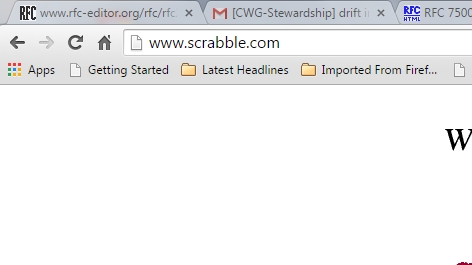
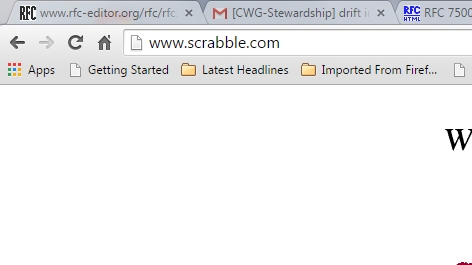
There are several alternatives. First, the page at <http://iana.org>iana.org could be used as a disambiguation page. An example of this can be found at <http://www.scrabble.com>www.scrabble.com.
Inline image 1
Indeed, the current <http://iana.org>iana.org home page is already very close to this, with separate sections for domain names, number resources and protocol assignments. Clicking on these leads to third level pages under domains, numbers and protocols. These could easily be reworked into subdomains <http://domains.iana.org>domains.iana.org, <http://numbers.iana.org>numbers.iana.org and <http://protocols.iana.org>protocols.iana.org, which could then be hosted on servers managed by the community that has separated from ICANN as the IFO. Alternatively, the link for domains, numbers or protocols could go to an entirely different second level domain (e.g., iananumbers.web).
Another alternative is for the separating customer to stop using the <http://iana.org>iana.org domain entirely, but the first two options are probably more palatable and less disruptive. If this is approach is taken, you would probably want some form of notification (I would say a pop-up, but pop-up blockers make that suboptimal) of the new domain name, at least for a period of time.
This could be dealt with by contract now or at the time of the split (or some combination of the two).
Greg
On Wed, Jun 10, 2015 at 11:29 PM, Alan Greenberg <<mailto:alan.greenberg@mcgill.ca>alan.greenberg@mcgill.ca> wrote: Greg, not quite.
You are thinking about this as a TM attorney. There are also technical issues. Currently <http://iana.org>iana.org has uses within all three communities and it is simple to do since it ia all run out of the current IANA. If there were to be a split at some point, it is not just a matter of granting the right to use the TM, but creating the mechanics to allow the domain name to be transparently used by all three entities. And if one of the groups has left because they no longer have faith in the ability of the then-current IANA to do things correctly, that could be problematic.
But the problems will be there regardless of where the <http://iana.org>iana.org name resolves to if there is a split. The best we can do is try to cover it with contractual assurances.
And as was pointed out ion the IETF list when this was first discussed. Although no one wants to stop using <http://iana.org>iana.org, and it would probably more disruptive for the IETF than others (my recollection is that the name is built into code), we would survive.
Alan
At 10/06/2015 11:15 PM, Greg Shatan wrote:
Alan,
You took the words out of my mouth. A clause in the agreements between ICANN and the other two communities should require ICANN to grant a worldwide royalty-free license to use the trademarks. This is a simple fix. If we want to get fancy, there can be a contingent license that automatically springs into place when the customer separates.
I also agree with your point on defense/enforcement.
Greg
On Wed, Jun 10, 2015 at 11:03 PM, Alan Greenberg <<mailto:alan.greenberg@mcgill.ca>alan.greenberg@mcgill.ca > wrote: I refrained from weighing in when this was first discussed and in this iteration. But I will now. I think that whatever the solution, there must be some principle adhered to: 1. The TM must be owned by an entity that is prepared to defend it if necessary. 2. Whoever owns it must enter into an agreement with all three users of it (or the other two if the owner is one of the users) so that if that user chooses to move withdraw from the IFO used by the others, the TM owner will grant it all necessary rights and privileges to continue using the TM with no user disruption. In my opinion, it makes sense for the owner to be ICANN for the immediate future, because it will, either directly or through PTI, have agreements with the RIRs and the IETF and those agreements are reasonable places in which to embody principle 2. And ICANN has the funding and legal resources to defend the TM if necessary. But there are certainly other solutions that could also satisfy both principles. Like Chuck, I may be naive (something I have rarely been accused of), but I cannot see the details of the implementation being of concern to the AC/SO (with the possible exception of the ASO and the IPC). Alan
At 10/06/2015 08:21 PM, Milton L Mueller wrote:
Maarten, The simple rationale for the numbers proposal, and the protocol communityâs acceptance of it, was that both of them em insist on having the right to switch IANA functions operator at some time in the future. If the IANA trademarks and domains are âownedââ¢â¬ by a single IFO we cannot have that separability. If we want the IFO to be able to change, then the trademarks and domains must not he owned by either ICANN (which is the âownerâ/controller of PTIof PTI) or any subsequent IFO. Itâs that t simple.
--MM
From: <mailto:cwg-stewardship-bounces@icann.org>cwg-stewardship-bounces@icann.org [ mailto:cwg-stewardship-bounces@icann.org] On Behalf Of Maarten Simon Sent: Wednesday, June 10, 2015 4:22 PM To: Seun Ojedeji; Greg Shatan Cc: <mailto:cwg-stewardship@icann.org>cwg-stewardship@icann.org IANA Subject: Re: [CWG-Stewardship] drift in v5
Next to Seunâs argument, I think the trademdemarks should remain with ICANN as it is ICANN that will grant PTI the right to operate the IANA functions through the contract. It seems logical to me that ICANN only provides a license to PTI to use the trademarks through the same contract and not transfer the trademarks themselves.
The further question is if in the case of a separation the assets will go from PTI to the new entity (probably in practise: yes) but in a legal sense I would assume that PTI returns the assets to ICANN and that ICANN provide these to the new operator.
From: Seun Ojedeji <<mailto:seun.ojedeji@gmail.com>seun.ojedeji@gmail.com > Date: Wednesday 10 June 2015 22:05 To: Greg Shatan <<mailto:gregshatanipc@gmail.com>gregshatanipc@gmail.com > Cc: SIDN SIDN <<mailto:maarten.simon@sidn.nl>maarten.simon@sidn.nl>, "<mailto:cwg-stewardship@icann.org> cwg-stewardship@icann.org" <<mailto:cwg-stewardship@icann.org> cwg-stewardship@icann.org> Subject: Re: [CWG-Stewardship] drift in v5
Hi Greg, Perhaps its worth noting that the other 2 operational communities are still considering whether to contract directly with PTI as their proposals currently indicates contracting with ICANN. So if for instance there is a need for numbers community to move its functions, it would be appropriate that the entity its contracting with provides access to the IANA trademarks accordingly. As far as PTI is concerned at the moment, its separation mechanisms as proposed by CWG is largely based on the names community (with the other 2 communities having optional liaison roles). Based on that, i don't see the other 2 communities agreeing to transfer the IANA transdemarks (which is for all 3 operational communities) to PTI whose accountability mechanism is largely names based. Regards
On Wed, Jun 10, 2015 at 8:52 PM, Greg Shatan <<mailto:gregshatanipc@gmail.com>gregshatanipc@gmail.com > wrote: Maarten,
That is not my understanding of separation. If ICANN selects a new provider, that provider would take all of the assets of PTI (including the trademarks, under this scenario), so it could provide the IANA services. PTI would then be wound down and ultimately dissolved by ICANN. Recall that PTI is a controlled entity of ICANN and would remain so throughout. In this case, the IANA operations are separated from PTI.
If PTI is actually separated (spun out) from ICANN so that it is no longer under ICANN control, it would be done to further separate the IANA Functions from ICANN and IANA would continue as a going concern (active business).
Under no circumstances does PTI become separated from ICANN without continuing to serve as the IANA operator, yet continue to hold IANA-related assets.
Greg
On Wed, Jun 10, 2015 at 3:44 PM, Maarten Simon <<mailto:maarten.simon@sidn.nl>maarten.simon@sidn.nl> wrote: Hi Greg,
I would like to respond to your suggestion:
'An acceptable alternative may be to have PTI, rather than ICANN, own the IANA trademarks. This is actually a simpler solution and is consistent with trademark law and practice. This also contributes to separability, since all of the IFO-related assets would be in a single entity.â ¢
If PTI is separated, ICANN will select a new IANA provider. Am I correct that if the IANA trademarks rest with PTI, we will than have to rename the services after the separation and they will not any longer be named the IANA services ?
If that is correct, I rather keep the rights in ICANN.
Best,
Maarten
From: Greg Shatan <<mailto:gregshatanipc@gmail.com>gregshatanipc@gmail.com > Date: Wednesday 10 June 2015 21:06 To: manning <<mailto:bmanning@karoshi.com>bmanning@karoshi.com> Cc: "<mailto:cwg-stewardship@icann.org> cwg-stewardship@icann.org" <<mailto:cwg-stewardship@icann.org> cwg-stewardship@icann.org> Subject: Re: [CWG-Stewardship] drift in v5
ICANN is an appropriate owner of the IANA trademarks. PTI is also an appropriate owner of the IANA trademarks. The IETF Trust does not appear to be an appropriate owner of the IANA trademarks.
A trademark is an indicator of source or origin. The owner of a trademark should be the ultimate source of the goods and services offered under that trademark. In the most straightforward case, the trademark owner offers those goods and services themselves or through a subsidiary. The trademark owner can license the mark to third parties to offer goods and services under the mark; but, consistent with their status as the ultimate source, the trademark owner is required by law to exercise continuing quality controls over the goods and services offered by the licensee and the use of the trademark by the licensee. A trademark owner cannot merely "hold the asset" as CRISP proposed. Ownership of a trademark fundamentally involves being the âsource or originÃnâ of the goods and services and fulfilling the âquality controlââ¢â¬ oversight role, among other things.
Quality control generally involves approvals by the licensor of any potential new products or services, and approvals of any changes in products or services (what they are, how they are offered, methods and processes, etc.), as well as ongoing monitoring of quality. The benchmark typically is that licensee's level of quality should be at least as high as the goods and services offered by the licensor (i.e., the owner of the mark and the ultimate source/origin of the goods/services). This is all set forth in a trademark license between the licensee ans licensor. If a trademark license has no quality control provisions, or the quality control provisions are not adequate or not adequately exercised, the license may be deemed a âÅnaked license,â exposing the trademark to the risk of abandonment (loss of validity as a trademark, and loss of the right to claim ownership and usage rights of the mark). When a licensee uses a trademark, all goodwill (brand reputation) goes to the owner, not the licensee. The owner is the holder of that goodwill.
I don't see how the IETF Trust makes legal sense as the owner of the IANA Trademarks. The IETF Trust is not and does not intend to be the ultimate source and origin of IANA services. Unlike copyrights and patents, trademarks can't be owned by administrators; they need to be owned by the source of the services. Further, the IETF Trust is clearly not granting ICANN the right to provide the IANA Services, so it is even more inappropriate for the IETF Trust to be the owner of the mark associated with those services.
An acceptable alternative may be to have PTI, rather than ICANN, own the IANA trademarks. This is actually a simpler solution and is consistent with trademark law and practice. This also contributes to separability, since all of the IFO-related assets would be in a single entity.
If we assume for a moment that the IETF Trust were to own the IANA trademarks, significant issues arise.
In a trademark license, the IETF Trust, as licensor, would have the power to terminate the license according to its terms (e.g., for material breach of the agreement, misuse of the trademark, etc.) or to decide not to renew the license, in which case ICANN would no longer have the right to use the IANA trademark in the provision of services. It would be inappropriate for the IETF Trust to have this power, without accountability to and oversight by the names and numbers communities. A mechanism would need to built for that.
Quality control presents another challenge. In virtually all circumstances, a licensor exercises these quality control obligations through an employee or employees knowledgeable and capable of exercising quality control over the licensee and its services. .It may also be appropriate for the operational communities to be involved in quality control and other aspects of the license as well, especially since quality control and trademark usage guidelines can be changed from time to time, typically at the licensorâs discretion, andand since the IETF is not in a position to exercise quality control in the names and numbers space. This may require amendment of the IETF Trust Agreement, as well as the drafting of a somewhat unusual trademark license.
Furthermore, the IETF Trust would also be responsible for policing and enforcement of the trademark against third parties and for maintenance of trademark registrations.
It is not clear how the IETF Trust intends to carry out any of these roles.
Also, for the IETF Trust to become the owner of the IANA trademark, ICANN would need to assign all of its right, title and interest in and to the IANA trademark to the IETF Trust, along with all goodwill relating to the mark (typically, in exchange for good and valuable consideration). This may require a valuation of the IANA trademark and its associated goodwill, which in turn may have tax or other financial consequences for one or both parties.
Finally, the IETF Trust, as such, may not be capable of owning the IANA Trademark, since the IETF Trust does not appear to be a ââ¬legal entity.â If this is correct, the Trustees (in their roole as Trustees) are the collective owners of the IANA Trademark (in trust for the IETF, as Beneficiaries of the IETF Trust), and would need to enter into the trademark license (again, in their role as Trustees of the Trust). This appears to be consistent with Section 9.5 of the Amended and Restated Trust Agreement and the ownership of the IETF trademarks (which are owned by âThe Trustees of the IETETF Trustâ ) in the USPTO database. (Oddly, this is inconsistent with the IETF General Trademark License (on the IETF Trust website) which states that the IETF Trust is the licensor of the IETF marks, and which also lacks appropriate quality control provisions.)
Greg Shatan
On Wed, Jun 10, 2015 at 3:18 AM, manning <<mailto:bmanning@karoshi.com>bmanning@karoshi.com> wrote: Missed the attachment which now iis attached! manning <mailto:bmanning@karoshi.com>bmanning@karoshi.com PO Box 12317 Marina del Rey, CA 90295 <tel:310.322.8102>310.322.8102 On 10June2015Wednesday, at 0:12, manning <<mailto:bmanning@karoshi.com>bmanning@karoshi.com> wrote:
On 19 May 2015, the number community
provided specific feedback regarding the need for alignment on the IETF trademark and domain (see attached email from Izumi to the CWG call for comments).
Did you notice that the most recent draft
(v5) for discussion that came out yesterday morning specifically moves farther away from this direction, leaving these marks in ICANN rather than moving them to the IETF Trust?
CWG email re new draft - -<
Draft Document - <
Proposed text in most recent document -
" ICANN grants to PTI an exclusive,
royalty-free, fully-paid, worldwide license to use the IANA trademark and all related trademarks, and all applications and registrations therefor, for use in connection with PTIâs activities under the ICANN-PTIPTI Contract. â
this moves the draft farther away from the
received comments, and would this make the ICGâs job of aligning the va various proposals from the affected parties into a cohesive plan even more difficult?
It might be premature to go to BA with this
as an accepted direction, without concurrence from the affected parties.
manning <mailto:bmanning@karoshi.com>bmanning@karoshi.com PO Box 12317 Marina del Rey, CA 90295 <tel:310.322.8102>310.322.8102
_______________________________________________ CWG-Stewardship mailing list <mailto:CWG-Stewardship@icann.org>CWG-Stewardship@icann.org https://mm.icann.org/mailman/listinfo/cwg-stewardship
_______________________________________________ CWG-Stewardship mailing list <mailto:CWG-Stewardship@icann.org>CWG-Stewardship@icann.org https://mm.icann.org/mailman/listinfo/cwg-stewardship
_______________________________________________ CWG-Stewardship mailing list <mailto:CWG-Stewardship@icann.org>CWG-Stewardship@icann.org https://mm.icann.org/mailman/listinfo/cwg-stewardship
-- ------------------------------------------------------------------------ Seun Ojedeji, Federal University Oye-Ekiti web: <http://www.fuoye.edu.ng>http://www.fuoye.edu.ng Mobile: <tel:%2B2348035233535>+2348035233535 alt email:<mailto:seun.ojedeji@fuoye.edu.ng> seun.ojedeji@fuoye.edu.ng The key to understanding is humility - my view !
_______________________________________________ CWG-Stewardship mailing list <mailto:CWG-Stewardship@icann.org>CWG-Stewardship@icann.org https://mm.icann.org/mailman/listinfo/cwg-stewardship
Content-Type: image/png; name="image.png" Content-Disposition: inline; filename="image.png" Content-ID: <ii_14de0cbf61d40fdc> X-Attachment-Id: ii_14de0cbf61d40fdc

I'm fine with stopping at principles. Indeed, I thought I had. I just took exception to the idea I was unaware of or unable to conceptualize the technical issues (or domain name issues) alongside the trademark issues I was referring to in my prior email. Thus my attention to those issues. I've worked on quite a number of corporate transactions in which issues like this have arisen, so I have ended up with a fair amount of experience that is applicable to the current situation. Whether that rises to the level of "expertise," I don't know.... Greg On Thu, Jun 11, 2015 at 1:28 AM, Alan Greenberg <alan.greenberg@mcgill.ca> wrote: > Greg, there you go down the rabbit hole. > > Yes, I said the problems COULD arise regardless of the home of the server > the IANA.ORG domain points to. And yes, I have complete confidence that > there are technical solutions (even ones that *I* could develop, and that > is certainly not my field of expertise). BUT developing them is not within > our mandate nor on our critical path. > > THAT is why I suggested stopping at principles for the moment. > > Alan > > > At 11/06/2015 12:25 AM, Greg Shatan wrote: > > Alan, > > I was going to go into the technical issues regarding managing the domain > name issue, but I stopped myself, ssince as you say these issues will exist > regardless of who is the domain registrant. Indeed, if the IETF Trust were > to start operating the iana.org website after the transition, those > issues would arise quickly. > > Since you've opened the door to the subject, I'll walk in. (FWIW, I > probably spend far more time these days dealing with tech issues than pure > trademark issues....) > > There are several alternatives. First, the page at iana.org could be > used as a disambiguation page. An example of this can be found at > www.scrabble.com. > > [image: Inline image 1] > > Indeed, the current iana.org home page is already very close to this, > with separate sections for domain names, number resources and protocol > assignments. Clicking on these leads to third level pages under domains, > numbers and protocols. These could easily be reworked into subdomains > domains.iana.org, numbers.iana.org and protocols.iana.org, which could > then be hosted on servers managed by the community that has separated from > ICANN as the IFO. Alternatively, the link for domains, numbers or > protocols could go to an entirely different second level domain (e.g., > iananumbers.web). > > Another alternative is for the separating customer to stop using the > iana.org domain entirely, but the first two options are probably more > palatable and less disruptive. If this is approach is taken, you would > probably want some form of notification (I would say a pop-up, but pop-up > blockers make that suboptimal) of the new domain name, at least for a > period of time. > > This could be dealt with by contract now or at the time of the split (or > some combination of the two). > > Greg > > On Wed, Jun 10, 2015 at 11:29 PM, Alan Greenberg <alan.greenberg@mcgill.ca > > wrote: > Greg, not quite. > > You are thinking about this as a TM attorney. There are also technical > issues. Currently iana.org has uses within all three communities and it > is simple to do since it ia all run out of the current IANA. If there were > to be a split at some point, it is not just a matter of granting the right > to use the TM, but creating the mechanics to allow the domain name to be > transparently used by all three entities. And if one of the groups has left > because they no longer have faith in the ability of the then-current IANA > to do things correctly, that could be problematic. > > But the problems will be there regardless of where the iana.org name > resolves to if there is a split. The best we can do is try to cover it with > contractual assurances. > > And as was pointed out ion the IETF list when this was first discussed. > Although no one wants to stop using iana.org, and it would probably more > disruptive for the IETF than others (my recollection is that the name is > built into code), we would survive. > > Alan > > > > At 10/06/2015 11:15 PM, Greg Shatan wrote: > > Alan, > > You took the words out of my mouth. A clause in the agreements between > ICANN and the other two communities should require ICANN to grant a > worldwide royalty-free license to use the trademarks. This is a simple fix. > If we want to get fancy, there can be a contingent license that > automatically springs into place when the customer separates. > > I also agree with your point on defense/enforcement. > > Greg > > On Wed, Jun 10, 2015 at 11:03 PM, Alan Greenberg <alan.greenberg@mcgill.ca > > wrote: > I refrained from weighing in when this was first discussed and in this > iteration. But I will now. I think that whatever the solution, there must > be some principle adhered to: > 1. The TM must be owned by an entity that is prepared to defend it if > necessary. > 2. Whoever owns it must enter into an agreement with all three users of it > (or the other two if the owner is one of the users) so that if that user > chooses to move withdraw from the IFO used by the others, the TM owner will > grant it all necessary rights and privileges to continue using the TM with > no user disruption. > In my opinion, it makes sense for the owner to be ICANN for the immediate > future, because it will, either directly or through PTI, have agreements > with the RIRs and the IETF and those agreements are reasonable places in > which to embody principle 2. And ICANN has the funding and legal resources > to defend the TM if necessary. > But there are certainly other solutions that could also satisfy both > principles. > Like Chuck, I may be naive (something I have rarely been accused of), but > I cannot see the details of the implementation being of concern to the > AC/SO (with the possible exception of the ASO and the IPC). > Alan > > At 10/06/2015 08:21 PM, Milton L Mueller wrote: > > Maarten, The simple rationale for the numbers proposal, and the protocol > community’s acceptance of it, was that both of them em insist on having > the right to switch IANA functions operator at some time in the future. If > the IANA trademarks and domains are “ownedââ¢â‚¬ by a single IFO we > cannot have that separability. If we want the IFO to be able to change, > then the trademarks and domains must not he owned by either ICANN (which is > the “owner’/controller of PTIof PTI) or any subsequent IFO. It’s > that t simple. --MM From: cwg-stewardship-bounces@icann.org [ > mailto:cwg-stewardship-bounces@icann.org > <cwg-stewardship-bounces@icann.org>] On Behalf Of Maarten Simon Sent: > Wednesday, June 10, 2015 4:22 PM To: Seun Ojedeji; Greg Shatan Cc: > cwg-stewardship@icann.org IANA Subject: Re: [CWG-Stewardship] drift in v5 > Next to Seun’s argument, I think the trademdemarks should remain with > ICANN as it is ICANN that will grant PTI the right to operate the IANA > functions through the contract. It seems logical to me that ICANN only > provides a license to PTI to use the trademarks through the same contract > and not transfer the trademarks themselves. The further question is if > in the case of a separation the assets will go from PTI to the new entity > (probably in practise: yes) but in a legal sense I would assume that PTI > returns the assets to ICANN and that ICANN provide these to the new > operator. From: Seun Ojedeji <seun.ojedeji@gmail.com > Date: Wednesday > 10 June 2015 22:05 To: Greg Shatan <gregshatanipc@gmail.com > Cc: SIDN > SIDN <maarten.simon@sidn.nl>, " cwg-stewardship@icann.org" < > cwg-stewardship@icann.org> Subject: Re: [CWG-Stewardship] drift in v5 Hi > Greg, Perhaps its worth noting that the other 2 operational communities > are still considering whether to contract directly with PTI as their > proposals currently indicates contracting with ICANN. So if for instance > there is a need for numbers community to move its functions, it would be > appropriate that the entity its contracting with provides access to the > IANA trademarks accordingly. As far as PTI is concerned at the moment, > its separation mechanisms as proposed by CWG is largely based on the names > community (with the other 2 communities having optional liaison roles). > Based on that, i don't see the other 2 communities agreeing to transfer the > IANA transdemarks (which is for all 3 operational communities) to PTI whose > accountability mechanism is largely names based. Regards On Wed, Jun > 10, 2015 at 8:52 PM, Greg Shatan <gregshatanipc@gmail.com > wrote: Maarten, > That is not my understanding of separation. If ICANN selects a new > provider, that provider would take all of the assets of PTI (including the > trademarks, under this scenario), so it could provide the IANA services. > PTI would then be wound down and ultimately dissolved by ICANN. Recall > that PTI is a controlled entity of ICANN and would remain so throughout. > In this case, the IANA operations are separated from PTI. If PTI is > actually separated (spun out) from ICANN so that it is no longer under > ICANN control, it would be done to further separate the IANA Functions from > ICANN and IANA would continue as a going concern (active business). Under > no circumstances does PTI become separated from ICANN without continuing to > serve as the IANA operator, yet continue to hold IANA-related assets. Greg > On Wed, Jun 10, 2015 at 3:44 PM, Maarten Simon <maarten.simon@sidn.nl> > wrote: Hi Greg, I would like to respond to your suggestion: 'An > acceptable alternative may be to have PTI, rather than ICANN, own the IANA > trademarks. This is actually a simpler solution and is consistent with > trademark law and practice. This also contributes to separability, since > all of the IFO-related assets would be in a single entity.’ ¢ If PTI > is separated, ICANN will select a new IANA provider. Am I correct that if > the IANA trademarks rest with PTI, we will than have to rename the services > after the separation and they will not any longer be named the IANA > services ? If that is correct, I rather keep the rights in ICANN. Best, > Maarten From: Greg Shatan <gregshatanipc@gmail.com > Date: Wednesday > 10 June 2015 21:06 To: manning <bmanning@karoshi.com> Cc: " > cwg-stewardship@icann.org" < cwg-stewardship@icann.org> Subject: Re: > [CWG-Stewardship] drift in v5 ICANN is an appropriate owner of the IANA > trademarks. PTI is also an appropriate owner of the IANA trademarks. The > IETF Trust does not appear to be an appropriate owner of the IANA > trademarks. A trademark is an indicator of source or origin. The owner > of a trademark should be the ultimate source of the goods and services > offered under that trademark. In the most straightforward case, the > trademark owner offers those goods and services themselves or through a > subsidiary. The trademark owner can license the mark to third parties to > offer goods and services under the mark; but, consistent with their status > as the ultimate source, the trademark owner is required by law to exercise > continuing quality controls over the goods and services offered by the > licensee and the use of the trademark by the licensee. A trademark owner > cannot merely "hold the asset" as CRISP proposed. Ownership of a trademark > fundamentally involves being the “source or originÃn†of the goods and > services and fulfilling the “quality controlââ¢â‚¬ oversight role, > among other things. Quality control generally involves approvals by > the licensor of any potential new products or services, and approvals of > any changes in products or services (what they are, how they are offered, > methods and processes, etc.), as well as ongoing monitoring of quality. > The benchmark typically is that licensee's level of quality should be at > least as high as the goods and services offered by the licensor (i.e., the > owner of the mark and the ultimate source/origin of the goods/services). > This is all set forth in a trademark license between the licensee ans > licensor. If a trademark license has no quality control provisions, or the > quality control provisions are not adequate or not adequately exercised, > the license may be deemed a “œnaked license,†exposing the trademark > to the risk of abandonment (loss of validity as a trademark, and loss of > the right to claim ownership and usage rights of the mark). When a > licensee uses a trademark, all goodwill (brand reputation) goes to the > owner, not the licensee. The owner is the holder of that goodwill. I > don't see how the IETF Trust makes legal sense as the owner of the IANA > Trademarks. The IETF Trust is not and does not intend to be the ultimate > source and origin of IANA services. Unlike copyrights and patents, > trademarks can't be owned by administrators; they need to be owned by the > source of the services. Further, the IETF Trust is clearly not granting > ICANN the right to provide the IANA Services, so it is even more > inappropriate for the IETF Trust to be the owner of the mark associated > with those services. An acceptable alternative may be to have PTI, > rather than ICANN, own the IANA trademarks. This is actually a simpler > solution and is consistent with trademark law and practice. This also > contributes to separability, since all of the IFO-related assets would be > in a single entity. If we assume for a moment that the IETF Trust were > to own the IANA trademarks, significant issues arise. In a trademark > license, the IETF Trust, as licensor, would have the power to terminate the > license according to its terms (e.g., for material breach of the agreement, > misuse of the trademark, etc.) or to decide not to renew the license, in > which case ICANN would no longer have the right to use the IANA trademark > in the provision of services. It would be inappropriate for the IETF Trust > to have this power, without accountability to and oversight by the names > and numbers communities. A mechanism would need to built for that. Quality > control presents another challenge. In virtually all circumstances, a > licensor exercises these quality control obligations through an employee or > employees knowledgeable and capable of exercising quality control over the > licensee and its services. .It may also be appropriate for the operational > communities to be involved in quality control and other aspects of the > license as well, especially since quality control and trademark usage > guidelines can be changed from time to time, typically at the licensor’s > discretion, andand since the IETF is not in a position to exercise quality > control in the names and numbers space. This may require amendment of the > IETF Trust Agreement, as well as the drafting of a somewhat unusual > trademark license. Furthermore, the IETF Trust would also be > responsible for policing and enforcement of the trademark against third > parties and for maintenance of trademark registrations. It is not > clear how the IETF Trust intends to carry out any of these roles. Also, > for the IETF Trust to become the owner of the IANA trademark, ICANN would > need to assign all of its right, title and interest in and to the IANA > trademark to the IETF Trust, along with all goodwill relating to the mark > (typically, in exchange for good and valuable consideration). This may > require a valuation of the IANA trademark and its associated goodwill, > which in turn may have tax or other financial consequences for one or both > parties. Finally, the IETF Trust, as such, may not be capable of > owning the IANA Trademark, since the IETF Trust does not appear to be a > “legal entity.†If this is correct, the Trustees (in their roole > as Trustees) are the collective owners of the IANA Trademark (in trust for > the IETF, as Beneficiaries of the IETF Trust), and would need to enter into > the trademark license (again, in their role as Trustees of the Trust). > This appears to be consistent with Section 9.5 of the Amended and Restated > Trust Agreement and the ownership of the IETF trademarks (which are owned > by “The Trustees of the IETETF Trust†) in the USPTO database. > (Oddly, this is inconsistent with the IETF General Trademark License (on > the IETF Trust website) which states that the IETF Trust is the licensor of > the IETF marks, and which also lacks appropriate quality control > provisions.) Greg Shatan On Wed, Jun 10, 2015 at 3:18 AM, > manning <bmanning@karoshi.com> wrote: Missed the attachment… which now > iis attached! > manning bmanning@karoshi.com PO Box 12317 Marina del Rey, CA 90295 > 310.322.8102 > On 10June2015Wednesday, at 0:12, manning <bmanning@karoshi.com> wrote: > > > On 19 May 2015, the number community provided specific feedback regarding > the need for alignment on the IETF trademark and domain (see attached email > from Izumi to the CWG call for comments). > > Did you notice that the > most recent draft (v5) for discussion that came out yesterday morning > specifically moves farther away from this direction, leaving these marks in > ICANN rather than moving them to the IETF Trust? > > CWG email re new > draft - -< > http://mm.icann.org/pipermail/cwg-stewardship/2015-June/003650.html > > > Draft Document - < > http://mm.icann.org/pipermail/cwg-stewardship/attachments/20150609/aea1179e/FinalTransitionProposal_v5-Redline-commentsandeditsfordiscussion-0001.docx > > > > Proposed text in most recent document - > >> " ICANN grants to PTI > an exclusive, royalty-free, fully-paid, worldwide license to use the IANA > trademark and all related trademarks, and all applications and > registrations therefor, for use in connection with PTI’s activities > under the ICANN-PTIPTI Contract. “ > > this moves the draft farther > away from the received comments, and would this make the ICG’s job of > aligning the va various proposals from the affected parties into a cohesive > plan even more difficult? > > > It might be premature to go to BA with this as an accepted direction, > without concurrence from the affected parties. > > > manning > > bmanning@karoshi.com > PO Box 12317 > Marina del Rey, CA 90295 > > 310.322.8102 > > > > _______________________________________________ > > CWG-Stewardship mailing list > CWG-Stewardship@icann.org > > https://mm.icann.org/mailman/listinfo/cwg-stewardship _______________________________________________ > CWG-Stewardship mailing list CWG-Stewardship@icann.org > https://mm.icann.org/mailman/listinfo/cwg-stewardship > > > > > > _______________________________________________ > CWG-Stewardship mailing list > CWG-Stewardship@icann.org > https://mm.icann.org/mailman/listinfo/cwg-stewardship > > > > > -- > ------------------------------------------------------------------------ Seun > Ojedeji, Federal University Oye-Ekiti web: http://www.fuoye.edu.ng Mobile: > +2348035233535 alt email: seun.ojedeji@fuoye.edu.ng The key to > understanding is humility - my view ! > > > _______________________________________________ > CWG-Stewardship mailing list > CWG-Stewardship@icann.org > https://mm.icann.org/mailman/listinfo/cwg-stewardship > > > Content-Type: image/png; name="image.png" > Content-Disposition: inline; filename="image.png" > Content-ID: <ii_14de0cbf61d40fdc> > X-Attachment-Id: ii_14de0cbf61d40fdc > >
participants (2)
-
 Alan Greenberg
 -
 Greg Shatan