Notes and Action Items - New gTLD Subsequent Procedures PDP WG - 13 March 2019

Dear Working Group members, Please see below the notes from the meetings at ICANN64 in Kobe on 13 March 2019. These high-level notes are designed to help WG members navigate through the content of the call and are not a substitute for the recording, transcript, or the chat, which will be posted at: https://community.icann.org/display/NGSPP/2019-03-13+ICANN64+Kobe+-+New+gTLD.... Please also see the attached referenced slides. Kind regards, Julie Julie Hedlund, Policy Director Notes and Action Items: Session 3 of 3: Topics that Might Warrant Closure: -- Show how we have assembled the topic review. -- How to bring this to closure. -- Next steps. -- Still are some potential open topics that might need to go to the Implementation Review Team or do more work. See the Public Comment Tool: https://docs.google.com/spreadsheets/d/15zDdzlBwLCz5m2sNXui6N6pporbUq-lDFEwf... 1. Applicant Guidebook – Slide 20: -- Information on the slide is conceptual, not recommendation language. 2. Systems – Slides 21-22: -- Question: Which of the recommendations are implementation guidance and which are policy? The first bullet (adequate time) would be more specific than policy; second bullet suggests implementation guidance. Also, change to “real-time technical support” (delete “better”). -- Both bullet points seem to be implementation guidance. -- Prioritization would be key (such as identifying field requiring non-ASCII characters). Christopher Wilkinson: <COMMENT>Ihave a general reservation abiout language which woud facilitate multiople applications from a single applicant. Particularly with regard to Geographical Names<COMMENT> Christopher Wilkinson: <COMMENT> permitting portfolio applications will result in further concentration, more warehousing and speculation and threaten the interests of international communities <COMMENT> -- Creating multiple identical applications doesn’t seem to serve the Applicant Guidebook Process. Comment from Business Constituency was to be able to respond to multiple applications with the same question. That this answer applies to multiple applications. -- Sections in some applications may be pretty much the same, so the ability to copy text over would be beneficial. -- Should encourage clarity of what is expected in the answers. Would be helpful to know in advance what is expected of applicants. Anne Aikman-Scalese (IPC): COMMENT: Answers to Question 18 should not be rote fill-in identical answers. COMMENT Anne Aikman-Scalese (IPC): COMMENT: +1 to Justine 's request and to Kathy's observation re Question 18. We don't want to encourage super general language that is made more vague so that it can be applied automatically in numerous applications. COMMENT -- Should allow copy and pasting the same answer to purpose and mission, but how can we prevent that? Could do so by setting expectations. -- The discussion was around efficiency and ease of use for applicants. We didn’t consider what to allow for which questions. Christopher Wilkinson: <COMMENT> boilerplate replies from multiople applications will facilitate gaming to avoid substantive comments from other stakeholders and interested parties<COMMENT> Anne Aikman-Scalese (IPC): COMMENT: Re public comment on applications, cookie cutter answers are contrary to the principle of transparency. Applicants might easily construct such answers for the purpose of avoiding public comment. Justine's request is important. COMMENT -- The more complex we make the system the more costly it will be and difficult to use. Anne Aikman-Scalese (IPC): COMMENT: It's demeaning to the comments to say they are "in the weeds" and they are not "high level". it just means you oppose them. COMMENT -- To address the issue you’d have to have a policy recommendation that you can’t submit the exact same information across applications or within applications. -- What is the problem we are trying to solve, at a high level? If you can cut and paste you will do it, but don’t know if that will avoid the issues being raised. -- Seems that the problem is the pace the submission outpacing the ability of the community to review the volume of applications received. -- New Idea: Maybe prohibit duplicative language if you are a portfolio applicant. Anne Aikman-Scalese (IPC): COMMENT: It is not about solving a problem, it is about creating a new problem by making this recommendation. Jeff's suggestion to use languge that excepts the practice in relation to questions that go to Mission and Purpose. That is not a policy change. COMMENT Christopher Wilkinson: <COMMENT> one of the objectives of having several specialised rounds or batches is precisely to limit the volumes of applications to the capacity of the evaluation resources, over time <COMMENT> 3. Communications – Slides 23-24: -- Bullet 1: Minimum of 4 months – shouldn’t be summarized; there was a variety of comments. -- Bullet 2: Know what is in the GSE toolbox. -- For the two bullets – not a lot of mention of studying of objectives and holes for applications; what are we looking to achieve by communications and outreach. Would be good to measure. -- When we were talking about applicant support there were comments on how to measure success in future. -- Communications is different from applicant support, but we need to look at both. -- Open topics: The WG could do it, give it to an IRT, or recommend that ICANN Org do it. Christopher Wilkinson: <COMMENT> communications periods will be critical for geographical names because very few of local stakeholders world wide have been participating in Wt5 etc. <COMMENT> Anne Aikman-Scalese (IPC): QUESTION Was there something in the public comments related to making real-time chat available for applicants? QUESTION 4. Universal Acceptance – Slide 25: -- UASG has been successful in promoting UA – getting several major email providers to be UA ready. The question is whether the Registries/Registrars are using those email services. -- Might be too much to ask to expect Registries/Registrars to do what the major email providers do. -- This sounds like more of an issue with all TLDs – why would we just put it in as a condition of a new TLD if it isn’t a condition for legacy TLDs? -- ALAC – suggesting UA if the Registry/Registrar are owned by the same entity. 5. Application Submission Periods – Slides 26-27: Start on the next WG call. Anne Aikman-Scalese (IPC): COMMENT: Re Topic 5, how do we take into account the Neustar proposal re windows within an application period? That should be captured. COMMENT

Thanks Julie. To Jeff and Cheryl, I don’t think the concerns raised by Kathy, Justine, and me in the Sub Pro call #3 about “rote duplicative answers” as to Question 18 constitute a “new idea”. These were rather concerns expressed about moving forward with a policy recommendation to change the existing policy in the 2012 AGB. Requiring individual answers in Question 18 is not a “new idea”. It’s existing policy which should not be changed unless there is a strong consensus in the WG in favor of doing so. Based on what I have gleaned from our structure so far, it appears that Leadership could take the position that a “new idea” may only be recommended if it has unanimous or very strong support. (This doesn’t mean the WG won’t reach Consensus as to repetitive information being filed in numerous applications at the same time in categories other than mission and purpose.) But the fact that this idea received support in public comment should not override concerns of Working Group members relative to transparency and encouraging practices which facilitate public comment. So, in fact, rather than being a “new idea’, what you have is a lack of strong Consensus in the WG about this recommendation for the auto-fill capability as it relates to questions dealing with mission and purpose. Again, that is NOT a policy change or a “new idea.” This will come up again in relation to the disclosure of services at the time of application filing. So it would be good if Leadership could clarify EXACTLY how it intends to treat items that are characterized as a “New Idea.” Call me crazy but I think everyone is still a bit confused as to the “disposition” going forward in relation to “new ideas”. Thanks again for your willingness to bring this PDP “home”. It’s not an easy job and we really do appreciate Cheryl’s comment that “they said it couldn’t be done” but the work is getting done. My only point is that characterizing something as a “new idea” in relation to the questions that were put out in the Initial Report should not be used as a way to cast aside an obvious lack of Consensus in the WG on a given recommendation. The WG will have to be careful about this all the way through its deliberations in the coming months. Safe return travels to all. I could not make it to Kobe but am planning to be in Marrakech and Montreal. Anne From: Gnso-newgtld-wg [mailto:gnso-newgtld-wg-bounces@icann.org] On Behalf Of Julie Hedlund Sent: Wednesday, March 13, 2019 1:19 AM To: gnso-newgtld-wg@icann.org Subject: [Gnso-newgtld-wg] Notes and Action Items - New gTLD Subsequent Procedures PDP WG - 13 March 2019 [EXTERNAL] ________________________________ Dear Working Group members, Please see below the notes from the meetings at ICANN64 in Kobe on 13 March 2019. These high-level notes are designed to help WG members navigate through the content of the call and are not a substitute for the recording, transcript, or the chat, which will be posted at: https://community.icann.org/display/NGSPP/2019-03-13+ICANN64+Kobe+-+New+gTLD.... Please also see the attached referenced slides. Kind regards, Julie Julie Hedlund, Policy Director Notes and Action Items: Session 3 of 3: Topics that Might Warrant Closure: -- Show how we have assembled the topic review. -- How to bring this to closure. -- Next steps. -- Still are some potential open topics that might need to go to the Implementation Review Team or do more work. See the Public Comment Tool: https://docs.google.com/spreadsheets/d/15zDdzlBwLCz5m2sNXui6N6pporbUq-lDFEwf... 1. Applicant Guidebook – Slide 20: -- Information on the slide is conceptual, not recommendation language. 2. Systems – Slides 21-22: -- Question: Which of the recommendations are implementation guidance and which are policy? The first bullet (adequate time) would be more specific than policy; second bullet suggests implementation guidance. Also, change to “real-time technical support” (delete “better”). -- Both bullet points seem to be implementation guidance. -- Prioritization would be key (such as identifying field requiring non-ASCII characters). Christopher Wilkinson: <COMMENT>Ihave a general reservation abiout language which woud facilitate multiople applications from a single applicant. Particularly with regard to Geographical Names<COMMENT> Christopher Wilkinson: <COMMENT> permitting portfolio applications will result in further concentration, more warehousing and speculation and threaten the interests of international communities <COMMENT> -- Creating multiple identical applications doesn’t seem to serve the Applicant Guidebook Process. Comment from Business Constituency was to be able to respond to multiple applications with the same question. That this answer applies to multiple applications. -- Sections in some applications may be pretty much the same, so the ability to copy text over would be beneficial. -- Should encourage clarity of what is expected in the answers. Would be helpful to know in advance what is expected of applicants. Anne Aikman-Scalese (IPC): COMMENT: Answers to Question 18 should not be rote fill-in identical answers. COMMENT Anne Aikman-Scalese (IPC): COMMENT: +1 to Justine 's request and to Kathy's observation re Question 18. We don't want to encourage super general language that is made more vague so that it can be applied automatically in numerous applications. COMMENT -- Should allow copy and pasting the same answer to purpose and mission, but how can we prevent that? Could do so by setting expectations. -- The discussion was around efficiency and ease of use for applicants. We didn’t consider what to allow for which questions. Christopher Wilkinson: <COMMENT> boilerplate replies from multiople applications will facilitate gaming to avoid substantive comments from other stakeholders and interested parties<COMMENT> Anne Aikman-Scalese (IPC): COMMENT: Re public comment on applications, cookie cutter answers are contrary to the principle of transparency. Applicants might easily construct such answers for the purpose of avoiding public comment. Justine's request is important. COMMENT -- The more complex we make the system the more costly it will be and difficult to use. Anne Aikman-Scalese (IPC): COMMENT: It's demeaning to the comments to say they are "in the weeds" and they are not "high level". it just means you oppose them. COMMENT -- To address the issue you’d have to have a policy recommendation that you can’t submit the exact same information across applications or within applications. -- What is the problem we are trying to solve, at a high level? If you can cut and paste you will do it, but don’t know if that will avoid the issues being raised. -- Seems that the problem is the pace the submission outpacing the ability of the community to review the volume of applications received. -- New Idea: Maybe prohibit duplicative language if you are a portfolio applicant. Anne Aikman-Scalese (IPC): COMMENT: It is not about solving a problem, it is about creating a new problem by making this recommendation. Jeff's suggestion to use languge that excepts the practice in relation to questions that go to Mission and Purpose. That is not a policy change. COMMENT Christopher Wilkinson: <COMMENT> one of the objectives of having several specialised rounds or batches is precisely to limit the volumes of applications to the capacity of the evaluation resources, over time <COMMENT> 3. Communications – Slides 23-24: -- Bullet 1: Minimum of 4 months – shouldn’t be summarized; there was a variety of comments. -- Bullet 2: Know what is in the GSE toolbox. -- For the two bullets – not a lot of mention of studying of objectives and holes for applications; what are we looking to achieve by communications and outreach. Would be good to measure. -- When we were talking about applicant support there were comments on how to measure success in future. -- Communications is different from applicant support, but we need to look at both. -- Open topics: The WG could do it, give it to an IRT, or recommend that ICANN Org do it. Christopher Wilkinson: <COMMENT> communications periods will be critical for geographical names because very few of local stakeholders world wide have been participating in Wt5 etc. <COMMENT> Anne Aikman-Scalese (IPC): QUESTION Was there something in the public comments related to making real-time chat available for applicants? QUESTION 4. Universal Acceptance – Slide 25: -- UASG has been successful in promoting UA – getting several major email providers to be UA ready. The question is whether the Registries/Registrars are using those email services. -- Might be too much to ask to expect Registries/Registrars to do what the major email providers do. -- This sounds like more of an issue with all TLDs – why would we just put it in as a condition of a new TLD if it isn’t a condition for legacy TLDs? -- ALAC – suggesting UA if the Registry/Registrar are owned by the same entity. 5. Application Submission Periods – Slides 26-27: Start on the next WG call. Anne Aikman-Scalese (IPC): COMMENT: Re Topic 5, how do we take into account the Neustar proposal re windows within an application period? That should be captured. COMMENT ________________________________ This message and any attachments are intended only for the use of the individual or entity to which they are addressed. If the reader of this message or an attachment is not the intended recipient or the employee or agent responsible for delivering the message or attachment to the intended recipient you are hereby notified that any dissemination, distribution or copying of this message or any attachment is strictly prohibited. If you have received this communication in error, please notify us immediately by replying to the sender. The information transmitted in this message and any attachments may be privileged, is intended only for the personal and confidential use of the intended recipients, and is covered by the Electronic Communications Privacy Act, 18 U.S.C. §2510-2521.

Anne, Thanks for your e-mails and sorry it has taken a couple of days for me to get back to this and recover enough to respond. First, I don’t think we should get hung up on the terminology we used for purposes of the triage exercise. At this point, it does not matter whether something is classified as a new idea or not. What is important is whether the idea has enough support within the working group to merit further consideration and ultimately whether it would rise to the level of having Consensus support. So I would strongly encourage us to not dwell on the label that was used. With respect to the conversation on whether an applicant can elect to copy one application for a TLD (or certain fields from one application) into another application for a second TLD, or whether an applicant can provide one response to a clarifying question and ask that that response be applied to all of its similarly situated applications, is by no means complete at this point. That said, I am still scratching my head (and this may be just me) to understand (a) what we are trying to prevent / protect against, (b) how the solution of not allowing copying of one answer to put into another application would achieve (a) above, and (c) why is this a concern for us. What I heard during the discussion (and correct me if I am wrong) was that we wanted to make sure that at least with respect to the description of the mission / purpose or each TLD, there was a concern that by having an option to copy another application, we were encouraging applicants to not differentiate their TLD applications. So perhaps the argument for (a) above is that we are trying to prevent an applicant from submitting identical applications (albeit for separate strings). But where I get confused is that the solution of not having an option for the system to copy an answer, we are not preventing copying from going on. All we are doing is making applicants do this manually (which we cannot prevent)? And I am also trying to understand the (c), why are we concerned. The BC stated in their comments that they thought copying from one response to another “can result in unknown mistakes and may increase chances of errors in the application.” My confusion is that if we force applicants to “copy” answers manually where identical answers make sense, then that could increase the chances for mistakes over having the system do this in an automated fashion. And I still don’t understand why we should be concerned if there are similar answers. Leaving out Question 18 (mission/purpose) for the moment, why do we care if the following sections of each application are identical except for having different strings: * Applicant Information (Name, Address, Phone Number, Fax, E-mail, Website, etc.) * Primary Contact for the application (Name, DOB, contact information, etc.) * Proof of Legal Establishment * Applicant Background (Directors, Officers, Major Shareholders, Criminal & Cybersquatting History, etc.) * Registry Services (Question 23) * Technical and Operational Capabilities (Question 24 - 29) * Security (Question 30) * Technical Architecture, Database Capabilities, diversity of hardware, software, suppliers, etc. * DNS Services, Data Escrow, Registry Continuity, Failover Testing, Escalation Processes, DNSSEC * Financial Information, Statements, etc. Even if the mission/purpose of each TLD is different, the reality is that all of the above information is most likely going to be identical. So, either they will copy each of the answers manually (which is more prone to mistakes) or there can be an automated option to allow the automatic population of these fields which could actually reduce mistakes. As Chair, for the record, this concept was supported by the Work Track that made this recommendation without any dissent prior to the Initial Report. As far as the comments we got back, ICANN agreed with the recommendation, but expressed concern as to the complexity of implementing this. The only comment that disagreed was from the BC. Neustar, Lemarit, Fairwinds and the BRG supported the recommendation. This e-mail does not represent any form of decision or guidance by the Co-Chairs of the SubPro PDP, but is merely intended to provide some of my outstanding questions on the concerns. Thanks. Jeff Neuman Senior Vice President Com Laude | Valideus 1751 Pinnacle Drive Suite 600, McLean VA 22102, USA M: +1.202.549.5079 D: +1.703.635.7514 E: jeff.neuman@comlaude.com www.comlaude.com<http://www.comlaude.com/> Liability cannot be accepted for statements made which are clearly the sender’s own and not made on behalf of Com Laude USA or Valideus USA. This message is intended solely for the addressee and may contain confidential information. If you have received this message in error, please send it back to us, and immediately and permanently delete it. Do not use, copy or disclose the information contained in this message or in any attachment.Com Laude USA and Valideus are trading names of Consonum, Inc. From: Gnso-newgtld-wg <gnso-newgtld-wg-bounces@icann.org> On Behalf Of Aikman-Scalese, Anne Sent: Wednesday, March 13, 2019 4:47 PM To: Julie Hedlund <julie.hedlund@icann.org>; gnso-newgtld-wg@icann.org Subject: Re: [Gnso-newgtld-wg] Notes and Action Items - New gTLD Subsequent Procedures PDP WG - 13 March 2019 Thanks Julie. To Jeff and Cheryl, I don’t think the concerns raised by Kathy, Justine, and me in the Sub Pro call #3 about “rote duplicative answers” as to Question 18 constitute a “new idea”. These were rather concerns expressed about moving forward with a policy recommendation to change the existing policy in the 2012 AGB. Requiring individual answers in Question 18 is not a “new idea”. It’s existing policy which should not be changed unless there is a strong consensus in the WG in favor of doing so. Based on what I have gleaned from our structure so far, it appears that Leadership could take the position that a “new idea” may only be recommended if it has unanimous or very strong support. (This doesn’t mean the WG won’t reach Consensus as to repetitive information being filed in numerous applications at the same time in categories other than mission and purpose.) But the fact that this idea received support in public comment should not override concerns of Working Group members relative to transparency and encouraging practices which facilitate public comment. So, in fact, rather than being a “new idea’, what you have is a lack of strong Consensus in the WG about this recommendation for the auto-fill capability as it relates to questions dealing with mission and purpose. Again, that is NOT a policy change or a “new idea.” This will come up again in relation to the disclosure of services at the time of application filing. So it would be good if Leadership could clarify EXACTLY how it intends to treat items that are characterized as a “New Idea.” Call me crazy but I think everyone is still a bit confused as to the “disposition” going forward in relation to “new ideas”. Thanks again for your willingness to bring this PDP “home”. It’s not an easy job and we really do appreciate Cheryl’s comment that “they said it couldn’t be done” but the work is getting done. My only point is that characterizing something as a “new idea” in relation to the questions that were put out in the Initial Report should not be used as a way to cast aside an obvious lack of Consensus in the WG on a given recommendation. The WG will have to be careful about this all the way through its deliberations in the coming months. Safe return travels to all. I could not make it to Kobe but am planning to be in Marrakech and Montreal. Anne From: Gnso-newgtld-wg [mailto:gnso-newgtld-wg-bounces@icann.org] On Behalf Of Julie Hedlund Sent: Wednesday, March 13, 2019 1:19 AM To: gnso-newgtld-wg@icann.org<mailto:gnso-newgtld-wg@icann.org> Subject: [Gnso-newgtld-wg] Notes and Action Items - New gTLD Subsequent Procedures PDP WG - 13 March 2019 [EXTERNAL] ________________________________ Dear Working Group members, Please see below the notes from the meetings at ICANN64 in Kobe on 13 March 2019. These high-level notes are designed to help WG members navigate through the content of the call and are not a substitute for the recording, transcript, or the chat, which will be posted at: https://community.icann.org/display/NGSPP/2019-03-13+ICANN64+Kobe+-+New+gTLD.... Please also see the attached referenced slides. Kind regards, Julie Julie Hedlund, Policy Director Notes and Action Items: Session 3 of 3: Topics that Might Warrant Closure: -- Show how we have assembled the topic review. -- How to bring this to closure. -- Next steps. -- Still are some potential open topics that might need to go to the Implementation Review Team or do more work. See the Public Comment Tool: https://docs.google.com/spreadsheets/d/15zDdzlBwLCz5m2sNXui6N6pporbUq-lDFEwf... 1. Applicant Guidebook – Slide 20: -- Information on the slide is conceptual, not recommendation language. 2. Systems – Slides 21-22: -- Question: Which of the recommendations are implementation guidance and which are policy? The first bullet (adequate time) would be more specific than policy; second bullet suggests implementation guidance. Also, change to “real-time technical support” (delete “better”). -- Both bullet points seem to be implementation guidance. -- Prioritization would be key (such as identifying field requiring non-ASCII characters). Christopher Wilkinson: <COMMENT>Ihave a general reservation abiout language which woud facilitate multiople applications from a single applicant. Particularly with regard to Geographical Names<COMMENT> Christopher Wilkinson: <COMMENT> permitting portfolio applications will result in further concentration, more warehousing and speculation and threaten the interests of international communities <COMMENT> -- Creating multiple identical applications doesn’t seem to serve the Applicant Guidebook Process. Comment from Business Constituency was to be able to respond to multiple applications with the same question. That this answer applies to multiple applications. -- Sections in some applications may be pretty much the same, so the ability to copy text over would be beneficial. -- Should encourage clarity of what is expected in the answers. Would be helpful to know in advance what is expected of applicants. Anne Aikman-Scalese (IPC): COMMENT: Answers to Question 18 should not be rote fill-in identical answers. COMMENT Anne Aikman-Scalese (IPC): COMMENT: +1 to Justine 's request and to Kathy's observation re Question 18. We don't want to encourage super general language that is made more vague so that it can be applied automatically in numerous applications. COMMENT -- Should allow copy and pasting the same answer to purpose and mission, but how can we prevent that? Could do so by setting expectations. -- The discussion was around efficiency and ease of use for applicants. We didn’t consider what to allow for which questions. Christopher Wilkinson: <COMMENT> boilerplate replies from multiople applications will facilitate gaming to avoid substantive comments from other stakeholders and interested parties<COMMENT> Anne Aikman-Scalese (IPC): COMMENT: Re public comment on applications, cookie cutter answers are contrary to the principle of transparency. Applicants might easily construct such answers for the purpose of avoiding public comment. Justine's request is important. COMMENT -- The more complex we make the system the more costly it will be and difficult to use. Anne Aikman-Scalese (IPC): COMMENT: It's demeaning to the comments to say they are "in the weeds" and they are not "high level". it just means you oppose them. COMMENT -- To address the issue you’d have to have a policy recommendation that you can’t submit the exact same information across applications or within applications. -- What is the problem we are trying to solve, at a high level? If you can cut and paste you will do it, but don’t know if that will avoid the issues being raised. -- Seems that the problem is the pace the submission outpacing the ability of the community to review the volume of applications received. -- New Idea: Maybe prohibit duplicative language if you are a portfolio applicant. Anne Aikman-Scalese (IPC): COMMENT: It is not about solving a problem, it is about creating a new problem by making this recommendation. Jeff's suggestion to use languge that excepts the practice in relation to questions that go to Mission and Purpose. That is not a policy change. COMMENT Christopher Wilkinson: <COMMENT> one of the objectives of having several specialised rounds or batches is precisely to limit the volumes of applications to the capacity of the evaluation resources, over time <COMMENT> 3. Communications – Slides 23-24: -- Bullet 1: Minimum of 4 months – shouldn’t be summarized; there was a variety of comments. -- Bullet 2: Know what is in the GSE toolbox. -- For the two bullets – not a lot of mention of studying of objectives and holes for applications; what are we looking to achieve by communications and outreach. Would be good to measure. -- When we were talking about applicant support there were comments on how to measure success in future. -- Communications is different from applicant support, but we need to look at both. -- Open topics: The WG could do it, give it to an IRT, or recommend that ICANN Org do it. Christopher Wilkinson: <COMMENT> communications periods will be critical for geographical names because very few of local stakeholders world wide have been participating in Wt5 etc. <COMMENT> Anne Aikman-Scalese (IPC): QUESTION Was there something in the public comments related to making real-time chat available for applicants? QUESTION 4. Universal Acceptance – Slide 25: -- UASG has been successful in promoting UA – getting several major email providers to be UA ready. The question is whether the Registries/Registrars are using those email services. -- Might be too much to ask to expect Registries/Registrars to do what the major email providers do. -- This sounds like more of an issue with all TLDs – why would we just put it in as a condition of a new TLD if it isn’t a condition for legacy TLDs? -- ALAC – suggesting UA if the Registry/Registrar are owned by the same entity. 5. Application Submission Periods – Slides 26-27: Start on the next WG call. Anne Aikman-Scalese (IPC): COMMENT: Re Topic 5, how do we take into account the Neustar proposal re windows within an application period? That should be captured. COMMENT ________________________________ This message and any attachments are intended only for the use of the individual or entity to which they are addressed. If the reader of this message or an attachment is not the intended recipient or the employee or agent responsible for delivering the message or attachment to the intended recipient you are hereby notified that any dissemination, distribution or copying of this message or any attachment is strictly prohibited. If you have received this communication in error, please notify us immediately by replying to the sender. The information transmitted in this message and any attachments may be privileged, is intended only for the personal and confidential use of the intended recipients, and is covered by the Electronic Communications Privacy Act, 18 U.S.C. §2510-2521.

As Chair, for the record, this concept was supported by the Work Track that made this recommendation without any dissent prior to the Initial Report. As far as the comments we got back, ICANN agreed with the recommendation, but expressed concern as to the complexity of implementing this. The only comment that disagreed was from the BC. Neustar, Lemarit, Fairwinds and the BRG supported the recommendation.
I would like to highlight this point from Jeff but generalize it: I noticed some remarks in the list and in our meetings mentioning that recommendation X got Y comments against ; the point is that those recommendations have either no or little dissent to be put out as general agreements, while the ones with some dissent were made as questions in the initial report. So saying that a majority/all commenters were against makes for a bit of dissent, not for a majority, since that point already had significant support in the respective WTs. And while we did have some agreeing comments, people are more likely to express themselves in disagreement... so it's not surprising that the overall trend of comments would be against. If those dissents convince the WG to change those recommendations it will be exactly because the WG has then moved its position, not because the share of the comments. Rubens
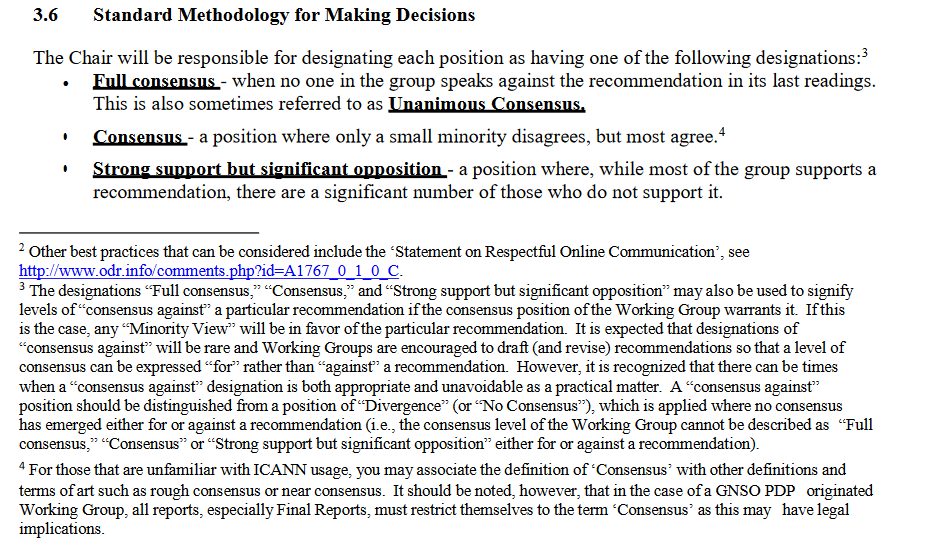
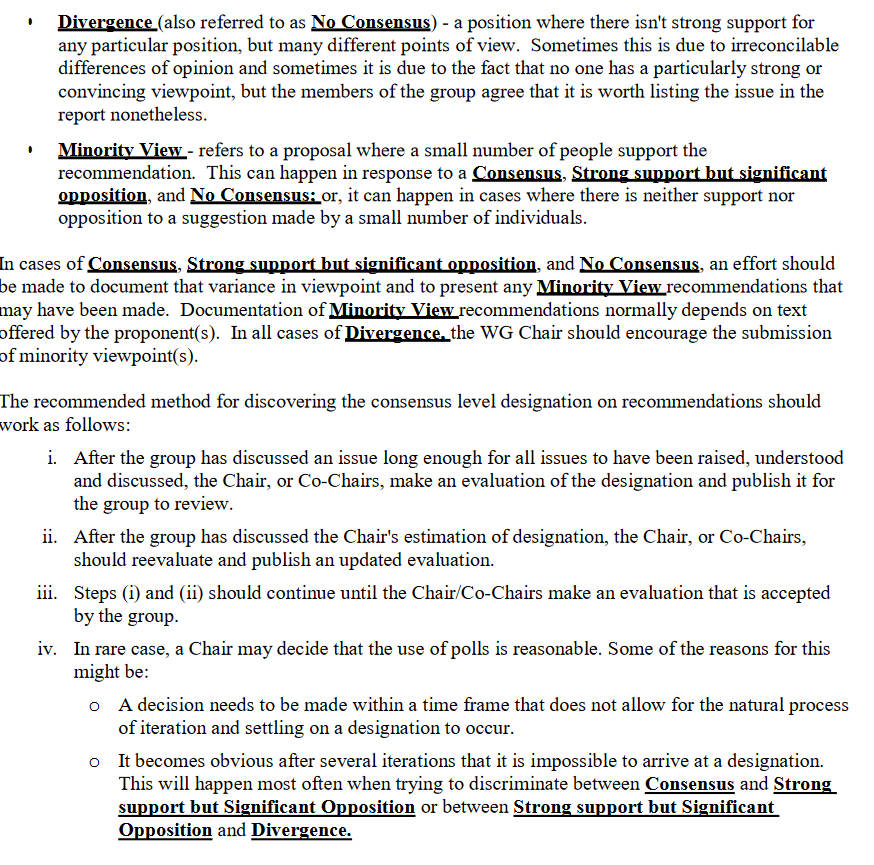
I agree that public comment is not the measure of Consensus under WG Guidelines. However, neither is the strict counting of the "majority". As Jeff has pointed out many times, Consensus is measured qualitatively, not quantitatively. The Guidelines (pasted below) are NOT a matter of getting "hung up on terminology used in the triage". Our goal is Consensus Call in about three months, so we had better have a good understanding as to how these recommendations are currently being characterized in relation to consensus - since Leadership has the ultimate responsibility of designating the level of Consensus (or Consensus against), which is then put out to the full WG for feedback as to whether the WG members agree with the Consensus level designations pursuant to 3.6 of the WG Guidelines. In fact, that is the very purpose for which we are reviewing these summaries, in preparation for the formal determination of Consensus. In the example of our "test case" from the third F2F in Kobe re "autofill", we can move the ball forward by gauging how the WG can get to Full Consensus rather than repeatedly arguing the position that the divergent comments made "don't make sense". (For example, the way to get to Full Consensus might be to carve out the questions related to mission and purpose when it comes to "autofill". Again, this is not a "new idea" to be delayed to some later policy-making effort. ) Other WG members, including Leadership, may have other "third alternatives' to get to Full Consensus, which is where we want to be if at all possible. In this regard, it is inappropriate to site to Work Track determinations ("without any dissent") when in fact WG Members were told (when agreeing to an Initial Report with no Consensus Call) that the Work Track recommendations, which did not include full WG participation, would not have any conclusive effect on Consensus determinations. (There would be way too much "bootstrapping" going on if this were the method of proceeding.) The present full WG deliberations are the relevant deliberations for determining Consensus pursuant to GNSO Working Group Guidelines. The goal in the WG deliberations should be to get to Full Consensus wherever possible. (That means compromise.) Guidelines are pasted below for reference. The levels are: Full Consensus, Unanimous Consensus, Consensus, Strong support but significant opposition, and Divergence (No Consensus). At this point, it seems pretty clear that each recommendation is going to require a Consensus Designation. And it is definitely not too soon to have a preliminary discussion about those designations. [cid:image001.png@01D4DE65.5D456880] [cid:image002.png@01D4DE67.115EF2E0] From: Gnso-newgtld-wg [mailto:gnso-newgtld-wg-bounces@icann.org] On Behalf Of Rubens Kuhl Sent: Tuesday, March 19, 2019 2:43 PM To: gnso-newgtld-wg@icann.org Subject: Re: [Gnso-newgtld-wg] Notes and Action Items - New gTLD Subsequent Procedures PDP WG - 13 March 2019 [EXTERNAL] ________________________________ As Chair, for the record, this concept was supported by the Work Track that made this recommendation without any dissent prior to the Initial Report. As far as the comments we got back, ICANN agreed with the recommendation, but expressed concern as to the complexity of implementing this. The only comment that disagreed was from the BC. Neustar, Lemarit, Fairwinds and the BRG supported the recommendation. I would like to highlight this point from Jeff but generalize it: I noticed some remarks in the list and in our meetings mentioning that recommendation X got Y comments against ; the point is that those recommendations have either no or little dissent to be put out as general agreements, while the ones with some dissent were made as questions in the initial report. So saying that a majority/all commenters were against makes for a bit of dissent, not for a majority, since that point already had significant support in the respective WTs. And while we did have some agreeing comments, people are more likely to express themselves in disagreement... so it's not surprising that the overall trend of comments would be against. If those dissents convince the WG to change those recommendations it will be exactly because the WG has then moved its position, not because the share of the comments. Rubens ________________________________ This message and any attachments are intended only for the use of the individual or entity to which they are addressed. If the reader of this message or an attachment is not the intended recipient or the employee or agent responsible for delivering the message or attachment to the intended recipient you are hereby notified that any dissemination, distribution or copying of this message or any attachment is strictly prohibited. If you have received this communication in error, please notify us immediately by replying to the sender. The information transmitted in this message and any attachments may be privileged, is intended only for the personal and confidential use of the intended recipients, and is covered by the Electronic Communications Privacy Act, 18 U.S.C. ?2510-2521.


Thanks Anne for the comments. We will discuss further on the call on Monday. I do agree that Consensus Calls are from the full Working Group deliberations and not the Work Tracks. But the discussions of the Work Track along with the public comments are all relevant for discussion points and for assisting with Consensus Determinations. We don't just throw all of that out and start over. With respect to guidelines as to how Cheryl and I will determine consensus, we will give this some more thought, but for anyone that thinks that we are going to come up with a solid formula or objective test, I don't want to set expectations. It is a qualitative analysis and the only guidelines we have are those cited below by Anne. If Cheryl or I were to add any requirements, then that would get criticized for being inconsistent with the guidelines. At the end of the day, this is a subjective call by Cheryl and I which we will review with the group and for which the Working Group has the ability to question. We are going to do our best, but at the end of the day, we are humans and by our very nature are not infallible. Jeff Neuman Senior Vice President Com Laude | Valideus 1751 Pinnacle Drive Suite 600, McLean VA 22102, USA M: +1.202.549.5079 D: +1.703.635.7514 E: jeff.neuman@comlaude.com www.comlaude.com<http://www.comlaude.com/> Liability cannot be accepted for statements made which are clearly the sender's own and not made on behalf of Com Laude USA or Valideus USA. This message is intended solely for the addressee and may contain confidential information. If you have received this message in error, please send it back to us, and immediately and permanently delete it. Do not use, copy or disclose the information contained in this message or in any attachment.Com Laude USA and Valideus are trading names of Consonum, Inc. From: Gnso-newgtld-wg <gnso-newgtld-wg-bounces@icann.org> On Behalf Of Aikman-Scalese, Anne Sent: Tuesday, March 19, 2019 6:43 PM To: Rubens Kuhl <rubensk@nic.br>; gnso-newgtld-wg@icann.org Subject: Re: [Gnso-newgtld-wg] Notes and Action Items - New gTLD Subsequent Procedures PDP WG - 13 March 2019 I agree that public comment is not the measure of Consensus under WG Guidelines. However, neither is the strict counting of the "majority". As Jeff has pointed out many times, Consensus is measured qualitatively, not quantitatively. The Guidelines (pasted below) are NOT a matter of getting "hung up on terminology used in the triage". Our goal is Consensus Call in about three months, so we had better have a good understanding as to how these recommendations are currently being characterized in relation to consensus - since Leadership has the ultimate responsibility of designating the level of Consensus (or Consensus against), which is then put out to the full WG for feedback as to whether the WG members agree with the Consensus level designations pursuant to 3.6 of the WG Guidelines. In fact, that is the very purpose for which we are reviewing these summaries, in preparation for the formal determination of Consensus. In the example of our "test case" from the third F2F in Kobe re "autofill", we can move the ball forward by gauging how the WG can get to Full Consensus rather than repeatedly arguing the position that the divergent comments made "don't make sense". (For example, the way to get to Full Consensus might be to carve out the questions related to mission and purpose when it comes to "autofill". Again, this is not a "new idea" to be delayed to some later policy-making effort. ) Other WG members, including Leadership, may have other "third alternatives' to get to Full Consensus, which is where we want to be if at all possible. In this regard, it is inappropriate to site to Work Track determinations ("without any dissent") when in fact WG Members were told (when agreeing to an Initial Report with no Consensus Call) that the Work Track recommendations, which did not include full WG participation, would not have any conclusive effect on Consensus determinations. (There would be way too much "bootstrapping" going on if this were the method of proceeding.) The present full WG deliberations are the relevant deliberations for determining Consensus pursuant to GNSO Working Group Guidelines. The goal in the WG deliberations should be to get to Full Consensus wherever possible. (That means compromise.) Guidelines are pasted below for reference. The levels are: Full Consensus, Unanimous Consensus, Consensus, Strong support but significant opposition, and Divergence (No Consensus). At this point, it seems pretty clear that each recommendation is going to require a Consensus Designation. And it is definitely not too soon to have a preliminary discussion about those designations. [cid:image001.png@01D4DEFC.4FEE7720] [cid:image002.png@01D4DEFC.4FEE7720] From: Gnso-newgtld-wg [mailto:gnso-newgtld-wg-bounces@icann.org] On Behalf Of Rubens Kuhl Sent: Tuesday, March 19, 2019 2:43 PM To: gnso-newgtld-wg@icann.org<mailto:gnso-newgtld-wg@icann.org> Subject: Re: [Gnso-newgtld-wg] Notes and Action Items - New gTLD Subsequent Procedures PDP WG - 13 March 2019 [EXTERNAL] ________________________________ As Chair, for the record, this concept was supported by the Work Track that made this recommendation without any dissent prior to the Initial Report. As far as the comments we got back, ICANN agreed with the recommendation, but expressed concern as to the complexity of implementing this. The only comment that disagreed was from the BC. Neustar, Lemarit, Fairwinds and the BRG supported the recommendation. I would like to highlight this point from Jeff but generalize it: I noticed some remarks in the list and in our meetings mentioning that recommendation X got Y comments against ; the point is that those recommendations have either no or little dissent to be put out as general agreements, while the ones with some dissent were made as questions in the initial report. So saying that a majority/all commenters were against makes for a bit of dissent, not for a majority, since that point already had significant support in the respective WTs. And while we did have some agreeing comments, people are more likely to express themselves in disagreement... so it's not surprising that the overall trend of comments would be against. If those dissents convince the WG to change those recommendations it will be exactly because the WG has then moved its position, not because the share of the comments. Rubens ________________________________ This message and any attachments are intended only for the use of the individual or entity to which they are addressed. If the reader of this message or an attachment is not the intended recipient or the employee or agent responsible for delivering the message or attachment to the intended recipient you are hereby notified that any dissemination, distribution or copying of this message or any attachment is strictly prohibited. If you have received this communication in error, please notify us immediately by replying to the sender. The information transmitted in this message and any attachments may be privileged, is intended only for the personal and confidential use of the intended recipients, and is covered by the Electronic Communications Privacy Act, 18 U.S.C. §2510-2521.


Thanks Jeff. The Board's comments/ questions about our process are nevertheless relevant. I appreciate the fact that Leadership will be discussing the process further and would like to add some thoughts for your consideration in that discussion. The WG needs clarification of a couple of things not covered by the Guidelines language I pasted below. These are process issues in our WG right now and the items may in fact be related. 1. Classification of comments/suggestions as "New Ideas" - there is nothing in the WG Guidelines about this as far as I know? a. How do we tell the difference between a "new idea" and a simple "lack of consensus"? b. Could a "new idea" be the subject of a consensus developed during the current process of reviewing staff summaries? If so, will WG members know it at the time of the discussion - in order to avoid objections to the characterization by Leadership that will come later in the process? c. How will a "new idea" (one that is clearly not a comment demonstrating a lack of consensus on a recommendation) be treated? Will the WG be compiling a list for future policy work? In other words, where is Leadership headed with classification of "new ideas" and will this also require the WG consensus on where to take them moving forward? 2. Is Leadership committed to working to Full Consensus or Consensus in the WG? I would have to say that I understand this to be the role of Leadership in a PDP - to facilitate compromise and reach full Consensus or Consensus if possible. Otherwise, we'll end up with a ton of disagreement about the designations for each recommendation and a ton of Minority Statements. We need to follow the facilitator model of leading WGs. (Several comments in the Internet Governance session in Kobe posited the view that the entire ICANN organizational behavior (not staff) has descended into "tribalism". Thus, in order to proceed in an even more productive manner, the full WG should be advised on the following: 1. Clarification as to how "new ideas" are going to be handled by Leadership (and hopefully with WG agreement on the approach) AND 2. Commitment from Leadership to facilitate a process whereby WG members can compromise and reach full consensus if possible. (I think this is actually in the role of the definition of the role of Co-Chairs in the WG guidelines - but you would know since you and Marika wrote the revised PDP Manual.) I'm sure we all appreciate how difficult it is to plough through this work. I appreciate your Leadership and Cheryl's, as well as your time commitment, and am hopeful that these comments may be viewed as constructive considerations for our final results in the long run. Anne From: Jeff Neuman [mailto:jeff.neuman@comlaude.com] Sent: Wednesday, March 20, 2019 6:07 AM To: Aikman-Scalese, Anne <AAikman@lrrc.com>; Rubens Kuhl <rubensk@nic.br>; gnso-newgtld-wg@icann.org Subject: RE: [Gnso-newgtld-wg] Notes and Action Items - New gTLD Subsequent Procedures PDP WG - 13 March 2019 [EXTERNAL] ________________________________ Thanks Anne for the comments. We will discuss further on the call on Monday. I do agree that Consensus Calls are from the full Working Group deliberations and not the Work Tracks. But the discussions of the Work Track along with the public comments are all relevant for discussion points and for assisting with Consensus Determinations. We don't just throw all of that out and start over. With respect to guidelines as to how Cheryl and I will determine consensus, we will give this some more thought, but for anyone that thinks that we are going to come up with a solid formula or objective test, I don't want to set expectations. It is a qualitative analysis and the only guidelines we have are those cited below by Anne. If Cheryl or I were to add any requirements, then that would get criticized for being inconsistent with the guidelines. At the end of the day, this is a subjective call by Cheryl and I which we will review with the group and for which the Working Group has the ability to question. We are going to do our best, but at the end of the day, we are humans and by our very nature are not infallible. Jeff Neuman Senior Vice President Com Laude | Valideus 1751 Pinnacle Drive Suite 600, McLean VA 22102, USA M: +1.202.549.5079 D: +1.703.635.7514 E: jeff.neuman@comlaude.com<mailto:jeff.neuman@comlaude.com> www.comlaude.com<http://www.comlaude.com/> Liability cannot be accepted for statements made which are clearly the sender's own and not made on behalf of Com Laude USA or Valideus USA. This message is intended solely for the addressee and may contain confidential information. If you have received this message in error, please send it back to us, and immediately and permanently delete it. Do not use, copy or disclose the information contained in this message or in any attachment.Com Laude USA and Valideus are trading names of Consonum, Inc. From: Gnso-newgtld-wg <gnso-newgtld-wg-bounces@icann.org<mailto:gnso-newgtld-wg-bounces@icann.org>> On Behalf Of Aikman-Scalese, Anne Sent: Tuesday, March 19, 2019 6:43 PM To: Rubens Kuhl <rubensk@nic.br<mailto:rubensk@nic.br>>; gnso-newgtld-wg@icann.org<mailto:gnso-newgtld-wg@icann.org> Subject: Re: [Gnso-newgtld-wg] Notes and Action Items - New gTLD Subsequent Procedures PDP WG - 13 March 2019 I agree that public comment is not the measure of Consensus under WG Guidelines. However, neither is the strict counting of the "majority". As Jeff has pointed out many times, Consensus is measured qualitatively, not quantitatively. The Guidelines (pasted below) are NOT a matter of getting "hung up on terminology used in the triage". Our goal is Consensus Call in about three months, so we had better have a good understanding as to how these recommendations are currently being characterized in relation to consensus - since Leadership has the ultimate responsibility of designating the level of Consensus (or Consensus against), which is then put out to the full WG for feedback as to whether the WG members agree with the Consensus level designations pursuant to 3.6 of the WG Guidelines. In fact, that is the very purpose for which we are reviewing these summaries, in preparation for the formal determination of Consensus. In the example of our "test case" from the third F2F in Kobe re "autofill", we can move the ball forward by gauging how the WG can get to Full Consensus rather than repeatedly arguing the position that the divergent comments made "don't make sense". (For example, the way to get to Full Consensus might be to carve out the questions related to mission and purpose when it comes to "autofill". Again, this is not a "new idea" to be delayed to some later policy-making effort. ) Other WG members, including Leadership, may have other "third alternatives' to get to Full Consensus, which is where we want to be if at all possible. In this regard, it is inappropriate to site to Work Track determinations ("without any dissent") when in fact WG Members were told (when agreeing to an Initial Report with no Consensus Call) that the Work Track recommendations, which did not include full WG participation, would not have any conclusive effect on Consensus determinations. (There would be way too much "bootstrapping" going on if this were the method of proceeding.) The present full WG deliberations are the relevant deliberations for determining Consensus pursuant to GNSO Working Group Guidelines. The goal in the WG deliberations should be to get to Full Consensus wherever possible. (That means compromise.) Guidelines are pasted below for reference. The levels are: Full Consensus, Unanimous Consensus, Consensus, Strong support but significant opposition, and Divergence (No Consensus). At this point, it seems pretty clear that each recommendation is going to require a Consensus Designation. And it is definitely not too soon to have a preliminary discussion about those designations. [cid:image001.png@01D4DF04.10867EE0] [cid:image002.png@01D4DF04.10867EE0] From: Gnso-newgtld-wg [mailto:gnso-newgtld-wg-bounces@icann.org] On Behalf Of Rubens Kuhl Sent: Tuesday, March 19, 2019 2:43 PM To: gnso-newgtld-wg@icann.org<mailto:gnso-newgtld-wg@icann.org> Subject: Re: [Gnso-newgtld-wg] Notes and Action Items - New gTLD Subsequent Procedures PDP WG - 13 March 2019 [EXTERNAL] ________________________________ As Chair, for the record, this concept was supported by the Work Track that made this recommendation without any dissent prior to the Initial Report. As far as the comments we got back, ICANN agreed with the recommendation, but expressed concern as to the complexity of implementing this. The only comment that disagreed was from the BC. Neustar, Lemarit, Fairwinds and the BRG supported the recommendation. I would like to highlight this point from Jeff but generalize it: I noticed some remarks in the list and in our meetings mentioning that recommendation X got Y comments against ; the point is that those recommendations have either no or little dissent to be put out as general agreements, while the ones with some dissent were made as questions in the initial report. So saying that a majority/all commenters were against makes for a bit of dissent, not for a majority, since that point already had significant support in the respective WTs. And while we did have some agreeing comments, people are more likely to express themselves in disagreement... so it's not surprising that the overall trend of comments would be against. If those dissents convince the WG to change those recommendations it will be exactly because the WG has then moved its position, not because the share of the comments. Rubens ________________________________ This message and any attachments are intended only for the use of the individual or entity to which they are addressed. If the reader of this message or an attachment is not the intended recipient or the employee or agent responsible for delivering the message or attachment to the intended recipient you are hereby notified that any dissemination, distribution or copying of this message or any attachment is strictly prohibited. If you have received this communication in error, please notify us immediately by replying to the sender. The information transmitted in this message and any attachments may be privileged, is intended only for the personal and confidential use of the intended recipients, and is covered by the Electronic Communications Privacy Act, 18 U.S.C. §2510-2521. ________________________________ This message and any attachments are intended only for the use of the individual or entity to which they are addressed. If the reader of this message or an attachment is not the intended recipient or the employee or agent responsible for delivering the message or attachment to the intended recipient you are hereby notified that any dissemination, distribution or copying of this message or any attachment is strictly prohibited. If you have received this communication in error, please notify us immediately by replying to the sender. The information transmitted in this message and any attachments may be privileged, is intended only for the personal and confidential use of the intended recipients, and is covered by the Electronic Communications Privacy Act, 18 U.S.C. §2510-2521.
Anne, Thanks for using a different color as it helps me see your comments. I will respond therefore in Blue below. Jeff Neuman Senior Vice President Com Laude | Valideus 1751 Pinnacle Drive Suite 600, McLean VA 22102, USA M: +1.202.549.5079 D: +1.703.635.7514 E: jeff.neuman@comlaude.com www.comlaude.com<http://www.comlaude.com/> Liability cannot be accepted for statements made which are clearly the sender's own and not made on behalf of Com Laude USA or Valideus USA. This message is intended solely for the addressee and may contain confidential information. If you have received this message in error, please send it back to us, and immediately and permanently delete it. Do not use, copy or disclose the information contained in this message or in any attachment.Com Laude USA and Valideus are trading names of Consonum, Inc. From: Aikman-Scalese, Anne <AAikman@lrrc.com> Sent: Wednesday, March 20, 2019 1:47 PM To: Jeff Neuman <jeff.neuman@comlaude.com>; gnso-newgtld-wg@icann.org Subject: RE: [Gnso-newgtld-wg] Notes and Action Items - New gTLD Subsequent Procedures PDP WG - 13 March 2019 Thanks Jeff. The Board's comments/ questions about our process are nevertheless relevant. I appreciate the fact that Leadership will be discussing the process further and would like to add some thoughts for your consideration in that discussion. [Jeff] By commenting only on your questions about consensus, I was not making any kind of statement that the Board comments/questions are irrelevant. Of course they are. And we do appreciate your comments and thoughts. The WG needs clarification of a couple of things not covered by the Guidelines language I pasted below. These are process issues in our WG right now and the items may in fact be related. 1. Classification of comments/suggestions as "New Ideas" - there is nothing in the WG Guidelines about this as far as I know? a. How do we tell the difference between a "new idea" and a simple "lack of consensus"? b. Could a "new idea" be the subject of a consensus developed during the current process of reviewing staff summaries? If so, will WG members know it at the time of the discussion - in order to avoid objections to the characterization by Leadership that will come later in the process? c. How will a "new idea" (one that is clearly not a comment demonstrating a lack of consensus on a recommendation) be treated? Will the WG be compiling a list for future policy work? In other words, where is Leadership headed with classification of "new ideas" and will this also require the WG consensus on where to take them moving forward? [Jeff] The term "New Idea" was only a way to classify the comments that came in. They term is not intended to be anything other than that. It is a label, not a judgement or anything else. The label is not relevant to the determination of consensus. The key is whether an idea has merit and is supported by a Consensus of the Working Group. This is true whether it is a new idea, old idea, or any other label used for an idea. Whether ideas have Consensus is ultimately a judgement call. But if there is an idea brought up (or has already been brought up) and there are only a few people that are seemingly in support of the idea, or there are lots of people/groups against that idea, that will give us a clue as to whether that idea should be explored further or not. 2. Is Leadership committed to working to Full Consensus or Consensus in the WG? I would have to say that I understand this to be the role of Leadership in a PDP - to facilitate compromise and reach full Consensus or Consensus if possible. Otherwise, we'll end up with a ton of disagreement about the designations for each recommendation and a ton of Minority Statements. We need to follow the facilitator model of leading WGs. (Several comments in the Internet Governance session in Kobe posited the view that the entire ICANN organizational behavior (not staff) has descended into "tribalism". [Jeff] Of course we are committed to working towards Consensus in the Working Group. To be brief, the problem is bigger than tribalism. Participants of Working Groups need to WANT to compromise and come to consensus. They need both the incentive to compromise as well as the authority to compromise. This may mean coming off of ones position or out of their silo to work in good faith to understand other views and work constructively to come up with a solution. As leaders, we cannot force this upon the Working Group members. I hope this Working Group is able to work towards that. Thus, in order to proceed in an even more productive manner, the full WG should be advised on the following: 1. Clarification as to how "new ideas" are going to be handled by Leadership (and hopefully with WG agreement on the approach) AND 2. Commitment from Leadership to facilitate a process whereby WG members can compromise and reach full consensus if possible. (I think this is actually in the role of the definition of the role of Co-Chairs in the WG guidelines - but you would know since you and Marika wrote the revised PDP Manual.) [Jeff] Wow, you are one of the few that remembers the writing of the revisions to the manual. Thanks! Again, as Co-Chairs, we are working to try and present potential compromises in areas where we can. But it really has to be the Working Group that works with us to not get caught up on labels used on slides, or terms that we may use accidentally or unintentionally. Lets focus on concepts. Lets focus on the problems we are trying to solve. I'm sure we all appreciate how difficult it is to plough through this work. I appreciate your Leadership and Cheryl's, as well as your time commitment, and am hopeful that these comments may be viewed as constructive considerations for our final results in the long run. Anne From: Jeff Neuman [mailto:jeff.neuman@comlaude.com] Sent: Wednesday, March 20, 2019 6:07 AM To: Aikman-Scalese, Anne <AAikman@lrrc.com<mailto:AAikman@lrrc.com>>; Rubens Kuhl <rubensk@nic.br<mailto:rubensk@nic.br>>; gnso-newgtld-wg@icann.org<mailto:gnso-newgtld-wg@icann.org> Subject: RE: [Gnso-newgtld-wg] Notes and Action Items - New gTLD Subsequent Procedures PDP WG - 13 March 2019 [EXTERNAL] ________________________________ Thanks Anne for the comments. We will discuss further on the call on Monday. I do agree that Consensus Calls are from the full Working Group deliberations and not the Work Tracks. But the discussions of the Work Track along with the public comments are all relevant for discussion points and for assisting with Consensus Determinations. We don't just throw all of that out and start over. With respect to guidelines as to how Cheryl and I will determine consensus, we will give this some more thought, but for anyone that thinks that we are going to come up with a solid formula or objective test, I don't want to set expectations. It is a qualitative analysis and the only guidelines we have are those cited below by Anne. If Cheryl or I were to add any requirements, then that would get criticized for being inconsistent with the guidelines. At the end of the day, this is a subjective call by Cheryl and I which we will review with the group and for which the Working Group has the ability to question. We are going to do our best, but at the end of the day, we are humans and by our very nature are not infallible. Jeff Neuman Senior Vice President Com Laude | Valideus 1751 Pinnacle Drive Suite 600, McLean VA 22102, USA M: +1.202.549.5079 D: +1.703.635.7514 E: jeff.neuman@comlaude.com<mailto:jeff.neuman@comlaude.com> www.comlaude.com<http://www.comlaude.com/> Liability cannot be accepted for statements made which are clearly the sender's own and not made on behalf of Com Laude USA or Valideus USA. This message is intended solely for the addressee and may contain confidential information. If you have received this message in error, please send it back to us, and immediately and permanently delete it. Do not use, copy or disclose the information contained in this message or in any attachment.Com Laude USA and Valideus are trading names of Consonum, Inc. From: Gnso-newgtld-wg <gnso-newgtld-wg-bounces@icann.org<mailto:gnso-newgtld-wg-bounces@icann.org>> On Behalf Of Aikman-Scalese, Anne Sent: Tuesday, March 19, 2019 6:43 PM To: Rubens Kuhl <rubensk@nic.br<mailto:rubensk@nic.br>>; gnso-newgtld-wg@icann.org<mailto:gnso-newgtld-wg@icann.org> Subject: Re: [Gnso-newgtld-wg] Notes and Action Items - New gTLD Subsequent Procedures PDP WG - 13 March 2019 I agree that public comment is not the measure of Consensus under WG Guidelines. However, neither is the strict counting of the "majority". As Jeff has pointed out many times, Consensus is measured qualitatively, not quantitatively. The Guidelines (pasted below) are NOT a matter of getting "hung up on terminology used in the triage". Our goal is Consensus Call in about three months, so we had better have a good understanding as to how these recommendations are currently being characterized in relation to consensus - since Leadership has the ultimate responsibility of designating the level of Consensus (or Consensus against), which is then put out to the full WG for feedback as to whether the WG members agree with the Consensus level designations pursuant to 3.6 of the WG Guidelines. In fact, that is the very purpose for which we are reviewing these summaries, in preparation for the formal determination of Consensus. In the example of our "test case" from the third F2F in Kobe re "autofill", we can move the ball forward by gauging how the WG can get to Full Consensus rather than repeatedly arguing the position that the divergent comments made "don't make sense". (For example, the way to get to Full Consensus might be to carve out the questions related to mission and purpose when it comes to "autofill". Again, this is not a "new idea" to be delayed to some later policy-making effort. ) Other WG members, including Leadership, may have other "third alternatives' to get to Full Consensus, which is where we want to be if at all possible. In this regard, it is inappropriate to site to Work Track determinations ("without any dissent") when in fact WG Members were told (when agreeing to an Initial Report with no Consensus Call) that the Work Track recommendations, which did not include full WG participation, would not have any conclusive effect on Consensus determinations. (There would be way too much "bootstrapping" going on if this were the method of proceeding.) The present full WG deliberations are the relevant deliberations for determining Consensus pursuant to GNSO Working Group Guidelines. The goal in the WG deliberations should be to get to Full Consensus wherever possible. (That means compromise.) Guidelines are pasted below for reference. The levels are: Full Consensus, Unanimous Consensus, Consensus, Strong support but significant opposition, and Divergence (No Consensus). At this point, it seems pretty clear that each recommendation is going to require a Consensus Designation. And it is definitely not too soon to have a preliminary discussion about those designations. [cid:image001.png@01D4DF30.0CC13580] [cid:image002.png@01D4DF30.0CC13580] From: Gnso-newgtld-wg [mailto:gnso-newgtld-wg-bounces@icann.org] On Behalf Of Rubens Kuhl Sent: Tuesday, March 19, 2019 2:43 PM To: gnso-newgtld-wg@icann.org<mailto:gnso-newgtld-wg@icann.org> Subject: Re: [Gnso-newgtld-wg] Notes and Action Items - New gTLD Subsequent Procedures PDP WG - 13 March 2019 [EXTERNAL] ________________________________ As Chair, for the record, this concept was supported by the Work Track that made this recommendation without any dissent prior to the Initial Report. As far as the comments we got back, ICANN agreed with the recommendation, but expressed concern as to the complexity of implementing this. The only comment that disagreed was from the BC. Neustar, Lemarit, Fairwinds and the BRG supported the recommendation. I would like to highlight this point from Jeff but generalize it: I noticed some remarks in the list and in our meetings mentioning that recommendation X got Y comments against ; the point is that those recommendations have either no or little dissent to be put out as general agreements, while the ones with some dissent were made as questions in the initial report. So saying that a majority/all commenters were against makes for a bit of dissent, not for a majority, since that point already had significant support in the respective WTs. And while we did have some agreeing comments, people are more likely to express themselves in disagreement... so it's not surprising that the overall trend of comments would be against. If those dissents convince the WG to change those recommendations it will be exactly because the WG has then moved its position, not because the share of the comments. Rubens ________________________________ This message and any attachments are intended only for the use of the individual or entity to which they are addressed. If the reader of this message or an attachment is not the intended recipient or the employee or agent responsible for delivering the message or attachment to the intended recipient you are hereby notified that any dissemination, distribution or copying of this message or any attachment is strictly prohibited. If you have received this communication in error, please notify us immediately by replying to the sender. The information transmitted in this message and any attachments may be privileged, is intended only for the personal and confidential use of the intended recipients, and is covered by the Electronic Communications Privacy Act, 18 U.S.C. §2510-2521. ________________________________ This message and any attachments are intended only for the use of the individual or entity to which they are addressed. If the reader of this message or an attachment is not the intended recipient or the employee or agent responsible for delivering the message or attachment to the intended recipient you are hereby notified that any dissemination, distribution or copying of this message or any attachment is strictly prohibited. If you have received this communication in error, please notify us immediately by replying to the sender. The information transmitted in this message and any attachments may be privileged, is intended only for the personal and confidential use of the intended recipients, and is covered by the Electronic Communications Privacy Act, 18 U.S.C. §2510-2521.


Hi Jeff and Cheryl, Per your invitation, I share my recollections of the Kobe meeting below (which are different) and the uncertainty I share with Anne and others about the consensus call. I think all pigs are equal, but some are more equal than others. Let me try to explain: There was a slide shown in the last face-to-face discussed that summarized the subteam discussion of copying certain fields from one application as supporting "identical" applications. I raised a question about identical applications as something we had never discussed. - Cheryl, who was sitting right next to me, said that the slide was not accurate on this point, and should not be taken too literally. I think she said this to the full group as well. [1] - Krista, who headed the subteam, described her recollection of the comments as discussing certain fields for duplication, but not identical applications. [2] - I said I remembered opposition in the comments to the copying of certain fields by IPC. I added that NCSG -- throughout its comments to the WG - supported policies that aid the community's ability to review, understand and comment on applications. Based on this prior stance, NCSG joined IPC in opposing the duplication of certain fields, especially those that the community relies on to be distinct and individualized. [3] To your question, I don't see is [1], [2] and [3] above in your summary below. So a few procedural questions: A. What's the reason for the WG discussion: Are we only looking at WG comments? Do we care what WG members say? If many comments come from one set of stakeholders, are the others "outvoted"? B. Can we all get clear and easy access to a few points that will be covered before each WG meeting -- with clear links to the underlying comment material? So that we can all easily review the comments and background before we enter the discussion - and not have to rely on what we remember from eight months ago? C. Given the importance in the first round (2012) to public portions of the application that the community, public and GAC could (and did) closely evaluate, and given the clear and high value today that that those who will be reviewing the future applications ascribe to them, shouldn't our next step as a WG be /strengthening the requirements /for clear and distinct responses to certain application fields so the community can fulfill its oversight function --/creating a race to the top, not a race to the bottom./ Best, Kathy/ / On 3/19/2019 5:16 PM, Jeff Neuman wrote:
Anne,
Thanks for your e-mails and sorry it has taken a couple of days for me to get back to this and recover enough to respond.
First, I don’t think we should get hung up on the terminology we used for purposes of the triage exercise. At this point, it does not matter whether something is classified as a new idea or not. What is important is whether the idea has enough support within the working group to merit further consideration and ultimately whether it would rise to the level of having Consensus support. So I would strongly encourage us to not dwell on the label that was used.
With respect to the conversation on whether an applicant can elect to copy one application for a TLD (or certain fields from one application) into another application for a second TLD, or whether an applicant can provide one response to a clarifying question and ask that that response be applied to all of its similarly situated applications, is by no means complete at this point. That said, I am still scratching my head (and this may be just me) to understand (a) what we are trying to prevent / protect against, (b) how the solution of not allowing copying of one answer to put into another application would achieve (a) above, and (c) why is this a concern for us.
What I heard during the discussion (and correct me if I am wrong) was that we wanted to make sure that at least with respect to the description of the mission / purpose or each TLD, there was a concern that by having an option to copy another application, we were encouraging applicants to not differentiate their TLD applications. So perhaps the argument for (a) above is that we are trying to prevent an applicant from submitting identical applications (albeit for separate strings). But where I get confused is that the solution of not having an option for the system to copy an answer, we are /not preventing copying from going on./ All we are doing is making applicants do this manually (which we cannot prevent)?
And I am also trying to understand the (c), _why are we concerned_. The BC stated in their comments that they thought copying from one response to another “can result in unknown mistakes and may increase chances of errors in the application.” My confusion is that if we force applicants to “copy” answers manually where identical answers make sense, then that could increase the chances for mistakes over having the system do this in an automated fashion. And I still don’t understand why we should be concerned if there are similar answers. Leaving out Question 18 (mission/purpose) for the moment, why do we care if the following sections of each application are identical except for having different strings:
* Applicant Information (Name, Address, Phone Number, Fax, E-mail, Website, etc.) * Primary Contact for the application (Name, DOB, contact information, etc.) * Proof of Legal Establishment * Applicant Background (Directors, Officers, Major Shareholders, Criminal & Cybersquatting History, etc.) * Registry Services (Question 23) * Technical and Operational Capabilities (Question 24 - 29) * Security (Question 30) * Technical Architecture, Database Capabilities, diversity of hardware, software, suppliers, etc. * DNS Services, Data Escrow, Registry Continuity, Failover Testing, Escalation Processes, DNSSEC * Financial Information, Statements, etc.
Even if the mission/purpose of each TLD is different, the reality is that all of the above information is most likely going to be identical. So, either they will copy each of the answers manually (which is more prone to mistakes) or there can be an automated option to allow the automatic population of these fields which could actually reduce mistakes.
As Chair, for the record, this concept was supported by the Work Track that made this recommendation without any dissent prior to the Initial Report. As far as the comments we got back, ICANN agreed with the recommendation, but expressed concern as to the complexity of implementing this. The only comment that disagreed was from the BC. Neustar, Lemarit, Fairwinds and the BRG supported the recommendation.
This e-mail does not represent any form of decision or guidance by the Co-Chairs of the SubPro PDP, but is merely intended to provide some of my outstanding questions on the concerns. Thanks.
*Jeff Neuman*
Senior Vice President
**
*Com Laude | Valideus *1751 Pinnacle Drive
Suite 600, McLean
VA 22102, USA
M: +1.202.549.5079
D: +1.703.635.7514
E: _jeff.neuman@comlaude.com_ www.comlaude.com <http://www.comlaude.com/>__
Liability cannot be accepted for statements made which are clearly the sender’s own and not made on behalf of Com Laude USA or Valideus USA. This message is intended solely for the addressee and may contain confidential information. If you have received this message in error, please send it back to us, and immediately and permanently delete it. Do not use, copy or disclose the information contained in this message or in any attachment.Com Laude USA and Valideus are trading names of Consonum, Inc.__
*From:* Gnso-newgtld-wg <gnso-newgtld-wg-bounces@icann.org> *On Behalf Of *Aikman-Scalese, Anne *Sent:* Wednesday, March 13, 2019 4:47 PM *To:* Julie Hedlund <julie.hedlund@icann.org>; gnso-newgtld-wg@icann.org *Subject:* Re: [Gnso-newgtld-wg] Notes and Action Items - New gTLD Subsequent Procedures PDP WG - 13 March 2019
Thanks Julie. To Jeff and Cheryl, I don’t think the concerns raised by Kathy, Justine, and me in the Sub Pro call #3 about “rote duplicative answers” as to Question 18 constitute a “new idea”. These were rather concerns expressed about moving forward with a policy recommendation to change the existing policy in the 2012 AGB. Requiring individual answers in Question 18 is not a “new idea”. It’s existing policy which should not be changed unless there is a strong consensus in the WG in favor of doing so.
Based on what I have gleaned from our structure so far, it appears that Leadership could take the position that a “new idea” may only be recommended if it has unanimous or very strong support. (This doesn’t mean the WG won’t reach Consensus as to repetitive information being filed in numerous applications at the same time in categories other than mission and purpose.) But the fact that this idea received support in public comment should not override concerns of Working Group members relative to transparency and encouraging practices which facilitate public comment. So, in fact, rather than being a “new idea’, what you have is a lack of strong Consensus in the WG about this recommendation for the auto-fill capability as it relates to questions dealing with mission and purpose. Again, that is NOT a policy change or a “new idea.”
This will come up again in relation to the disclosure of services at the time of application filing. So it would be good if Leadership could clarify EXACTLY how it intends to treat items that are characterized as a “New Idea.” Call me crazy but I think everyone is still a bit confused as to the “disposition” going forward in relation to “new ideas”.
Thanks again for your willingness to bring this PDP “home”. It’s not an easy job and we really do appreciate Cheryl’s comment that “they said it couldn’t be done” but the work is getting done. My only point is that characterizing something as a “new idea” in relation to the questions that were put out in the Initial Report should not be used as a way to cast aside an obvious lack of Consensus in the WG on a given recommendation. The WG will have to be careful about this all the way through its deliberations in the coming months.
Safe return travels to all. I could not make it to Kobe but am planning to be in Marrakech and Montreal.
Anne
*From:* Gnso-newgtld-wg [mailto:gnso-newgtld-wg-bounces@icann.org] *On Behalf Of *Julie Hedlund *Sent:* Wednesday, March 13, 2019 1:19 AM *To:* gnso-newgtld-wg@icann.org <mailto:gnso-newgtld-wg@icann.org> *Subject:* [Gnso-newgtld-wg] Notes and Action Items - New gTLD Subsequent Procedures PDP WG - 13 March 2019
*[EXTERNAL]*
------------------------------------------------------------------------
Dear Working Group members,
Please see below the notes from the meetings at ICANN64 in Kobe on 13 March 2019. These high-level notes are designed to help WG members navigate through the content of the call and are not a substitute for the recording, transcript, or the chat, which will be posted at: https://community.icann.org/display/NGSPP/2019-03-13+ICANN64+Kobe+-+New+gTLD....
Please also see the attached referenced slides.
Kind regards,
Julie
Julie Hedlund, Policy Director
*Notes and Action Items:*
*Session 3 of 3:*
_Topics that Might Warrant Closure_:
-- Show how we have assembled the topic review.
-- How to bring this to closure.
-- Next steps.
-- Still are some potential open topics that might need to go to the Implementation Review Team or do more work.
See the Public Comment Tool: https://docs.google.com/spreadsheets/d/15zDdzlBwLCz5m2sNXui6N6pporbUq-lDFEwf...
_1. Applicant Guidebook – Slide 20_:
-- Information on the slide is conceptual, not recommendation language.
_2. Systems – Slides 21-22_:
-- Question: Which of the recommendations are implementation guidance and which are policy? The first bullet (adequate time) would be more specific than policy; second bullet suggests implementation guidance. Also, change to “real-time technical support” (delete “better”).
-- Both bullet points seem to be implementation guidance.
-- Prioritization would be key (such as identifying field requiring non-ASCII characters).
Christopher Wilkinson: <COMMENT>Ihave a general reservation abiout language which woud facilitate multiople applications from a single applicant. Particularly with regard to Geographical Names<COMMENT>
Christopher Wilkinson: <COMMENT> permitting portfolio applications will result in further concentration, more warehousing and speculation and threaten the interests of international communities <COMMENT>
-- Creating multiple identical applications doesn’t seem to serve the Applicant Guidebook Process. Comment from Business Constituency was to be able to respond to multiple applications with the same question. That this answer applies to multiple applications.
-- Sections in some applications may be pretty much the same, so the ability to copy text over would be beneficial.
-- Should encourage clarity of what is expected in the answers. Would be helpful to know in advance what is expected of applicants.
Anne Aikman-Scalese (IPC): COMMENT: Answers to Question 18 should not be rote fill-in identical answers. COMMENT
Anne Aikman-Scalese (IPC): COMMENT: +1 to Justine 's request and to Kathy's observation re Question 18. We don't want to encourage super general language that is made more vague so that it can be applied automatically in numerous applications. COMMENT
-- Should allow copy and pasting the same answer to purpose and mission, but how can we prevent that? Could do so by setting expectations.
-- The discussion was around efficiency and ease of use for applicants. We didn’t consider what to allow for which questions.
Christopher Wilkinson: <COMMENT> boilerplate replies from multiople applications will facilitate gaming to avoid substantive comments from other stakeholders and interested parties<COMMENT>
Anne Aikman-Scalese (IPC): COMMENT: Re public comment on applications, cookie cutter answers are contrary to the principle of transparency. Applicants might easily construct such answers for the purpose of avoiding public comment. Justine's request is important. COMMENT
-- The more complex we make the system the more costly it will be and difficult to use.
Anne Aikman-Scalese (IPC): COMMENT: It's demeaning to the comments to say they are "in the weeds" and they are not "high level". it just means you oppose them. COMMENT
-- To address the issue you’d have to have a policy recommendation that you can’t submit the exact same information across applications or within applications.
-- What is the problem we are trying to solve, at a high level? If you can cut and paste you will do it, but don’t know if that will avoid the issues being raised.
-- Seems that the problem is the pace the submission outpacing the ability of the community to review the volume of applications received.
-- New Idea: Maybe prohibit duplicative language if you are a portfolio applicant.
Anne Aikman-Scalese (IPC): COMMENT: It is not about solving a problem, it is about creating a new problem by making this recommendation. Jeff's suggestion to use languge that excepts the practice in relation to questions that go to Mission and Purpose. That is not a policy change. COMMENT
Christopher Wilkinson: <COMMENT> one of the objectives of having several specialised rounds or batches is precisely to limit the volumes of applications to the capacity of the evaluation resources, over time <COMMENT>
_3. Communications – Slides 23-24_:
-- Bullet 1: Minimum of 4 months – shouldn’t be summarized; there was a variety of comments.
-- Bullet 2: Know what is in the GSE toolbox.
-- For the two bullets – not a lot of mention of studying of objectives and holes for applications; what are we looking to achieve by communications and outreach. Would be good to measure.
-- When we were talking about applicant support there were comments on how to measure success in future.
-- Communications is different from applicant support, but we need to look at both.
-- Open topics: The WG could do it, give it to an IRT, or recommend that ICANN Org do it.
Christopher Wilkinson: <COMMENT> communications periods will be critical for geographical names because very few of local stakeholders world wide have been participating in Wt5 etc. <COMMENT>
Anne Aikman-Scalese (IPC): QUESTION Was there something in the public comments related to making real-time chat available for applicants? QUESTION
_4. Universal Acceptance – Slide 25_:
-- UASG has been successful in promoting UA – getting several major email providers to be UA ready. The question is whether the Registries/Registrars are using those email services.
-- Might be too much to ask to expect Registries/Registrars to do what the major email providers do.
-- This sounds like more of an issue with all TLDs – why would we just put it in as a condition of a new TLD if it isn’t a condition for legacy TLDs?
-- ALAC – suggesting UA if the Registry/Registrar are owned by the same entity.
_5. Application Submission Periods – Slides 26-27_: Start on the next WG call.
Anne Aikman-Scalese (IPC): COMMENT: Re Topic 5, how do we take into account the Neustar proposal re windows within an application period? That should be captured. COMMENT
------------------------------------------------------------------------
This message and any attachments are intended only for the use of the individual or entity to which they are addressed. If the reader of this message or an attachment is not the intended recipient or the employee or agent responsible for delivering the message or attachment to the intended recipient you are hereby notified that any dissemination, distribution or copying of this message or any attachment is strictly prohibited. If you have received this communication in error, please notify us immediately by replying to the sender. The information transmitted in this message and any attachments may be privileged, is intended only for the personal and confidential use of the intended recipients, and is covered by the Electronic Communications Privacy Act, 18 U.S.C. §2510-2521.
_______________________________________________ Gnso-newgtld-wg mailing list Gnso-newgtld-wg@icann.org https://mm.icann.org/mailman/listinfo/gnso-newgtld-wg
Thank you Kathy. Please find my comments below in Red. Sorry this is long, but I felt your comments merited a comprehensive response. This response is my response and I am sure Cheryl has her own thoughts which may be different from mine. From: Gnso-newgtld-wg <gnso-newgtld-wg-bounces@icann.org> On Behalf Of Kathy Kleiman Sent: Wednesday, March 20, 2019 12:17 PM To: gnso-newgtld-wg@icann.org Subject: Re: [Gnso-newgtld-wg] Notes and Action Items - New gTLD Subsequent Procedures PDP WG - 13 March 2019 Hi Jeff and Cheryl, Per your invitation, I share my recollections of the Kobe meeting below (which are different) and the uncertainty I share with Anne and others about the consensus call. I think all pigs are equal, but some are more equal than others. Let me try to explain: There was a slide shown in the last face-to-face discussed that summarized the subteam discussion of copying certain fields from one application as supporting "identical" applications. I raised a question about identical applications as something we had never discussed. [Jeff] As was explained a number of times during the meeting, we truncated subjects on the slides so that they could fit on a slide. This meant that summary terms were used when they may not have been the right terms. By identical applications, we were referring to Applications by a single entity for which the only material difference was the actual string. But the label identical is not important for the concept. The question is whether the system should contain an option to allow an Applicant that files multiple applications to copy some/all of the fields from one application into another application where the answers will be the same regardless of the string. Please focus on the concept and NOT on the label used in the slide. Slides are a tool to aid in discussion and nothing more. - Cheryl, who was sitting right next to me, said that the slide was not accurate on this point, and should not be taken too literally. I think she said this to the full group as well. [1] [Jeff] See comment above. - Krista, who headed the subteam, described her recollection of the comments as discussing certain fields for duplication, but not identical applications. [2] [Jeff] See comment above. - I said I remembered opposition in the comments to the copying of certain fields by IPC. I added that NCSG -- throughout its comments to the WG - supported policies that aid the community's ability to review, understand and comment on applications. Based on this prior stance, NCSG joined IPC in opposing the duplication of certain fields, especially those that the community relies on to be distinct and individualized. [3] [Jeff] I went back to the comments to do some research and it was NOT the IPC that filed comments on this subject, but rather it was the Business Constituency as I explained below. With respect to the NCSG comment, no where in the filed comment does it state the stance you have taken (namely opposing the duplication of fields). See https://mm.icann.org/pipermail/comments-gtld-subsequent-procedures-initial-0.... Not to diminish your comment at all, we cannot extrapolate that the opposition of duplication of certain fields is at this point an NCSG position. Of course an official statement from the NCSG could always amend that. [Jeff] Now, to the point of my comment below. Yes the NCSG did comment on its ability to review and comment on applications. But you have made an assumption in your last sentence that the community relies on applications to be “distinct and individualized.” Again, this is a comment you made, but one that has never been made before. Please explain from what source did you rely on for that assumption. And then please explain the link between whether the system allows the copying of certain fields from one application to another and interfering with “the community’s ability to review, understand and comment on applications.” Also, lets be clear on which fields you are referring to. Are the bulleted fields the ones you are concerned about, or as we discussed, is it really any questions dealing with mission, purpose, registration requirements, etc. We could for example allow the copying of all fields other than those dealing with the mission, purpose, registration requirements, etc. That would be a middle ground and one that would facilitate consensus especially when there are a number of people, groups, etc. that have commented in support of allowing copying. Help us get to consensus. To your question, I don't see is [1], [2] and [3] above in your summary below. So a few procedural questions: A. What's the reason for the WG discussion: Are we only looking at WG comments? Do we care what WG members say? If many comments come from one set of stakeholders, are the others "outvoted"? [Jeff] The point now is not to completely rehash every single discussion from scratch. After all we have had 3 years of discussions on topics. So, yes we are looking at WG comments AND we care about WG members say. But we ask that the Working Group work towards figuring out ways to integrate their own subjective views with the recommendations from the Initial Report (where there were such recommendations) and the multiple comments that we have received during Community Comment 1, Community Comment 2, the Initial Report Comments Period and the Supplemental Initial Report Comment Period. To the extent that a Working Group Member just starts to become involved in the process and tries to rehash the same discussions that have already taken place and which are not supported by the comments that we have received or the Initial Report, then the Co-Chairs may cut off those discussions. [Jeff] On your question on being outvoted, the answer is obviously no. We do not vote. B. Can we all get clear and easy access to a few points that will be covered before each WG meeting -- with clear links to the underlying comment material? So that we can all easily review the comments and background before we enter the discussion - and not have to rely on what we remember from eight months ago? [Jeff] Everything is posted on our wiki including the calendar of discussions as well as clear links to the comments. It is all there and has always been there. We expect that everyone that attends the calls have done their homework and has read what they need to have read to be prepared. For example, Julie Hedlund posted the Agenda for the meeting March 25th as well as the links to the documentation. She sent this out to the group on March 14th. C. Given the importance in the first round (2012) to public portions of the application that the community, public and GAC could (and did) closely evaluate, and given the clear and high value today that that those who will be reviewing the future applications ascribe to them, shouldn't our next step as a WG be strengthening the requirements for clear and distinct responses to certain application fields so the community can fulfill its oversight function -- creating a race to the top, not a race to the bottom. [Jeff] I would ask that you please refrain from platitudes like “creating a race to the bottom” as this negatively implies that the leadership of this WG and the rest of the Working Group are not taking their roles seriously. It also implies that those who may not agree with your views are trying to make the process worse or that the substance of their views are inferior to your own. I know that that is not the intent of your message, but I always try to assume that every member of the Working Group is doing their best to improve the program. For example, taking this e-mail as a whole, the message I am getting is that if we ask for a system that allows some fields to be copied from one application to another (if submitted by the same applicant), then that will in some way adversely impact the public’s ability to review, evaluate and comment on applications. And that in turn will create a race to the bottom. We need to ask the Working Group members whether they share that view as well. Best, Kathy On 3/19/2019 5:16 PM, Jeff Neuman wrote: Anne, Thanks for your e-mails and sorry it has taken a couple of days for me to get back to this and recover enough to respond. First, I don’t think we should get hung up on the terminology we used for purposes of the triage exercise. At this point, it does not matter whether something is classified as a new idea or not. What is important is whether the idea has enough support within the working group to merit further consideration and ultimately whether it would rise to the level of having Consensus support. So I would strongly encourage us to not dwell on the label that was used. With respect to the conversation on whether an applicant can elect to copy one application for a TLD (or certain fields from one application) into another application for a second TLD, or whether an applicant can provide one response to a clarifying question and ask that that response be applied to all of its similarly situated applications, is by no means complete at this point. That said, I am still scratching my head (and this may be just me) to understand (a) what we are trying to prevent / protect against, (b) how the solution of not allowing copying of one answer to put into another application would achieve (a) above, and (c) why is this a concern for us. What I heard during the discussion (and correct me if I am wrong) was that we wanted to make sure that at least with respect to the description of the mission / purpose or each TLD, there was a concern that by having an option to copy another application, we were encouraging applicants to not differentiate their TLD applications. So perhaps the argument for (a) above is that we are trying to prevent an applicant from submitting identical applications (albeit for separate strings). But where I get confused is that the solution of not having an option for the system to copy an answer, we are not preventing copying from going on. All we are doing is making applicants do this manually (which we cannot prevent)? And I am also trying to understand the (c), why are we concerned. The BC stated in their comments that they thought copying from one response to another “can result in unknown mistakes and may increase chances of errors in the application.” My confusion is that if we force applicants to “copy” answers manually where identical answers make sense, then that could increase the chances for mistakes over having the system do this in an automated fashion. And I still don’t understand why we should be concerned if there are similar answers. Leaving out Question 18 (mission/purpose) for the moment, why do we care if the following sections of each application are identical except for having different strings: * Applicant Information (Name, Address, Phone Number, Fax, E-mail, Website, etc.) * Primary Contact for the application (Name, DOB, contact information, etc.) * Proof of Legal Establishment * Applicant Background (Directors, Officers, Major Shareholders, Criminal & Cybersquatting History, etc.) * Registry Services (Question 23) * Technical and Operational Capabilities (Question 24 - 29) * Security (Question 30) * Technical Architecture, Database Capabilities, diversity of hardware, software, suppliers, etc. * DNS Services, Data Escrow, Registry Continuity, Failover Testing, Escalation Processes, DNSSEC * Financial Information, Statements, etc. Even if the mission/purpose of each TLD is different, the reality is that all of the above information is most likely going to be identical. So, either they will copy each of the answers manually (which is more prone to mistakes) or there can be an automated option to allow the automatic population of these fields which could actually reduce mistakes. As Chair, for the record, this concept was supported by the Work Track that made this recommendation without any dissent prior to the Initial Report. As far as the comments we got back, ICANN agreed with the recommendation, but expressed concern as to the complexity of implementing this. The only comment that disagreed was from the BC. Neustar, Lemarit, Fairwinds and the BRG supported the recommendation. This e-mail does not represent any form of decision or guidance by the Co-Chairs of the SubPro PDP, but is merely intended to provide some of my outstanding questions on the concerns. Thanks. Jeff Neuman Senior Vice President Com Laude | Valideus 1751 Pinnacle Drive Suite 600, McLean VA 22102, USA M: +1.202.549.5079 D: +1.703.635.7514 E: jeff.neuman@comlaude.com<mailto:jeff.neuman@comlaude.com> www.comlaude.com<http://www.comlaude.com/> Liability cannot be accepted for statements made which are clearly the sender’s own and not made on behalf of Com Laude USA or Valideus USA. This message is intended solely for the addressee and may contain confidential information. If you have received this message in error, please send it back to us, and immediately and permanently delete it. Do not use, copy or disclose the information contained in this message or in any attachment.Com Laude USA and Valideus are trading names of Consonum, Inc. From: Gnso-newgtld-wg <gnso-newgtld-wg-bounces@icann.org><mailto:gnso-newgtld-wg-bounces@icann.org> On Behalf Of Aikman-Scalese, Anne Sent: Wednesday, March 13, 2019 4:47 PM To: Julie Hedlund <julie.hedlund@icann.org><mailto:julie.hedlund@icann.org>; gnso-newgtld-wg@icann.org<mailto:gnso-newgtld-wg@icann.org> Subject: Re: [Gnso-newgtld-wg] Notes and Action Items - New gTLD Subsequent Procedures PDP WG - 13 March 2019 Thanks Julie. To Jeff and Cheryl, I don’t think the concerns raised by Kathy, Justine, and me in the Sub Pro call #3 about “rote duplicative answers” as to Question 18 constitute a “new idea”. These were rather concerns expressed about moving forward with a policy recommendation to change the existing policy in the 2012 AGB. Requiring individual answers in Question 18 is not a “new idea”. It’s existing policy which should not be changed unless there is a strong consensus in the WG in favor of doing so. Based on what I have gleaned from our structure so far, it appears that Leadership could take the position that a “new idea” may only be recommended if it has unanimous or very strong support. (This doesn’t mean the WG won’t reach Consensus as to repetitive information being filed in numerous applications at the same time in categories other than mission and purpose.) But the fact that this idea received support in public comment should not override concerns of Working Group members relative to transparency and encouraging practices which facilitate public comment. So, in fact, rather than being a “new idea’, what you have is a lack of strong Consensus in the WG about this recommendation for the auto-fill capability as it relates to questions dealing with mission and purpose. Again, that is NOT a policy change or a “new idea.” This will come up again in relation to the disclosure of services at the time of application filing. So it would be good if Leadership could clarify EXACTLY how it intends to treat items that are characterized as a “New Idea.” Call me crazy but I think everyone is still a bit confused as to the “disposition” going forward in relation to “new ideas”. Thanks again for your willingness to bring this PDP “home”. It’s not an easy job and we really do appreciate Cheryl’s comment that “they said it couldn’t be done” but the work is getting done. My only point is that characterizing something as a “new idea” in relation to the questions that were put out in the Initial Report should not be used as a way to cast aside an obvious lack of Consensus in the WG on a given recommendation. The WG will have to be careful about this all the way through its deliberations in the coming months. Safe return travels to all. I could not make it to Kobe but am planning to be in Marrakech and Montreal. Anne From: Gnso-newgtld-wg [mailto:gnso-newgtld-wg-bounces@icann.org] On Behalf Of Julie Hedlund Sent: Wednesday, March 13, 2019 1:19 AM To: gnso-newgtld-wg@icann.org<mailto:gnso-newgtld-wg@icann.org> Subject: [Gnso-newgtld-wg] Notes and Action Items - New gTLD Subsequent Procedures PDP WG - 13 March 2019 [EXTERNAL] ________________________________ Dear Working Group members, Please see below the notes from the meetings at ICANN64 in Kobe on 13 March 2019. These high-level notes are designed to help WG members navigate through the content of the call and are not a substitute for the recording, transcript, or the chat, which will be posted at: https://community.icann.org/display/NGSPP/2019-03-13+ICANN64+Kobe+-+New+gTLD.... Please also see the attached referenced slides. Kind regards, Julie Julie Hedlund, Policy Director Notes and Action Items: Session 3 of 3: Topics that Might Warrant Closure: -- Show how we have assembled the topic review. -- How to bring this to closure. -- Next steps. -- Still are some potential open topics that might need to go to the Implementation Review Team or do more work. See the Public Comment Tool: https://docs.google.com/spreadsheets/d/15zDdzlBwLCz5m2sNXui6N6pporbUq-lDFEwf... 1. Applicant Guidebook – Slide 20: -- Information on the slide is conceptual, not recommendation language. 2. Systems – Slides 21-22: -- Question: Which of the recommendations are implementation guidance and which are policy? The first bullet (adequate time) would be more specific than policy; second bullet suggests implementation guidance. Also, change to “real-time technical support” (delete “better”). -- Both bullet points seem to be implementation guidance. -- Prioritization would be key (such as identifying field requiring non-ASCII characters). Christopher Wilkinson: <COMMENT>Ihave a general reservation abiout language which woud facilitate multiople applications from a single applicant. Particularly with regard to Geographical Names<COMMENT> Christopher Wilkinson: <COMMENT> permitting portfolio applications will result in further concentration, more warehousing and speculation and threaten the interests of international communities <COMMENT> -- Creating multiple identical applications doesn’t seem to serve the Applicant Guidebook Process. Comment from Business Constituency was to be able to respond to multiple applications with the same question. That this answer applies to multiple applications. -- Sections in some applications may be pretty much the same, so the ability to copy text over would be beneficial. -- Should encourage clarity of what is expected in the answers. Would be helpful to know in advance what is expected of applicants. Anne Aikman-Scalese (IPC): COMMENT: Answers to Question 18 should not be rote fill-in identical answers. COMMENT Anne Aikman-Scalese (IPC): COMMENT: +1 to Justine 's request and to Kathy's observation re Question 18. We don't want to encourage super general language that is made more vague so that it can be applied automatically in numerous applications. COMMENT -- Should allow copy and pasting the same answer to purpose and mission, but how can we prevent that? Could do so by setting expectations. -- The discussion was around efficiency and ease of use for applicants. We didn’t consider what to allow for which questions. Christopher Wilkinson: <COMMENT> boilerplate replies from multiople applications will facilitate gaming to avoid substantive comments from other stakeholders and interested parties<COMMENT> Anne Aikman-Scalese (IPC): COMMENT: Re public comment on applications, cookie cutter answers are contrary to the principle of transparency. Applicants might easily construct such answers for the purpose of avoiding public comment. Justine's request is important. COMMENT -- The more complex we make the system the more costly it will be and difficult to use. Anne Aikman-Scalese (IPC): COMMENT: It's demeaning to the comments to say they are "in the weeds" and they are not "high level". it just means you oppose them. COMMENT -- To address the issue you’d have to have a policy recommendation that you can’t submit the exact same information across applications or within applications. -- What is the problem we are trying to solve, at a high level? If you can cut and paste you will do it, but don’t know if that will avoid the issues being raised. -- Seems that the problem is the pace the submission outpacing the ability of the community to review the volume of applications received. -- New Idea: Maybe prohibit duplicative language if you are a portfolio applicant. Anne Aikman-Scalese (IPC): COMMENT: It is not about solving a problem, it is about creating a new problem by making this recommendation. Jeff's suggestion to use languge that excepts the practice in relation to questions that go to Mission and Purpose. That is not a policy change. COMMENT Christopher Wilkinson: <COMMENT> one of the objectives of having several specialised rounds or batches is precisely to limit the volumes of applications to the capacity of the evaluation resources, over time <COMMENT> 3. Communications – Slides 23-24: -- Bullet 1: Minimum of 4 months – shouldn’t be summarized; there was a variety of comments. -- Bullet 2: Know what is in the GSE toolbox. -- For the two bullets – not a lot of mention of studying of objectives and holes for applications; what are we looking to achieve by communications and outreach. Would be good to measure. -- When we were talking about applicant support there were comments on how to measure success in future. -- Communications is different from applicant support, but we need to look at both. -- Open topics: The WG could do it, give it to an IRT, or recommend that ICANN Org do it. Christopher Wilkinson: <COMMENT> communications periods will be critical for geographical names because very few of local stakeholders world wide have been participating in Wt5 etc. <COMMENT> Anne Aikman-Scalese (IPC): QUESTION Was there something in the public comments related to making real-time chat available for applicants? QUESTION 4. Universal Acceptance – Slide 25: -- UASG has been successful in promoting UA – getting several major email providers to be UA ready. The question is whether the Registries/Registrars are using those email services. -- Might be too much to ask to expect Registries/Registrars to do what the major email providers do. -- This sounds like more of an issue with all TLDs – why would we just put it in as a condition of a new TLD if it isn’t a condition for legacy TLDs? -- ALAC – suggesting UA if the Registry/Registrar are owned by the same entity. 5. Application Submission Periods – Slides 26-27: Start on the next WG call. Anne Aikman-Scalese (IPC): COMMENT: Re Topic 5, how do we take into account the Neustar proposal re windows within an application period? That should be captured. COMMENT ________________________________ This message and any attachments are intended only for the use of the individual or entity to which they are addressed. If the reader of this message or an attachment is not the intended recipient or the employee or agent responsible for delivering the message or attachment to the intended recipient you are hereby notified that any dissemination, distribution or copying of this message or any attachment is strictly prohibited. If you have received this communication in error, please notify us immediately by replying to the sender. The information transmitted in this message and any attachments may be privileged, is intended only for the personal and confidential use of the intended recipients, and is covered by the Electronic Communications Privacy Act, 18 U.S.C. §2510-2521. _______________________________________________ Gnso-newgtld-wg mailing list Gnso-newgtld-wg@icann.org<mailto:Gnso-newgtld-wg@icann.org> https://mm.icann.org/mailman/listinfo/gnso-newgtld-wg
participants (5)
-
 Aikman-Scalese, Anne
 -
 Jeff Neuman
 -
 Julie Hedlund
 -
 Kathy Kleiman
 -
 Rubens Kuhl