Date: Thu, 8 Aug 2013 07:17:47 -0400 Subject: Re: PDP - Discussion with ATRT2 From: Brian Cute <brianacute@gmail.com> To: Alan Greenberg <alan.greenberg@mcgill.ca> CC: Mike O'Connor <mike@haven2.com>, Alice Jansen <alice.jansen@icann.org>, Michele Neylon - Blacknight <michele@blacknight.com>, "rickert@anwaelte.de" <rickert@anwaelte.de>, Chuck Gomes <cgomes@verisign.com>, "jbladel@godaddy.com" <jbladel@godaddy.com>, Paul Diaz <pdiaz@pir.org>, "roberto_gaetano@hotmail.com" <roberto_gaetano@hotmail.com>, "jeff.neuman@neustar.biz" <jeff.neuman@neustar.biz>, Avri Doria <avri@ella.com>, Marika Konings <marika.konings@icann.org>, "Larisa B. Gurnick" <larisa.gurnick@icann.org>, Charla Shambley <charla.shambley@icann.org>, Brian Cute <bcute@pir.org>
Alan and Mikey,
A few thoughts to add that I hope provide focus for Mikey and the WG Chairs prior to our interaction. Among the concerns ATRT2 has heard during its data gathering phase (which we are still in), are: 1) that certain stakeholders have not been able to adequately participate - that could be a "structural issue" or it could be a "sufficient representation" issue or both; and 2) that there has been manipulation of the PDP process (from Yoav during the GNSO interaction in Durban). He did not that his allegations go back 2 years or longer and he has been asked to provide data on that point. Personally, I draw no conclusions from Yoav's statements and will not until we see data on those points. I think Mikey hits on a couple of important issues regarding chartering the PDP and "schedule pressure" and I hope Mikey and other WG Chairs can elaborate on those points - and others that address the effectiveness (or not) of the PDP. Personally, I am not sure that the question "is the PDP broken" is actually the best question to focus on in assessing the process. Even if that is a question put to the ATRT2, I don't think we have seen enough data at this point to draw any conclusions on it. I hope this is helpful and look forward to input from the WG Chairs.
Regards, Brian
On Thu, Aug 8, 2013 at 12:04 AM, Alan Greenberg <<mailto:alan.greenberg@mcgill.ca>alan.greenberg@mcgill.ca> wrote: A couple of more thought Mikey (and again, they are mine).
When you are thinking about how to get more people involved (and up the very steep learning curve of what some of these issues are about - even the "simple" ones tend to have a lot of complex wrinkles), consider those who do not have any sponsor to pay their way and give them a bunch of meetings to start to feel at home. Of the people we get appointed to the ALAC, only a minority really take to ICANN and the policy process. And getting people involved who have never seen an ICANN meeting, or see one every N years, has not proven very successful.
The undefined "public interest" is not going to go away. How do we make sure it is being addressed in PDPs?
In my mind, the new PDP process is a good improvement, but most of the changes were actually in place (or we were moving there) before the new process was adopted. So I think the change you are seeing is a gradual improvement of the process used, and not really due to the new Bylaw words and such (not to minimize the importance of some things such as the preliminary Issue Report, but I don't think that is why we are doing better. It is not the IRTP or Locking PDPs that are the challenge. We understand how to do those. It is the difficult ones that we need to do better. It remains to be seen what is going to come out of the IGO/INGO PDP, and when we get to the next Whois/Directory Services one, things may get challenging again. And ones with large $ involved, with both sides present at the table, are going to be real hard.
So I don't think the PDP is "broken". But how it is executed needs to be modified to meet the more challenging of situations.
Alan
At 07/08/2013 11:42 PM, Mike O'Connor wrote:
hi Alan,
a couple ideas come to mind from your list of questions.
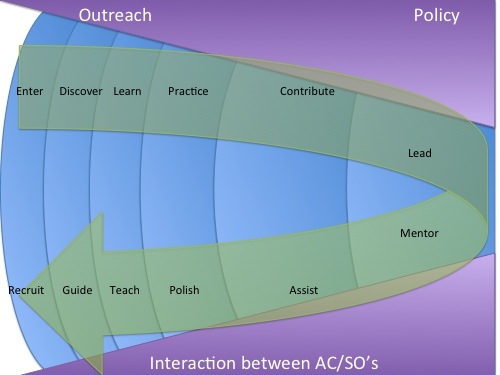
first, another Mikey Picture. this one highlights an idea that is emerging for me, but not quite fully-baked. i think one key piece that's missing from the current policy process is an orderly way to bring in New Blood. so our current crop of PDP participants is "graduating" to other tasks (constituency-leadership, new-jobs-with-applicants, expert working-groups, whatever) but we aren't filling in the gaps they leave with new people who are well-prepared to take up the slack. with that in mind, here's my Revision Zero picture of the on-ramp for new participants and the off-ramp for those of us who want to wind down a little bit. there are some things i don't like, but this is close enough for jazz.
[]
it seems to me that we could see a lot of benefit from building a deeper pool of people in the "contribute" and "lead" layers of all AC/SOs if we paid more attention to the onramp for new folks (enter -> discover -> learn -> practice), and take better advantage of the old-timers by having offering corresponding tasks that they could help with as they wind down (recruit new people, guide them into the parts of ICANN that might interest them, help them learn the ropes, help them polish their early efforts, assist them as they contribute, and mentor the leadership layer).
it also seems to me that there's a completely blurry continuum between the "outreach" effort and the "policy" effort that's being missed right now. my sense is that currently the outreach folks don't really know much about the policy side and thus aren't meeting with much success in bringing people on board in a way that they're ready to jump into policy-making. meanwhile, i think the policy side is being starved for resources (and not taking best advantage of the resources that are already here). some kind of blending of these two functions might be a way to beef up that pool of contributors and leaders. i think this could be cheap, and rewarding for everybody.
note that this picture isn't just aimed at the GNSO. and to that point i think it would be helpful if we got better that cross-organizational stuff. again, i think we're under-utilizing our old-timers. getting better at the cross-organizational stuff could also be cheap/fun.
second reaction, since i've been on all the WGs you mention Alan (and had a chair role in a couple). i think the WG process has gotten a LOT better as the GNSO has settled into the new PDP that came out of the last Review. the trouble is that these changes take time to take hold, and we're only now starting to see our first complete PDPs out of that new process. IRTP, Locking, Thick Whois are good examples of pretty-rapid, pretty-good efforts. i like those ones where the Council and Board votes are unanimous.
big point: don't be too quick to "fix" the PDP just yet -- that's like overwatering a garden or over-pruning a bonsai tree. let the core process mature a little bit more. pay more attention to that which surrounds that core policy-making activity for now. plenty of room for improvement there.
Vertical Integration was tough. a lot of you were on it. Roberto and i co-chaired it. i think that PDP is an exception that proves a few of the rules. here are the rules it proved for me:
- charter PDPs carefully. ambiguities in the VI charter meant that we had a bit of a hill to climb before we could really even get under way. a lot of our energy was spent trying to out-guess the Board, and the Council's reaction to the Board's decisions. it felt to me like a double-blind poker game sometimes. i had a tough time chairing Fast Flux too -- again, the charter wasn't very good. i wrote a pretty detailed discussion about the FFlux charter which you can read here -- <http://haven2.com/FF-observations.pdf>http://haven2.com/FF-observations.pdf (note: this was written in 2008, so while there are good ideas in there, some things have changed since then -- but there's lots of role/responsibility discussion that still applies today).
- protect the schedule. i'm still convinced we could have arrived at consensus (or rough consensus) in VI, had we not been jerked around on our schedule the way we were. this is a lesson that generalizes nicely to the whole new-gTLD program (by the way, that PDP left a lot to be desired in terms of implementation detail, no?). i think we (all of us) have got a lot of lessons to learn about how the schedule of the new gTLD program was managed. expectations are all over the map. it remains, to this very day, a source of conflict. my view is that PDPs are especially vulnerable to schedule-pressure because it cuts off an important "let's-take-time-to-figure-this-out" premise that underlies consensus decision-making. a similar impact to the house-limit on the state of play in a casino.
- keep the "layers" clear. i share the view that the bottom of the the bottom-up process ought to be where the rigorous discussions, leading to precise language, ought to take place. non-consensus ("representational") layers above (e.g. GNSO Council and Board) should either say "yes, good job" or "no, try again" but i don't think they are as well equipped to actually dive in and chew on the details. i think we tend to get into trouble when we deviate from that approach. final VI point -- the Board really surprised me when it gave us that really-short (2-week) deadline at the end of VI and then took the decision upon itself when we said we couldn't get done that fast. while i support the Board's decision, i'm not sure it's a real good one.
see? all that stuff off my chest and now there's more oxygen available for our conference call. thanks for your points Alan. maybe some of the others want to a) add on to this thread or b) ask more questions?
mikey
On Aug 7, 2013, at 10:39 AM, Alan Greenberg <<mailto:alan.greenberg@mcgill.ca>alan.greenberg@mcgill.ca > wrote:
We'll follow up with something that is more than just my opinion, but here goes with some of my thoughts.
1. There is little question that the current PDP can work well (ie all sides represented in the process and sound balanced policy as an outcome) in some instances. I think the current IRTP PDPs and Lock are fine illustrations. All parties working in good faith to find a common ground.
2. Vertical Integration is one of the PDPs that attracts the most attention. Some people think that a deadlock is a reasonable outcome, given that it highlights the issues and punts to the Board to make the decision. Other feel the Board should never need to make such a decision, and at best (and I am paraphrasing one Board member during the Durban ATRT-Board interaction) the Board should take an interim do-no-harm decision and then push back to the GNSO.
3. You know I will raise PEDNR as another example. It took far too long to produce relatively little. I personally think that it was a very poor use of time and did not meet the original goals and is a good example of the inability to attract sufficient non-contracted parties to a PDP unless it is very emotionally charged.
4. If we were to (heaven forbid) re-do the new gTLD policy using the current rules, would be any better at getting something that is not mired in the controversy of the current process.
The bottom line is that ICANN has a number of responsibilities but setting policy for the gTLD space is the one that it spends the most time on and is essentially a make-or-break function for the organization. Can we rely on the GNSO PDP to make sound policy representing the balanced needs of all stakeholders, both present and not present, and in the public interest?
Alan
At 07/08/2013 09:45 AM, Mike O'Connor wrote:
hi all,
could somebody unpack this a little bit? "whether the current GNSO PDP process satisfies the needs of the multi stakeholder model and Internet users" is a pretty broad topic (to put it mildly). presuming that this is going to be a 1-hour call, 90 minutes at most, i would find it helpful if the ATRT2 could come up with 3-4 questions you would like us to think about and build an agenda from there.
thanks,
mikey
On Aug 7, 2013, at 8:03 AM, Alice Jansen <<mailto:alice.jansen@icann.org>alice.jansen@icann.org > wrote:
Dear All, It is my understanding that my colleague Charla has been touched with you to schedule a call with the Second Accountability & Transparency Review Team (ATRT2). The ATRT2's activities are focused on paragraph 9.1 of the AoC where ICANN commits to maintain and improve robust mechanisms for public input, accountability, and transparency so as to ensure that the outcomes of its decision-making will reflect the public interest and be accountable to all stakeholders. As part of its mandate, the ATRT has decided to review the effectiveness of ICANN Generic Names Supporting Organization (GNSO) Policy Development Process (PDP) and so determine whether the current GNSO PDP process satisfies the needs of the multi stakeholder model and Internet users. Given your experience and expertise, the ATRT2 is interested in hearing your thoughts and wishes you to share your unique perspective with them. The ATRT2 has a face-to-face meeting scheduled for next week (141516 August) in Los Angeles. Would you be available - tentatively on Wednesday, 14 August - to join their session remotely? Please confirm your availability via <http://www.doodle.com/x9nk6czhz2exvsyh>http://www.doodle.com/x9nk6czhz2exvsyh by Thursday, 8 August COB. The Review Team has received your request for preparatory materials. Rest assured that we will provide you with more information as soon as available. I look forward to reading your doodle poll entries and thank you for your help. Please let me know if you have any questions or concerns. Thanks Very best regards Alice ---- Alice Jansen Strategic Initiatives Manager ICANN Rond Point Schuman 6, Bt.1 B-1040 Brussels, Belgium Office: <tel:%2B32%20289%20474%2003>+32 289 474 03 Mobile: <tel:%2B32%204%2073%2031%2076%2056>+32 4 73 31 76 56 Skype: alice_jansen_icann Email: <mailto:alice.jansen@icann.org>alice.jansen@icann.org
PHONE: <tel:651-647-6109>651-647-6109, FAX: <tel:866-280-2356>866-280-2356, WEB: <http://www.haven2.com/>www.haven2.com, HANDLE: OConnorStP (ID for Twitter, Facebook, LinkedIn, etc.)
PHONE: <tel:651-647-6109>651-647-6109, FAX: <tel:866-280-2356>866-280-2356, WEB: <http://www.haven2.com>www.haven2.com, HANDLE: OConnorStP (ID for Twitter, Facebook, LinkedIn, etc.)
Content-Type: image/jpeg; name="2e11bd8.jpg"; x-mac-type=4A504547; x-mac-creator=4A565752 Content-ID: <.0> X-Attachment-Id: d1614b4666f98c90_0.1