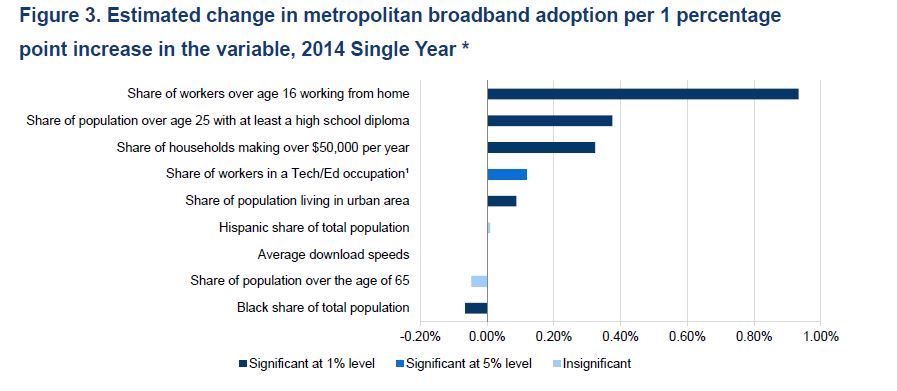
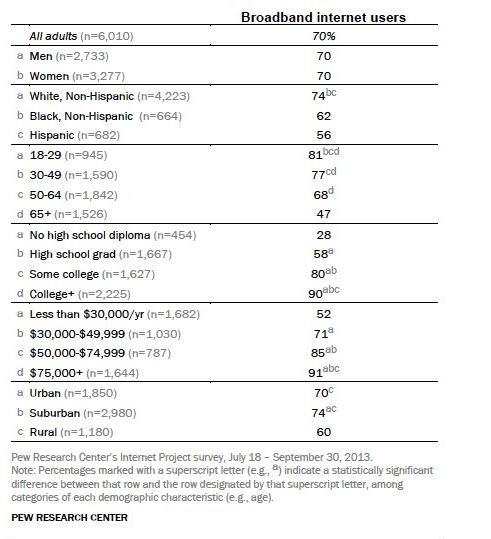
Thanks Joly The study identify that plus 65 and Black Americans are the two groups have negative growth rates Attached screen capture Also this report *Pew Research Center survey statistics on broadband adoption, Oct 2015http://www.pewinternet.org/fact-sheets/broadband-technology-fact-sheet/ <http://www.pewinternet.org/fact-sheets/broadband-technology-fact-sheet/>* Attached screen capture This chart includes the rural rates in the US 60 per cent rural No stats on Native Americans Glenn Glenn McKnight mcknight.glenn@gmail.com skype gmcknight twitter gmcknight . On Mon, Dec 7, 2015 at 3:27 PM, Joly MacFie <joly@punkcast.com> wrote:
http://www.brookings.edu/~/media/Research/Files/Reports/2015/12/07-broadband...
Until now, public, private, and civic leaders have frequently concentrated on broadband adoption at a national or international scale, looking at how rates vary across large segments of the population.5 However, new survey questions from the U.S. Census Bureau enable analysis at the metropolitan scale, creating new ways to measure and understand where America falls short in getting people online. This subnational approach is especially important because local and state governments play a lead role in guiding Internet policy, including infrastructure deployment, public outreach, skills development, and affordability programs.6 This brief uses 2013 and 2014 American Community Survey data to track current and changing broadband adoption rates at the metropolitan scale, while using a combination of other Census and Internet speed data to model what factors affect metropolitan adoption rates. In turn, the results of this analysis have clear implications for efforts to address the significant gaps in American Internet adoption.
-- --------------------------------------------------------------- Joly MacFie 218 565 9365 Skype:punkcast -------------------------------------------------------------- -
_______________________________________________ As an Internet Society Chapter Officer of the North American region you are automatically subscribed to this list, which is regularly synchronized with the Internet Society Chapter Portal (AMS): https://portal.isoc.org