Communication to ICANN GC

Hello All, In connection with a discussion that took place on yesterday's CPWG call, I decided to send the following communication to ICANN's General Counsel in an individual capacity. Best regards, Michael From: Michael Palage Sent: Wednesday, August 23, 2023 4:13 PM To: John Jeffrey Subject: Anti-Trust/Competition Concern wrt Transfer Policy Review PDP WG (22-Aug-2023 Call) Hello John, I would like to bring to your attention some concerns about the substance of yesterday's Transfer Policy Review PDP WG. Although I raised this concern during today's At-Large Consolidated Policy Working Group (CPWG), this comment is being submitted in an individual capacity. During yesterday's call registrars and registries were engaged in discussions regarding registry pricing (both floors and ceilings) in connection with ICANN Approved Transfers. A copy of the recording is available here - https://community.icann.org/display/TPRPDP/2023-08-22+Transfer+Policy+Review... Based on the portions of the call that I listened to live, I think ICANN staff did an appropriate job walking a very fine line when they referenced fees, including I recall a suggestion to remove the fee reference from the existing policy. However, I believe there were multiple references to fee minimums and caps imposed by Registries that were concerning, especially when enforced via an ICANN policy document. Recently, I have been active in other standards bodies and trade associations. I have noticed a growing best practice of these organizations to include a standard reference to the organization's anti-trust policy at the beginning of most calls/events. Therefore, I would like to propose the following action items: * I do not believe that ICANN has a public Anti-Trust/Competition policy. My apologies if I have somehow missed this. If one does exist I would greatly appreciate a pointer to this document. If one does not exist, then ICANN should strongly consider developing a public Anti-Trust / Competition policy. * I believe the standard ICANN preamble text that is read before each session/call (e.g. "Those who take part in the ICANN multistakeholder process are to comply with the expected standards of behavior" be amended to include a specific reference to the Anti-Trust / Competition policy when one is adopted. * It would seem advisable for someone from ICANN legal to monitor these calls when the agenda specifically envisions a discussion of fees as it did today. [cid:image001.png@01D9D5DD.0EA5B5D0] Best regards, Michael

Dear Michael, After listened to the recordings from the GNSO-TPR and the CPWG calls, I (still) have some problem understanding the ICANN Approved transfers and the Anti Trust questions you rise. The present policy has a fixed fee (USD 50,000) for transfers of >50,000 domain name per TLD. The WG has in several meeting discussed removing this fee in the revisited policy. It is worth noticing that the present policy was defined before the opening of the new gTLDs. My understanding is that there is some consensus that if there should be a fee, the fee should be set by the registry operator. ICANN Approved transfers has two main categories: * Voluntary agreed transfers that falls under the definition of ICANN approved transfers. * Involuntary transfers that falls under the definition of ICANN approved transfers. A typical scenario for a voluntary agreed transfers is when a registrar (A) has acquired another registrar (B) and thereby want to transfer the domain names to the accreditation(s) of registrar A. Registrar A will do the calculation whether an ICANN bulk transfer will be beneficial based on the volume (and policy) and the fees set by the gTLDs. The alternative is to transfer the domain names in a regular inter-registrar transfer process (get auth codes, initiate the transers etc). A typical involuntary transfers is when a registrar has lost their accreditation (RAA) or the Registry Registrar Agreement(s) is terminated. In these scenarios, the domain names will be without a sponsorship, hence "someone" has to take the work to sponsor the namespace in question. Further, in these involuntary scenarios there often will be lack of support from the "losing" registrar. The discussions connected to involuntary transfers have touched "who should pay" the Registry operator(s) (ICANN or the selected registrar that takes the responsibility to get the domain name sponsored) and what should it cost (a fixed fee – set by the Registry Operator(s), or "cost recovery"). I have problems seeing the above as relevant in an Anti Trust discussion connected to ICANN Approved transfers. For the domain name holders, it is important that their domain names get a sponsorship. Regards, Steinar Grøtterød From: CPWG <cpwg-bounces@icann.org> on behalf of mike palage.com via CPWG <cpwg@icann.org> Date: Thursday, 24 August 2023 at 13:57 To: cpwg@icann.org <cpwg@icann.org> Subject: [CPWG] Communication to ICANN GC Hello All, In connection with a discussion that took place on yesterday’s CPWG call, I decided to send the following communication to ICANN’s General Counsel in an individual capacity. Best regards, Michael From: Michael Palage Sent: Wednesday, August 23, 2023 4:13 PM To: John Jeffrey Subject: Anti-Trust/Competition Concern wrt Transfer Policy Review PDP WG (22-Aug-2023 Call) Hello John, I would like to bring to your attention some concerns about the substance of yesterday’s Transfer Policy Review PDP WG. Although I raised this concern during today’s At-Large Consolidated Policy Working Group (CPWG), this comment is being submitted in an individual capacity. During yesterday’s call registrars and registries were engaged in discussions regarding registry pricing (both floors and ceilings) in connection with ICANN Approved Transfers. A copy of the recording is available here – https://community.icann.org/display/TPRPDP/2023-08-22+Transfer+Policy+Review... Based on the portions of the call that I listened to live, I think ICANN staff did an appropriate job walking a very fine line when they referenced fees, including I recall a suggestion to remove the fee reference from the existing policy. However, I believe there were multiple references to fee minimums and caps imposed by Registries that were concerning, especially when enforced via an ICANN policy document. Recently, I have been active in other standards bodies and trade associations. I have noticed a growing best practice of these organizations to include a standard reference to the organization’s anti-trust policy at the beginning of most calls/events. Therefore, I would like to propose the following action items: * I do not believe that ICANN has a public Anti-Trust/Competition policy. My apologies if I have somehow missed this. If one does exist I would greatly appreciate a pointer to this document. If one does not exist, then ICANN should strongly consider developing a public Anti-Trust / Competition policy. * I believe the standard ICANN preamble text that is read before each session/call (e.g. “Those who take part in the ICANN multistakeholder process are to comply with the expected standards of behavior” be amended to include a specific reference to the Anti-Trust / Competition policy when one is adopted. * It would seem advisable for someone from ICANN legal to monitor these calls when the agenda specifically envisions a discussion of fees as it did today. [cid:image001.png@01D9D5DD.0EA5B5D0] Best regards, Michael

Hello Steinar, So we are in agreement that protecting registrants should be a focal point of our work, although I respectfully disagree with many of your other points which I will attempt to address below. However, at the end of the day, it is not your opinion or my opinion that matters, but the legal opinion of ICANN's general counsel that matters. As I mentioned in my original email I have been actively involved with a number of trade associations and standards bodies where anti-trust recitals are read at the beginning of each call, much like the ICANN standards of behavior. Even as an observer on Tuesday's call, I felt uncomfortable with the discussion of pricing by Registrars and Registries. Consistent with my professional experience and the best practices of other organizations that I participate in, I directed my concerns to the appropriate party. The easiest path for me would be to say nothing and allow friends and colleagues to potentially dig themselves into a deeper hole. The more evil path would have been for me to report these exchanges to relevant competition authorities. I chose what I thought was the best path for ICANN and the preservation of the multi-stakeholder model, and did so after initially raising this concern on the CPWG call. Yes, I am keenly aware of the current policy and its origins, as well as the genesis of the original transfer policy. As the original chair of the Registrar Consistency, I helped convene a meeting in Reston back in 2000 where the FBI attended and gave us a briefing on domain name thefts that were taking place through loopholes in the newly introduced competitive registrar marketplace. The $50,000 fee set forth in the current ICANN policy document, was conceived during a time when ICANN regularly included pricing in their Registry Agreement. However, as the ICANN community is aware, ICANN has made a conscious decision to remove pricing from the baseline registry agreement. The only exception to this rule I believe is the .COM Registry Agreement, and that is because Verisign's .COM TLD is special. As the United States Department of Justice, Anti-Trust Division stated in 2008 "the creation of additional gTLDs is unlikely to constrain the exercise of market power by existing TLDs, especially the .com registry operated by Verisign." See https://www.icann.org/en/system/files/files/baker-to-dengate-thrush-18dec08-... The point I am trying to make is that just because pricing was previously included in an ICANN policy does not make it okay for competitors (some of which are vertically integrated) to discuss setting Registry pricing (floors and ceilings). Even more problematic was at the end of the call when I recall there being a reference to the potential applicability of this work in connection with BTAPPA transfers. I believe it would be constructive to expand on BTAPPA transfers because I believe they provide a roadmap for how the WG should proceed to minimize legal risk. Interesting trivia fact for you and the rest of the CPWG mailing list. As an external consultant to CSC, I worked with Jeff Neuman to implement this first approved RSEP, see https://www.icann.org/en/system/files/files/neulevel-request-25sep06-en.pdf What is very interesting is that if you go back and read this RSEP, NeuLevel specifically called out in the RSEP the fees it would charge Registrars, e.g. floor of a $1,000 and a maximum of $0.20 per domain name. However, in reviewing several recent BTAPPA RSEPS, I could find no specific reference to fees. I do not think this is a coincidence but rather by design. So my personal advice to you and Lutz which I will share with the entire CPWG next week is as follows. Consistent with current ICANN best practices, the transfer policy should be updated to remove any reference to Registry pricing. This would align with current BTAPPA transfers where Registries are able to set their price accordingly. In the interest of openness, transparency, and predictability ICANN should require Registries to post these fees. If a Registrar believes that a Registry Operator is abusing its exclusive control over that TLD, it is free to reference that concern to an appropriate competition authority. Perhaps they might even want to copy ICANN's own economist, Roberto Gustavo Peña. In closing, it is because of these types of market dynamics that I continue to advocate for a comprehensive domain name economic marketplace analysis and why the exemption of Verisign in connection with .COM and .NET from this standard Registry Operator provision is so problematic. Best regards, Michael From: Steinar Grøtterød <steinar@recito.no> Sent: Thursday, August 24, 2023 11:26 AM To: mike palage.com <mike@palage.com>; CPWG <cpwg@icann.org> Subject: Re: [CPWG] Communication to ICANN GC Dear Michael, After listened to the recordings from the GNSO-TPR and the CPWG calls, I (still) have some problem understanding the ICANN Approved transfers and the Anti Trust questions you rise. The present policy has a fixed fee (USD 50,000) for transfers of >50,000 domain name per TLD. The WG has in several meeting discussed removing this fee in the revisited policy. It is worth noticing that the present policy was defined before the opening of the new gTLDs. My understanding is that there is some consensus that if there should be a fee, the fee should be set by the registry operator. ICANN Approved transfers has two main categories: * Voluntary agreed transfers that falls under the definition of ICANN approved transfers. * Involuntary transfers that falls under the definition of ICANN approved transfers. A typical scenario for a voluntary agreed transfers is when a registrar (A) has acquired another registrar (B) and thereby want to transfer the domain names to the accreditation(s) of registrar A. Registrar A will do the calculation whether an ICANN bulk transfer will be beneficial based on the volume (and policy) and the fees set by the gTLDs. The alternative is to transfer the domain names in a regular inter-registrar transfer process (get auth codes, initiate the transers etc). A typical involuntary transfers is when a registrar has lost their accreditation (RAA) or the Registry Registrar Agreement(s) is terminated. In these scenarios, the domain names will be without a sponsorship, hence "someone" has to take the work to sponsor the namespace in question. Further, in these involuntary scenarios there often will be lack of support from the "losing" registrar. The discussions connected to involuntary transfers have touched "who should pay" the Registry operator(s) (ICANN or the selected registrar that takes the responsibility to get the domain name sponsored) and what should it cost (a fixed fee - set by the Registry Operator(s), or "cost recovery"). I have problems seeing the above as relevant in an Anti Trust discussion connected to ICANN Approved transfers. For the domain name holders, it is important that their domain names get a sponsorship. Regards, Steinar Grøtterød From: CPWG <cpwg-bounces@icann.org<mailto:cpwg-bounces@icann.org>> on behalf of mike palage.com via CPWG <cpwg@icann.org<mailto:cpwg@icann.org>> Date: Thursday, 24 August 2023 at 13:57 To: cpwg@icann.org<mailto:cpwg@icann.org> <cpwg@icann.org<mailto:cpwg@icann.org>> Subject: [CPWG] Communication to ICANN GC Hello All, In connection with a discussion that took place on yesterday's CPWG call, I decided to send the following communication to ICANN's General Counsel in an individual capacity. Best regards, Michael From: Michael Palage Sent: Wednesday, August 23, 2023 4:13 PM To: John Jeffrey Subject: Anti-Trust/Competition Concern wrt Transfer Policy Review PDP WG (22-Aug-2023 Call) Hello John, I would like to bring to your attention some concerns about the substance of yesterday's Transfer Policy Review PDP WG. Although I raised this concern during today's At-Large Consolidated Policy Working Group (CPWG), this comment is being submitted in an individual capacity. During yesterday's call registrars and registries were engaged in discussions regarding registry pricing (both floors and ceilings) in connection with ICANN Approved Transfers. A copy of the recording is available here - https://community.icann.org/display/TPRPDP/2023-08-22+Transfer+Policy+Review... Based on the portions of the call that I listened to live, I think ICANN staff did an appropriate job walking a very fine line when they referenced fees, including I recall a suggestion to remove the fee reference from the existing policy. However, I believe there were multiple references to fee minimums and caps imposed by Registries that were concerning, especially when enforced via an ICANN policy document. Recently, I have been active in other standards bodies and trade associations. I have noticed a growing best practice of these organizations to include a standard reference to the organization's anti-trust policy at the beginning of most calls/events. Therefore, I would like to propose the following action items: * I do not believe that ICANN has a public Anti-Trust/Competition policy. My apologies if I have somehow missed this. If one does exist I would greatly appreciate a pointer to this document. If one does not exist, then ICANN should strongly consider developing a public Anti-Trust / Competition policy. * I believe the standard ICANN preamble text that is read before each session/call (e.g. "Those who take part in the ICANN multistakeholder process are to comply with the expected standards of behavior" be amended to include a specific reference to the Anti-Trust / Competition policy when one is adopted. * It would seem advisable for someone from ICANN legal to monitor these calls when the agenda specifically envisions a discussion of fees as it did today. [cid:image001.png@01D9D685.6CDC6D80] Best regards, Michael

On Thu, Aug 24, 2023 at 3:17 PM mike palage.com via CPWG <cpwg@icann.org> wrote: So we are in agreement that protecting registrants should be a focal point
of our work,
Some of "us", that is . Others see such a corrupt consensus as mission creep of the highest order. As usual. ALAC has no mandate and thus no standing to protect the interest of registrants. Anyone checking the bylaws will notice that fully half of the GNSO is dedicated to representing the interests of various kinds of registrants. They don't need ALAC as a booster, ALAC has its own unique mandate and community. With so much energy spent on the bylaw-infringing protection of registrants, no wonder so little gets done on behalf of non-registrant end-users. This disease has, does and will continue to inhibit ALAC from putting all energies and resources into serving its bylaw mandate. If ALAC were doing its job, anyone with a conflict of interest -- making money in the creation, buying or selling of domains -- ought to be disqualified from At-Large decision making. There is already so much self-dealing within ICANN; ALAC could be an oasis of policy ethics but actively chooses not to. Let alone focal point, prices of Internet domains are no business of ALAC's mandated constituency. I have yet to hear ANY evidence, let alone compelling evidence, that domain pricing is an ALAC issue. Arguably, ALAC's only concern should be that ICANN fees must be sufficient to allow it to understand the needs of end users, enact complementary policies, provide education and enforce protections. And if that means fees that are higher than registrants want, well that's too bad, this becomes an area where end-user interests conflict with those of registrants and the side for which ALAC must advocate is quite explicit. Pity the diversion of appropriate focus is so predictable. At least it's spoken out loud with no attempt to hide. - Evan
Evan, I am keenly aware of the remit of ALAC under Section 12.2(d)(i) of the ICANN bylaws. However, I do not view the interests of Internet end users and Registrants as being mutually exclusive. I have multiple domain names and email addresses, some of which are purely for business purposes and others purely personal. I have enjoyed participating in CPWG calls for years because I believe they give some of the best objective reviews of the issues being discussed within the community. Do I always agree with them, no, but there is much less spin than other stakeholder groups within the ICANN community. I FULLY agree with your comments about ICANN funding, in fact, I raised some of these concerns in connection with the Verisign .NET registry agreement renewal. During my time on the ICANN Board (2003-2006) ICANN staff (Paul Twomey, John Jeffrey and Kurt Pritz) were instrumental in changing the original ICANN funding model. I had significant concerns then, and I believe those concerns have been validated in hindsight based on current trends within the industry. For those non-dinosaurs on this mailing list, allow me to provide an “extensive” historical context. ICANN currently operates on what can roughly be described as a tax and spend model. ICANN imposes a mix of fixed and variable fees on Registrars and Registries. In connection with Registrars, they pay an annual $4,000 accreditation fee and a quarterly variable fee ($120/$370 depending upon the domain names under management) and a per domain name ICANN transaction fee of approximately $0.18, see https://static.sched.com/hosted_files/icann76/e0/ICANN76%20Being%20an%20ICAN.... On the Registry side, the vast majority (but not all) of Registries pay ICANN a $25,000 annual fixed fee, and then a $0.25 per domain name transaction fee for domain names transactions in excess of 50,000. There are a couple of exceptions to this rule of thumb, the most glaring being Verisign which pays ICANN approximately $11 million annually above and beyond the baseline requirements in the standard Registry Agreement in connection with .COM and .NET. So back of the napkin math, the vast majority of ICANN’s 140 million dollar budget comes from these ICANN fees imposed on contracting parties. Prior to implementing this transactional tax and spend model, ICANN operated on what I would characterize as a cost recovery model. ICANN would collect fixed accreditation fees from Registrars and Registries and then impose a per domain name variable fee on Registrars to pay for the previous year’s approved budget. There was a tiered pricing structure for Registries based on the number of domain names under management, see Paragraph 3.14 of the baseline non-sponsored registry agreement, see https://www.icann.org/en/registry-agreements/multiple/proposed-unsponsored-t.... My recollection from the 2003-2005 time frame was that Verisign and Afilias were each paying ICANN approximately $127,000 annually for the operation of the .COM, .NET and .INFO TLDs because of the fee caps provision in Paragraph 3.14.4. On a quarterly basis, ICANN would then impose a per domain name fee on Registrars based upon their domain names under management to collect the remainder of the annual budget. As the number of domain names was regularly increasing during this time, this variable fee fluctuated but generally trended down. Now there were a couple of problems with this original funding model, the biggest being that ICANN was beholden to getting the annual approval of 2/3 of the accredited registrars (based on market share) for the fees ICANN charged them. During this time Registrar fees were the vast majority of the fees collected by ICANN, as Verisign was only paying ICANN approximately a quarter of a million dollars per year as the Registry Operator of the .COM and .NET TLDs. If ICANN did not get the annual approval from Registrars, ICANN would quickly become insolvent as an organization. While I have had my fair share of disagreements with Kurt Pritz over the years, it generally fell upon his shoulders during this time to corral the registrars into approving the budget/fees. To this day, that probably remained one of the most difficult tasks ICANN staff EVER had to undertake and for that I do respect Kurt. For those wondering, why didn’t ICANN just collect the registrar's fees from the Registries. Simply put it did not have the contractual authority to do so. To ICANN’s credit, ICANN has amended the baseline registry agreement so that Paragraph 6.3(a) now provides ICANN the ability to collect a variable registry fee via the Registry Operators if the Registrars do not approve the budget, see https://itp.cdn.icann.org/en/files/registry-agreements/base-registry-agreeme.... Given this conundrum, ICANN was in a very precarious position at a time that it needed to raise its annual budget from 8.3 million to 15.8 million. I would encourage anyone interested to read this article from 2004 that gives an excellent historical analysis, see https://www.computerworld.com/article/2566345/icann-ends-malaysia-meeting-wi... At this time, many people per the ComputerWorld article thought that ICANN was going to seek additional funds from the ccTLDs. However, ICANN staff had decided a different plan. As part of its negotiations with the Registrars, ICANN raised the per domain name fee to $0.25 annually with the promise that the fee would be fixed annually. This was of economic interest to the Registrars as they could now pass this fee directly onto Registrants. Because the per domain name fee under the old model was variable, Registrars could not pass this “fixed” fee onto Registrants. Most Registrars today now include in their invoice to Registrants a per domain name ICANN fee. After ICANN began collecting substantial revenue from the Registries, ICANN lowered the Registrar variable fee to the current $0.18. During these negotiations, ICANN represented that they would be getting the additional fees associated with the doubling of ICANN’s annual budget from 7 to 15 million from gTLD registries, under the auspices of getting gTLD registries to pay their fair share. What ICANN staff did not share with the Registrars during these negotiations is what they would be giving up to get Registries to agree to these increased fees. As noted above the baseline non-sponsored registry agreement had fee caps on the prices Registries could charge Registrars, and the potential for a competitive rebid process in connection with each Registry term, see Paragraph 5.2 of the original non-sponsored registry agreement, https://www.icann.org/en/registry-agreements/multiple/proposed-unsponsored-t.... As evidenced by the Registry Agreements from 2005 onward, ICANN not only granted the ability for Registry Operators to increase their prices, but it also made every gTLD Registry Agreement a de facto monopoly in perpetuity - unless the Registry Operator is really stupid, see Paragraph 4.3 of the current baseline registry agreement, https://newgtlds.icann.org/sites/default/files/agreements/agreement-approved.... The other major concession that Registry Operators granted ICANN was the removal of the ICANN indemnification provision, see Section 4.6 of the original baseline non-sponsored Registry Agreement https://www.icann.org/en/registry-agreements/multiple/proposed-unsponsored-t... As a result of these ICANN funding and Registry Agreement changes, Verisign went from paying ICANN approximately $250,000 per year in connection with the operation of .COM and .NET, to Verisign paying ICANN over $55 million to operate the .COM and .NET registries. Today Verisign is paying ICANN in excess of 41 million annually to operate .COM, and in excess of $10 million annually to operate .NET. When you throw in the $4 million dollars annually of the Binding Letter of Intent that equates to 55 million dollars annually and that does not include the Registry fees (a couple of hundred thousand) associated with .NAME, .VERISIGN, and Verisign’s portfolio or defensive IDN TLDs. Now does anyone in the ICANN community find it odd that Verisign went from paying ICANN a couple of hundred thousand dollars annually in the early 2000s to over 55 million dollars annually today? Does anyone find it concerning that over 1/3 of ICANN’s total revenue is attributed to one company? Is anyone in the ICANN community concerned about how this financial dynamic could potentially impact the health and operation of the ICANN multistakeholder model? Now for the past 20-plus years, this has not been a problem because the zone files during this time have consistently increased. However, with a growing maturity in the domain name market, the industry as a whole has experienced a much lower growth rate. Most problematic for ICANN is the potential for the domain names under management to contract. While this is unlikely in the near foreseeable future, the trend long term does not bode well for ICANN especially as its costs continue to grow steadily. The removal of price caps from the Registry Agreement, with no potential for ICANN to periodically rebid the TLD Registry Agreement removes any downward pressure on that Registry Operator to constrain pricing. This is one of the reasons I so strenuously advocated in my .NET public comment period for ICANN to include Section 2.15 of the baseline registry agreement into the .NET Registry Agreement. This section states in relevant part that “[i]f ICANN initiates or commissions an economic study on the impact or functioning of new generic top-level domains on the Internet, the DNS or related matters, Registry Operator shall reasonably cooperate with such study, including by delivering to ICANN or its designee conducting such study all data related to the operation of the TLD reasonably necessary for the purposes of such study requested by ICANN or its designee.” This provision is missing from both the .NET and .COM registry agreements. Again I ask anyone “still” reading this email, do they find it a bit odd that a single entity controlling approximately 80% of the gTLD market share AND contributing over 1/3 of ICANN’s annual budget is one of the only gTLD Registry Operators not required to participate in an ICANN economic study? After reading the NameCheap IRP, I began accumulating publicly available pricing information from gTLDs and ccTLDs and I noticed a very disturbing trend. Specifically, the pricing on gTLDs appears to be rising substantially higher than ccTLDs. I found this interesting for a couple of reasons. ccTLDs and gTLDs provide the same technical functionality, and in several cases, ccTLDs are actually ran on the same backend infrastructure as gTLDs. While there are different policies that may impact pricing, the following graphic from Neustar’s .US bid package really hit home the divergent pricing on ccTLD and gTLDs, see https://ntia.gov/files/ntia/publications/technical_proposal_volume_3.pdf [A graph with different colored lines Description automatically generated] It is noteworthy that while .US domains I still believe are priced at $6.50, .COM is now $9.59, an almost $2 dollar increase in the approximately 5 years since this chart was published. So Evan here is my proposal to you. I am a big believer in wanting to be part of the solution as opposed to be part of the problem. Now if we both want to be part of the problem we can engage in a tit for tat email exchange what will likely get us nowhere. Alternatively, I would really like to tap your old ZDNET skillset to help expand my research into the growing disparity between ccTLD and gTLD pricing. As noted above, as a result of changes made back in the early 2000’s to the baseline registry agreements, ICANN’s current tax and spend model is heading for trouble as increasing gTLD prices will likely have an adverse impact on the number of domain names under management. While Registry Operators have the unfettered ability to raise their prices, ICANN is locked into what it can charge gTLD registries. Let me be VERY clear, I want to work with the ICANN community to help bring this information to the attention of the current ICANN Board. I believe we are confronted with a unique opportunity in the history of ICANN for this Board to critically analyze a number of issues which some ICANN staff have conveniently brushed under the rug in the past. Hopefully this is something that you and I can reach consensus on and collaborate together within ALAC. Best regards, Michael From: Evan Leibovitch <evan@telly.org> Sent: Friday, August 25, 2023 12:36 AM To: mike palage.com <mike@palage.com> Cc: Steinar Grøtterød <steinar@recito.no>; CPWG <cpwg@icann.org>; John Jeffrey <john.jeffrey@icann.org> Subject: Re: [CPWG] Communication to ICANN GC On Thu, Aug 24, 2023 at 3:17 PM mike palage.com<http://palage.com> via CPWG <cpwg@icann.org<mailto:cpwg@icann.org>> wrote: So we are in agreement that protecting registrants should be a focal point of our work, Some of "us", that is . Others see such a corrupt consensus as mission creep of the highest order. As usual. ALAC has no mandate and thus no standing to protect the interest of registrants. Anyone checking the bylaws will notice that fully half of the GNSO is dedicated to representing the interests of various kinds of registrants. They don't need ALAC as a booster, ALAC has its own unique mandate and community. With so much energy spent on the bylaw-infringing protection of registrants, no wonder so little gets done on behalf of non-registrant end-users. This disease has, does and will continue to inhibit ALAC from putting all energies and resources into serving its bylaw mandate. If ALAC were doing its job, anyone with a conflict of interest -- making money in the creation, buying or selling of domains -- ought to be disqualified from At-Large decision making. There is already so much self-dealing within ICANN; ALAC could be an oasis of policy ethics but actively chooses not to. Let alone focal point, prices of Internet domains are no business of ALAC's mandated constituency. I have yet to hear ANY evidence, let alone compelling evidence, that domain pricing is an ALAC issue. Arguably, ALAC's only concern should be that ICANN fees must be sufficient to allow it to understand the needs of end users, enact complementary policies, provide education and enforce protections. And if that means fees that are higher than registrants want, well that's too bad, this becomes an area where end-user interests conflict with those of registrants and the side for which ALAC must advocate is quite explicit. Pity the diversion of appropriate focus is so predictable. At least it's spoken out loud with no attempt to hide. - Evan

Dear Michael, thank you for your extensive analysis which, IMHO, is spot on. Many years ago I raised the point that with inflation being what it is, ICANN's costs are going to increase accordingly, thus ICANN's annual budget will not stop increasing just to keep the same level of services. All was indeed well when the domain name market kept on expanding, but it is a different kettle of fish when the market has matured. It sounds like tough negotiations gave rise to the ICANN transaction fee being set, but that was in USD back then. It would make much more sense, just like any tax revenue model, that the fee be set as a percentage of the base selling price of the domain. That is something which ICANN is going to need to consider as a matter of survival. As for the overwhelming market shares (and thus funding) of two actors, Verisign in the Registries and GoDaddy in the Registrars this is historical and I have no idea how this can be resolved. These two companies hold the key to ICANN's financial wellbeing. Kindest regards, Olivier On 26/08/2023 23:41, mike palage.com via CPWG wrote:
Evan,
I am keenly aware of the remit of ALAC under Section 12.2(d)(i) of the ICANN bylaws. However, I do not view the interests of Internet end users and Registrants as being mutually exclusive. I have multiple domain names and email addresses, some of which are purely for business purposes and others purely personal. I have enjoyed participating in CPWG calls for years because I believe they give some of the best objective reviews of the issues being discussed within the community. Do I always agree with them, no, but there is much less spin than other stakeholder groups within the ICANN community.
I *FULLY* agree with your comments about ICANN funding, in fact, I raised some of these concerns in connection with the Verisign .NET registry agreement renewal. During my time on the ICANN Board (2003-2006) ICANN staff (Paul Twomey, John Jeffrey and Kurt Pritz) were instrumental in changing the original ICANN funding model. I had significant concerns then, and I believe those concerns have been validated in hindsight based on current trends within the industry. For those non-dinosaurs on this mailing list, allow me to provide an “extensive” historical context.
ICANN currently operates on what can roughly be described as a tax and spend model. ICANN imposes a mix of fixed and variable fees on Registrars and Registries. In connection with Registrars, they pay an annual $4,000 accreditation fee and a quarterly variable fee ($120/$370 depending upon the domain names under management) and a per domain name ICANN transaction fee of approximately $0.18, see https://static.sched.com/hosted_files/icann76/e0/ICANN76%20Being%20an%20ICAN.... On the Registry side, the vast majority (but not all) of Registries pay ICANN a $25,000 annual fixed fee, and then a $0.25 per domain name transaction fee for domain names transactions in excess of 50,000. There are a couple of exceptions to this rule of thumb, the most glaring being Verisign which pays ICANN approximately $11 million annually above and beyond the baseline requirements in the standard Registry Agreement in connection with .COM and .NET. So back of the napkin math, the vast majority of ICANN’s 140 million dollar budget comes from these ICANN fees imposed on contracting parties.
Prior to implementing this transactional tax and spend model, ICANN operated on what I would characterize as a cost recovery model. ICANN would collect fixed accreditation fees from Registrars and Registries and then impose a per domain name variable fee on Registrars to pay for the previous year’s approved budget. There was a tiered pricing structure for Registries based on the number of domain names under management, see Paragraph 3.14 of the baseline non-sponsored registry agreement, see https://www.icann.org/en/registry-agreements/multiple/proposed-unsponsored-t.... My recollection from the 2003-2005 time frame was that Verisign and Afilias were each paying ICANN approximately $127,000 annually for the operation of the .COM, .NET and .INFO TLDs because of the fee caps provision in Paragraph 3.14.4. On a quarterly basis, ICANN would then impose a per domain name fee on Registrars based upon their domain names under management to collect the remainder of the annual budget. As the number of domain names was regularly increasing during this time, this variable fee fluctuated but generally trended down.
Now there were a couple of problems with this original funding model, the biggest being that ICANN was beholden to getting the annual approval of 2/3 of the accredited registrars (based on market share) for the fees ICANN charged them. During this time Registrar fees were the vast majority of the fees collected by ICANN, as Verisign was only paying ICANN approximately a quarter of a million dollars per year as the Registry Operator of the .COM and .NET TLDs. If ICANN did not get the annual approval from Registrars, ICANN would quickly become insolvent as an organization. While I have had my fair share of disagreements with Kurt Pritz over the years, it generally fell upon his shoulders during this time to corral the registrars into approving the budget/fees. To this day, that probably remained one of the most difficult tasks ICANN staff *_EVER_* had to undertake and for that I do respect Kurt.
For those wondering, why didn’t ICANN just collect the registrar's fees from the Registries. Simply put it did not have the contractual authority to do so. To ICANN’s credit, ICANN has amended the baseline registry agreement so that Paragraph 6.3(a) now provides ICANN the ability to collect a variable registry fee via the Registry Operators if the Registrars do not approve the budget, see https://itp.cdn.icann.org/en/files/registry-agreements/base-registry-agreeme....
Given this conundrum, ICANN was in a very precarious position at a time that it needed to raise its annual budget from 8.3 million to 15.8 million. I would encourage anyone interested to read this article from 2004 that gives an excellent historical analysis, see https://www.computerworld.com/article/2566345/icann-ends-malaysia-meeting-wi...
At this time, many people per the ComputerWorld article thought that ICANN was going to seek additional funds from the ccTLDs. However, ICANN staff had decided a different plan. As part of its negotiations with the Registrars, ICANN raised the per domain name fee to $0.25 annually with the promise that the fee would be fixed annually. This was of economic interest to the Registrars as they could now pass this fee directly onto Registrants. Because the per domain name fee under the old model was variable, Registrars could not pass this “fixed” fee onto Registrants. Most Registrars today now include in their invoice to Registrants a per domain name ICANN fee. After ICANN began collecting substantial revenue from the Registries, ICANN lowered the Registrar variable fee to the current $0.18.
During these negotiations, ICANN represented that they would be getting the additional fees associated with the doubling of ICANN’s annual budget from 7 to 15 million from gTLD registries, under the auspices of getting gTLD registries to pay their fair share. What ICANN staff did not share with the Registrars during these negotiations is what they would be giving up to get Registries to agree to these increased fees. As noted above the baseline non-sponsored registry agreement had fee caps on the prices Registries could charge Registrars, and the potential for a competitive rebid process in connection with each Registry term, see Paragraph 5.2 of the original non-sponsored registry agreement, https://www.icann.org/en/registry-agreements/multiple/proposed-unsponsored-t.... As evidenced by the Registry Agreements from 2005 onward, ICANN not only granted the ability for Registry Operators to increase their prices, but it also made every gTLD Registry Agreement a de facto monopoly in perpetuity - unless the Registry Operator is really stupid, see Paragraph 4.3 of the current baseline registry agreement, https://newgtlds.icann.org/sites/default/files/agreements/agreement-approved.... The other major concession that Registry Operators granted ICANN was the removal of the ICANN indemnification provision, see Section 4.6 of the original baseline non-sponsored Registry Agreement https://www.icann.org/en/registry-agreements/multiple/proposed-unsponsored-t...
As a result of these ICANN funding and Registry Agreement changes, Verisign went from paying ICANN approximately $250,000 per year in connection with the operation of .COM and .NET, to Verisign paying ICANN over $55 million to operate the .COM and .NET registries. Today Verisign is paying ICANN in excess of 41 million annually to operate .COM, and in excess of $10 million annually to operate .NET. When you throw in the $4 million dollars annually of the Binding Letter of Intent that equates to 55 million dollars annually and that does not include the Registry fees (a couple of hundred thousand) associated with .NAME, .VERISIGN, and Verisign’s portfolio or defensive IDN TLDs.
Now does anyone in the ICANN community find it odd that Verisign went from paying ICANN a couple of hundred thousand dollars annually in the early 2000s to over 55 million dollars annually today? Does anyone find it concerning that over 1/3 of ICANN’s total revenue is attributed to one company? Is anyone in the ICANN community concerned about how this financial dynamic could potentially impact the health and operation of the ICANN multistakeholder model?
Now for the past 20-plus years, this has not been a problem because the zone files during this time have consistently increased. However, with a growing maturity in the domain name market, the industry as a whole has experienced a much lower growth rate. Most problematic for ICANN is the potential for the domain names under management to contract. While this is unlikely in the near foreseeable future, the trend long term does not bode well for ICANN especially as its costs continue to grow steadily.
The removal of price caps from the Registry Agreement, with no potential for ICANN to periodically rebid the TLD Registry Agreement removes any downward pressure on that Registry Operator to constrain pricing. This is one of the reasons I so strenuously advocated in my .NET public comment period for ICANN to include Section 2.15 of the baseline registry agreement into the .NET Registry Agreement. This section states in relevant part that “[i]f ICANN initiates or commissions an economic study on the impact or functioning of new generic top-level domains on the Internet, the DNS or related matters, Registry Operator shall reasonably cooperate with such study, including by delivering to ICANN or its designee conducting such study all data related to the operation of the TLD reasonably necessary for the purposes of such study requested by ICANN or its designee.”
This provision is missing from both the .NET and .COM registry agreements. Again I ask anyone “still” reading this email, do they find it a bit odd that a single entity controlling approximately 80% of the gTLD market share AND contributing over 1/3 of ICANN’s annual budget is one of the only gTLD Registry Operators not required to participate in an ICANN economic study?
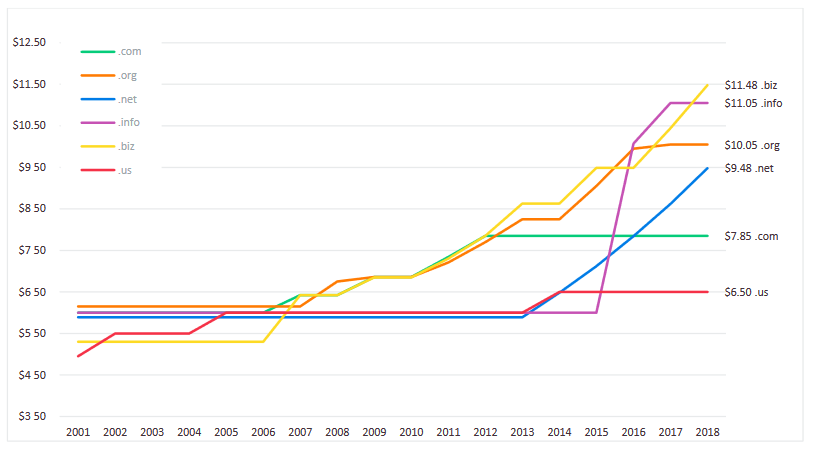
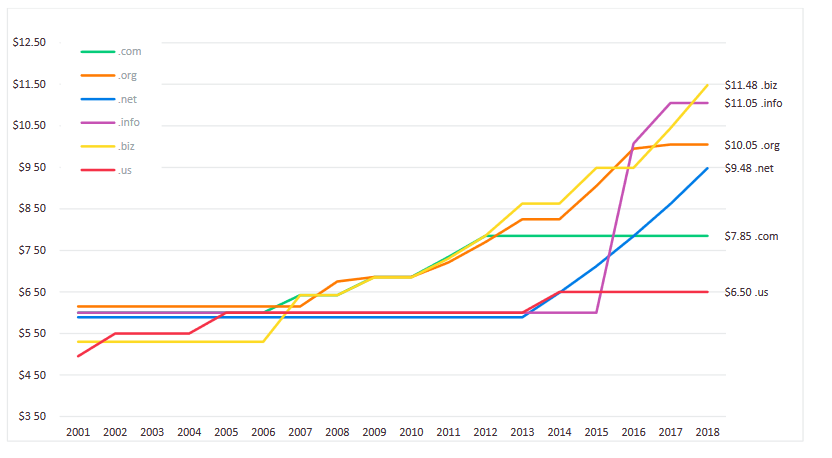
After reading the NameCheap IRP, I began accumulating publicly available pricing information from gTLDs and ccTLDs and I noticed a very disturbing trend. Specifically, the pricing on gTLDs appears to be rising substantially higher than ccTLDs. I found this interesting for a couple of reasons. ccTLDs and gTLDs provide the same technical functionality, and in several cases, ccTLDs are actually ran on the same backend infrastructure as gTLDs. While there are different policies that may impact pricing, the following graphic from Neustar’s .US bid package really hit home the divergent pricing on ccTLD and gTLDs, see https://ntia.gov/files/ntia/publications/technical_proposal_volume_3.pdf
A graph with different colored lines Description automatically generated
It is noteworthy that while .US domains I still believe are priced at $6.50, .COM is now $9.59, an almost $2 dollar increase in the approximately 5 years since this chart was published.
So Evan here is my proposal to you. I am a big believer in wanting to be part of the solution as opposed to be part of the problem. Now if we both want to be part of the problem we can engage in a tit for tat email exchange what will likely get us nowhere. Alternatively, I would really like to tap your old ZDNET skillset to help expand my research into the growing disparity between ccTLD and gTLD pricing. As noted above, as a result of changes made back in the early 2000’s to the baseline registry agreements, ICANN’s current tax and spend model is heading for trouble as increasing gTLD prices will likely have an adverse impact on the number of domain names under management. While Registry Operators have the unfettered ability to raise their prices, ICANN is locked into what it can charge gTLD registries.
Let me be VERY clear, I want to work with the ICANN community to help bring this information to the attention of the current ICANN Board. I believe we are confronted with a unique opportunity in the history of ICANN for this Board to critically analyze a number of issues which some ICANN staff have conveniently brushed under the rug in the past.
Hopefully this is something that you and I can reach consensus on and collaborate together within ALAC.
Best regards,
Michael
*From:* Evan Leibovitch <evan@telly.org> *Sent:* Friday, August 25, 2023 12:36 AM *To:* mike palage.com <mike@palage.com> *Cc:* Steinar Grøtterød <steinar@recito.no>; CPWG <cpwg@icann.org>; John Jeffrey <john.jeffrey@icann.org> *Subject:* Re: [CPWG] Communication to ICANN GC
On Thu, Aug 24, 2023 at 3:17 PM mike palage.com <http://palage.com> via CPWG <cpwg@icann.org> wrote:
So we are in agreement that protecting registrants should be a focal point of our work,
Some of "us", that is . Others see such a corrupt consensus as mission creep of the highest order.
As usual.
ALAC has no mandate and thus no standing to protect the interest of registrants. Anyone checking the bylaws will notice that fully half of the GNSO is dedicated to representing the interests of various kinds of registrants. They don't need ALAC as a booster, ALAC has its own unique mandate and community.
With so much energy spent on the bylaw-infringing protection of registrants, no wonder so little gets done on behalf of non-registrant end-users. This disease has, does and will continue to inhibit ALAC from putting all energies and resources into serving its bylaw mandate. If ALAC were doing its job, anyone with a conflict of interest -- making money in the creation, buying or selling of domains -- ought to be disqualified from At-Large decision making. There is already so much self-dealing within ICANN; ALAC could be an oasis of policy ethics but actively chooses not to.
Let alone focal point, prices of Internet domains are no business of ALAC's mandated constituency. I have yet to hear ANY evidence, let alone compelling evidence, that domain pricing is an ALAC issue. Arguably, ALAC's only concern should be that ICANN fees must be sufficient to allow it to understand the needs of end users, enact complementary policies, provide education and enforce protections. And if that means fees that are higher than registrants want, well that's too bad, this becomes an area where end-user interests conflict with those of registrants and the side for which ALAC must advocate is quite explicit.
Pity the diversion of appropriate focus is so predictable. At least it's spoken out loud with no attempt to hide.
- Evan
_______________________________________________ CPWG mailing list CPWG@icann.org https://mm.icann.org/mailman/listinfo/cpwg
_______________________________________________ By submitting your personal data, you consent to the processing of your personal data for purposes of subscribing to this mailing list accordance with the ICANN Privacy Policy (https://www.icann.org/privacy/policy) and the website Terms of Service (https://www.icann.org/privacy/tos). You can visit the Mailman link above to change your membership status or configuration, including unsubscribing, setting digest-style delivery or disabling delivery altogether (e.g., for a vacation), and so on.
-- Olivier MJ Crépin-Leblond, PhD http://www.gih.com/ocl.html
Hi Micheal, I greatly appreciate the length and thoughtfulness put into your email, as well as your offer. However I suspect that our approaches may be so radically different as to make collaboration difficult. As I describe my worldview of the domain-name landscape below, I invite any and all attempts to find common ground in seeking paths forward. You speak of the dot-com price increase of $2 over five years, and potential future increases as if they're a bad thing. I come from the opposite PoV, that they're way too cheap. The starting point of my solution is that retail domains should be at least $15 to $25, based on higher ICANN fees. The extra revenue generated by these fees would go toward abuse reduction, public education into using the Internet safely and effectively, as well as public oversight that has more substance and authority to it than ALAC was ever designed to provide. It would also compensate for the reduction in total domains, which is beneficial for a number of reasons. My rationale: To registrants using a domain for their legitimate business, communications or personal interest (going forward I will call them "domain consumers") , $15 a year is a miniscule part of the total cost of providing the infrastructure, content and marketing to maintain an Internet presence. If the benefits above were provided I think that most domain consumers would find that good value. (The public education component indicated above is bidirectional, requiring appropriate market research so that we know what the public wants and needs from Internet domains.) Of course, raising the price will also lower the volume of domain purchases and renewals, which I also think is a Very Good Thing. The status quo means that many sensible domain names are scooped up by speculators whose only "added value" is being in the queue first. I find the domain-resale industry, by and large, at the same ethical level as concert ticket scalpers. And the ticket-scalper analogy is very useful when you look at how ticket prices have skyrocketed for in-demand concerts. Far better for the artist to get the proceeds of that demand-induced price boost than the scalper. Higher domain prices will have negligible effect on domain consumers but I suspect it would have a significant effect on those keeping portfolios of speculative domains. Scores of domains that are of borderline value to speculators will be released back to the registry pools, making it less likely that new startups and other registrants have to resort to the rent-seeking resale market for a suitable domain. Even among existing domain consumers, there would be less need for defensive domains (if the extra fees were spent on fighting abuse) so they would benefit too. They would spend a little more per domain but would need fewer domains. An added bonus from higher fees could be a drop in the purchases of one-time "burner" domains obtained for the purpose of abuse. Of course, such a regime would be poison to today's ICANN because, as you said, it is financially self-interested (indeed dependent) on having as many extant domains as possible. I see it as spending the minimum possible in the public interest, using its resources to (a) support a governance infrastructure that is unwieldy and unaccountable by design and (b) promote its own growth by maximizing domain sales. (For instance, I have long held that the "Universal Acceptance" initiative is merely an elaborate marketing campaign designed to sell more domains in non-Latin scripts.) Higher fees mean fewer domains (though higher revenue from each) and probably even a smaller ICANN than now exists; I would also consider that to be a Good Thing. Of course maybe ICANN could find other revenue, from foundation grants and other sources that might make it less dependent on its derived industries for both governance and policies. I would welcome such a transition, along with the accompanying boost in accountability. Maybe even dues from public membership, that would allow people to actually vote for the Board again... ICANN's history has enabled entire industries to emerge with little purpose except to ultimately extract maximum value from domain consumers. These industries, through the GNSO, have acquired the ability to force the ICANN Board to enable policies friendly to them while public-interest views from governments and consumers are relegated to advisory roles. It's a very "inmates running the asylum" vibe, the very opposite of most organizations performing regulatory functions. One need look no further than ICANN's evolution from public Board elections, through a "Nominating Committee" that doesn't nominate (it appoints), to the sham "empowered community", to see how the power has shifted and how convoluted everything has become. It is for this reason that I bristle at those who already have voices through these other ICANN communities coming to ALAC with the "I'm an end-user too" justification. Sorry, but ALAC desperately needs more voices from those who have not and never will buy a domain, and fewer voices from insiders that know the game. At very least At-Large needs a conflict-of-interest policy that goes beyond mere disclosure. The current insider-heavy makeup is why ALAC serves to constantly react to the agendas of others rather than set its own from a purely end-user perspective. Those who know me can verify that these are not new ideas, they are long-held views that emerged more than a decade ago from my experiences in ALAC leadership. It's my belief that an ALAC that was truly serving its bylaw mandate, it would advocate for a domain pool that was smaller but more effective, and end-users that are better informed on how to use domains safely and efficiently. Cheers, - Evan PS: Don't get me started on the disparity between gTLDs and ccTLDs. ICANN has FOREVER had a responsibility to inform the public what the difference is. - How is dot-com different from dot-co? - Why is there still a dot-su TLD? - Is my use of bit.ly for URL shortening really sending my data through Libya? - Why can I buy a .me domain if I don't live in Montenegro? So much public confusion exists, yet ICANN has shirked its responsibility to address it.

On 27/08/2023 11:28, Evan Leibovitch via CPWG wrote:
You speak of the dot-com price increase of $2 over five years, and potential future increases as if they're a bad thing. I come from the opposite PoV, that they're way too cheap. The starting point of my solution is that retail domains should be at least $15 to $25, based on
Just a few points, Evan, Some registrars use a low first year registration fee as a loss-leader and that's why the $9 or below registration fee offers appear. The renewal fee iis typically higher. Not all registrars offer a low new registration fee.
Of course, raising the price will also lower the volume of domain purchases and renewals, which I also think is a Very Good Thing. The
The link between renewals and increased fees is counterintuitive. A higher renewal fee can encourage the registrant to consider the domain name to be worth renewing especially if they have renewed it for a few years previously. (The Sunk Cost fallacy.) The renewal rate of TLDs is also dependent on the economic conditions in country of the registrant. The .COM and other gTLDs may appear to be one single market but they are actually composite markets of a small global market and many country level markets. Even the business model of registrars affects renewal rates of domain names registered through those registrars. This talk of registration fees being too low is all well and good for people in the developed countries with good incomes but it puts those in underserved and developing countries at a serious disadvantage because, in real terms, the cost of a gTLD registration will be a higher percentage of the registrant's income.
status quo means that many sensible domain names are scooped up by speculators whose only "added value" is being in the queue first. I find the domain-resale industry, by and large, at the same ethical level as concert ticket scalpers. And the ticket-scalper analogy is very useful when you look at how ticket prices have skyrocketed for in-demand concerts. Far better for the artist to get the proceeds of that demand-induced price boost than the scalper.
Approximately 9% of the .COM is currently on sale (I run a full gTLD website/IP survey each month as part of the monthly HosterStats Registrars and Resellers report and it breaks down the gTLD websites by some categories. PPC and Sales are two of them.) The domain names that are on sale typically have a higher rate of non-renewal than ordinary domain names. There is a core of domain names that are on sale that will continually renew as they are considered premium domain names. For-sale domain names are often confused with undeveloped domain names that have been parked by the registrars or owners.
Higher domain prices will have negligible effect on domain consumers but I suspect it would have a significant effect on those keeping portfolios of speculative domains. Scores of domains that are of borderline value
It would primarily affect those with lower quality domain names but many of those lower quality domain names would be deleted after a year. Even with domain names parked for the PPC advertising, a similar deletion effect happens with non-performing domain names.
fewer domains. An added bonus from higher fees could be a drop in the purchases of one-time "burner" domains obtained for the purpose of abuse.
Much of this type of DNS Abuse has shifted to some new gTLDs where the first year reg fee is less than $5 or even around $1. The heavy discounting model of some new gTLDs has changed the economics of DNS Abuse. Ironically, it was the classic economic substitution effect where a new gTLD was chosen instead of a legacy gTLD by registrants. It wasn't quite the one envisaged by ICANN.
PS: Don't get me started on the disparity between gTLDs and ccTLDs. ICANN has FOREVER had a responsibility to inform the public what the difference is. - How is dot-com different from dot-co? - Why is there still a dot-su TLD? - Is my use of bit.ly <http://bit.ly> for URL shortening really sending my data through Libya? - Why can I buy a .me domain if I don't live in Montenegro?
The ccTLDs got a credibility boost in the mid to late 2000s when ICANN delayed taking any action on Domain Tasting until it was too late. Over 1,000,000,000 .COM domain names were registered and deleted during large-scale Domain Tasting period. Arguably, Domain Tasting created the appearance of a demand for new gTLDs because people could not register the domain names they wanted in .COM/NET/ORG as most of the good deleting domain names were being immediately reregistered by drop catcher registrars (the majority of ICANN registrars are still drop catch registrars that do not sell directly to the public). When there was legal action taken against some of the main registrars involved in Domain Tasting, Google decided to stop monetising these five day Add Grace Period domain names, and ICANN finally added a "restocking" fee on AGP deletions, the large-scale Domain Tasting business collapsed. Much of the demand for new gTLDs disappeared too but the ICANN train was trundling down the tracks to the 2012 round launch. ICANN's projections for the first year registration volume for the new gTLDs were badly wrong. Registrants in countries outside of the US shifted to their local ccTLD because they found that they could register the domain name they wanted in their local ccTLD. The effect of this was severe for the gTLDs in that some of the legacy gTLDs like .NET/ORG/BIZ/INFO are now at replacement level in various countries where the ccTLD is the first choice TLD. The new registrations in the local ccTLDs often outnumber those in .COM (locally) by 2:1 or more. The ccTLD regisries and registrars are often very good at catering for their own markets. I'm not sure how ICANN educating people about the differences between gTLDs and ccTLDs would be perceived in ccTLD markets. Education may be good but it is a big world. The typical registrant may not even know that ICANN exists. The ccTLD community might not be so eager to see ICANN intruding. For many of the developed ccTLD markets, it is way too late for ICANN to try anything like that. The people in some of the countries that are ccTLD-positive now consider their local ccTLD to be *their* TLD in a way that .COM is not. The Internet (the domain name registration part of it) went local. The main driver in .COM, and the other legacy gTLD markets is the US market as the .COM is, in reality, the de facto US ccTLD. The market changed but ICANN's reactive nature was too slow to adapt and that's why the more nimble ccTLDs took over their markets eventhough .COM is still the global king of TLDs. The antitrust issues are very important but the market has changed in the last few years and growth in .COM has almost plateaued for the last two years. Getting rid of speculation or PPC is not going to solve that. This isn't the 1990s market from which ICANN emerged. The decision to allow registries to own and operate registrars a few years ago may have unintentionally created some possible antitrust issues if pricing is being discussed amongst registrars and the registry's registrar(s) is part of such a conversation. Regards...jmcc -- ********************************************************** John McCormac * e-mail: jmcc@hosterstats.com MC2 * web: http://www.hosterstats.com/ 22 Viewmount * Domain Registrations Statistics Waterford * Domnomics - the business of domain names Ireland * https://amzn.to/2OPtEIO IE * Skype: hosterstats.com ********************************************************** -- This email has been checked for viruses by Avast antivirus software. www.avast.com

Let the record show I bear witness that the views expressed are not new but arrived at after fulsome deliberations; some are at least 15 years old. I was an early convert to Evan's countervailing idea on domain pricing after seeing evidence provided by a few ccTLD registries. The argument from inside then was that the competition expected from DNS expansion would put a brake on prices. This narrative conveniently ignored how the mandated pricing structure for the .com domains contoured the domain name market. Mind you, the Verisign agreements, if nothing else, was a primary exhibit for a prima facie case for ICANN as de facto [market] regulator on one hand even as it absolved itself of its duty to act as regulator. The ALAC's role as mandated in by-law is particularly challenging because it chafes against the reality of how a private power is exercised in cyberspace as if it were a treaty power, the representational model we seek to employ and power equation in play. Not a new idea for sure. What we see comes straight from an earlier land grab that created the need for the papal bull known as the Treaty of Tordesillas in 1494. That's the one which prompted the grouse [allegedly] of the French Bourbon king "Am I not a christian and a prince'. Carlton ============================== *Carlton A Samuels* *Mobile: 876-818-1799Strategy, Process, Governance, Assessment & Turnaround* ============================= On Sun, 27 Aug 2023 at 05:30, Evan Leibovitch via CPWG <cpwg@icann.org> wrote:
Hi Micheal,
I greatly appreciate the length and thoughtfulness put into your email, as well as your offer. However I suspect that our approaches may be so radically different as to make collaboration difficult. As I describe my worldview of the domain-name landscape below, I invite any and all attempts to find common ground in seeking paths forward.
You speak of the dot-com price increase of $2 over five years, and potential future increases as if they're a bad thing. I come from the opposite PoV, that they're way too cheap. The starting point of my solution is that retail domains should be at least $15 to $25, based on higher ICANN fees. The extra revenue generated by these fees would go toward abuse reduction, public education into using the Internet safely and effectively, as well as public oversight that has more substance and authority to it than ALAC was ever designed to provide. It would also compensate for the reduction in total domains, which is beneficial for a number of reasons.
My rationale:
To registrants using a domain for their legitimate business, communications or personal interest (going forward I will call them "domain consumers") , $15 a year is a miniscule part of the total cost of providing the infrastructure, content and marketing to maintain an Internet presence. If the benefits above were provided I think that most domain consumers would find that good value. (The public education component indicated above is bidirectional, requiring appropriate market research so that we know what the public wants and needs from Internet domains.)
Of course, raising the price will also lower the volume of domain purchases and renewals, which I also think is a Very Good Thing. The status quo means that many sensible domain names are scooped up by speculators whose only "added value" is being in the queue first. I find the domain-resale industry, by and large, at the same ethical level as concert ticket scalpers. And the ticket-scalper analogy is very useful when you look at how ticket prices have skyrocketed for in-demand concerts. Far better for the artist to get the proceeds of that demand-induced price boost than the scalper.
Higher domain prices will have negligible effect on domain consumers but I suspect it would have a significant effect on those keeping portfolios of speculative domains. Scores of domains that are of borderline value to speculators will be released back to the registry pools, making it less likely that new startups and other registrants have to resort to the rent-seeking resale market for a suitable domain. Even among existing domain consumers, there would be less need for defensive domains (if the extra fees were spent on fighting abuse) so they would benefit too. They would spend a little more per domain but would need fewer domains. An added bonus from higher fees could be a drop in the purchases of one-time "burner" domains obtained for the purpose of abuse.
Of course, such a regime would be poison to today's ICANN because, as you said, it is financially self-interested (indeed dependent) on having as many extant domains as possible. I see it as spending the minimum possible in the public interest, using its resources to (a) support a governance infrastructure that is unwieldy and unaccountable by design and (b) promote its own growth by maximizing domain sales. (For instance, I have long held that the "Universal Acceptance" initiative is merely an elaborate marketing campaign designed to sell more domains in non-Latin scripts.) Higher fees mean fewer domains (though higher revenue from each) and probably even a smaller ICANN than now exists; I would also consider that to be a Good Thing. Of course maybe ICANN could find other revenue, from foundation grants and other sources that might make it less dependent on its derived industries for both governance and policies. I would welcome such a transition, along with the accompanying boost in accountability. Maybe even dues from public membership, that would allow people to actually vote for the Board again...
ICANN's history has enabled entire industries to emerge with little purpose except to ultimately extract maximum value from domain consumers. These industries, through the GNSO, have acquired the ability to force the ICANN Board to enable policies friendly to them while public-interest views from governments and consumers are relegated to advisory roles. It's a very "inmates running the asylum" vibe, the very opposite of most organizations performing regulatory functions. One need look no further than ICANN's evolution from public Board elections, through a "Nominating Committee" that doesn't nominate (it appoints), to the sham "empowered community", to see how the power has shifted and how convoluted everything has become. It is for this reason that I bristle at those who already have voices through these other ICANN communities coming to ALAC with the "I'm an end-user too" justification. Sorry, but ALAC desperately needs more voices from those who have not and never will buy a domain, and fewer voices from insiders that know the game. At very least At-Large needs a conflict-of-interest policy that goes beyond mere disclosure. The current insider-heavy makeup is why ALAC serves to constantly react to the agendas of others rather than set its own from a purely end-user perspective.
Those who know me can verify that these are not new ideas, they are long-held views that emerged more than a decade ago from my experiences in ALAC leadership. It's my belief that an ALAC that was truly serving its bylaw mandate, it would advocate for a domain pool that was smaller but more effective, and end-users that are better informed on how to use domains safely and efficiently.
Cheers,
- Evan
PS: Don't get me started on the disparity between gTLDs and ccTLDs. ICANN has FOREVER had a responsibility to inform the public what the difference is. - How is dot-com different from dot-co? - Why is there still a dot-su TLD? - Is my use of bit.ly for URL shortening really sending my data through Libya? - Why can I buy a .me domain if I don't live in Montenegro?
So much public confusion exists, yet ICANN has shirked its responsibility to address it.
_______________________________________________ CPWG mailing list CPWG@icann.org https://mm.icann.org/mailman/listinfo/cpwg
_______________________________________________ By submitting your personal data, you consent to the processing of your personal data for purposes of subscribing to this mailing list accordance with the ICANN Privacy Policy (https://www.icann.org/privacy/policy) and the website Terms of Service (https://www.icann.org/privacy/tos). You can visit the Mailman link above to change your membership status or configuration, including unsubscribing, setting digest-style delivery or disabling delivery altogether (e.g., for a vacation), and so on.
Hi Michael, Thanks for valued information re the present ICANN fee (and your response to Evan in a separate thread). I will find a way to inform the GNSO-TPR WG re the proposed “statement” on fees (remove references to Registry pricing), but I would love some discussions in the CPWG call on this first, hence hope to get some time on the upcoming CPWG call. Regards, Steinar Grøtterød From: mike palage.com <mike@palage.com> Date: Thursday, 24 August 2023 at 21:16 To: Steinar Grøtterød <steinar@recito.no>, CPWG <cpwg@icann.org>, John Jeffrey <john.jeffrey@icann.org> Subject: RE: [CPWG] Communication to ICANN GC Hello Steinar, So we are in agreement that protecting registrants should be a focal point of our work, although I respectfully disagree with many of your other points which I will attempt to address below. However, at the end of the day, it is not your opinion or my opinion that matters, but the legal opinion of ICANN’s general counsel that matters. As I mentioned in my original email I have been actively involved with a number of trade associations and standards bodies where anti-trust recitals are read at the beginning of each call, much like the ICANN standards of behavior. Even as an observer on Tuesday’s call, I felt uncomfortable with the discussion of pricing by Registrars and Registries. Consistent with my professional experience and the best practices of other organizations that I participate in, I directed my concerns to the appropriate party. The easiest path for me would be to say nothing and allow friends and colleagues to potentially dig themselves into a deeper hole. The more evil path would have been for me to report these exchanges to relevant competition authorities. I chose what I thought was the best path for ICANN and the preservation of the multi-stakeholder model, and did so after initially raising this concern on the CPWG call. Yes, I am keenly aware of the current policy and its origins, as well as the genesis of the original transfer policy. As the original chair of the Registrar Consistency, I helped convene a meeting in Reston back in 2000 where the FBI attended and gave us a briefing on domain name thefts that were taking place through loopholes in the newly introduced competitive registrar marketplace. The $50,000 fee set forth in the current ICANN policy document, was conceived during a time when ICANN regularly included pricing in their Registry Agreement. However, as the ICANN community is aware, ICANN has made a conscious decision to remove pricing from the baseline registry agreement. The only exception to this rule I believe is the .COM Registry Agreement, and that is because Verisign’s .COM TLD is special. As the United States Department of Justice, Anti-Trust Division stated in 2008 “the creation of additional gTLDs is unlikely to constrain the exercise of market power by existing TLDs, especially the .com registry operated by Verisign.” See https://www.icann.org/en/system/files/files/baker-to-dengate-thrush-18dec08-... The point I am trying to make is that just because pricing was previously included in an ICANN policy does not make it okay for competitors (some of which are vertically integrated) to discuss setting Registry pricing (floors and ceilings). Even more problematic was at the end of the call when I recall there being a reference to the potential applicability of this work in connection with BTAPPA transfers. I believe it would be constructive to expand on BTAPPA transfers because I believe they provide a roadmap for how the WG should proceed to minimize legal risk. Interesting trivia fact for you and the rest of the CPWG mailing list. As an external consultant to CSC, I worked with Jeff Neuman to implement this first approved RSEP, see https://www.icann.org/en/system/files/files/neulevel-request-25sep06-en.pdf What is very interesting is that if you go back and read this RSEP, NeuLevel specifically called out in the RSEP the fees it would charge Registrars, e.g. floor of a $1,000 and a maximum of $0.20 per domain name. However, in reviewing several recent BTAPPA RSEPS, I could find no specific reference to fees. I do not think this is a coincidence but rather by design. So my personal advice to you and Lutz which I will share with the entire CPWG next week is as follows. Consistent with current ICANN best practices, the transfer policy should be updated to remove any reference to Registry pricing. This would align with current BTAPPA transfers where Registries are able to set their price accordingly. In the interest of openness, transparency, and predictability ICANN should require Registries to post these fees. If a Registrar believes that a Registry Operator is abusing its exclusive control over that TLD, it is free to reference that concern to an appropriate competition authority. Perhaps they might even want to copy ICANN’s own economist, Roberto Gustavo Peña. In closing, it is because of these types of market dynamics that I continue to advocate for a comprehensive domain name economic marketplace analysis and why the exemption of Verisign in connection with .COM and .NET from this standard Registry Operator provision is so problematic. Best regards, Michael From: Steinar Grøtterød <steinar@recito.no> Sent: Thursday, August 24, 2023 11:26 AM To: mike palage.com <mike@palage.com>; CPWG <cpwg@icann.org> Subject: Re: [CPWG] Communication to ICANN GC Dear Michael, After listened to the recordings from the GNSO-TPR and the CPWG calls, I (still) have some problem understanding the ICANN Approved transfers and the Anti Trust questions you rise. The present policy has a fixed fee (USD 50,000) for transfers of >50,000 domain name per TLD. The WG has in several meeting discussed removing this fee in the revisited policy. It is worth noticing that the present policy was defined before the opening of the new gTLDs. My understanding is that there is some consensus that if there should be a fee, the fee should be set by the registry operator. ICANN Approved transfers has two main categories: * Voluntary agreed transfers that falls under the definition of ICANN approved transfers. * Involuntary transfers that falls under the definition of ICANN approved transfers. A typical scenario for a voluntary agreed transfers is when a registrar (A) has acquired another registrar (B) and thereby want to transfer the domain names to the accreditation(s) of registrar A. Registrar A will do the calculation whether an ICANN bulk transfer will be beneficial based on the volume (and policy) and the fees set by the gTLDs. The alternative is to transfer the domain names in a regular inter-registrar transfer process (get auth codes, initiate the transers etc). A typical involuntary transfers is when a registrar has lost their accreditation (RAA) or the Registry Registrar Agreement(s) is terminated. In these scenarios, the domain names will be without a sponsorship, hence "someone" has to take the work to sponsor the namespace in question. Further, in these involuntary scenarios there often will be lack of support from the "losing" registrar. The discussions connected to involuntary transfers have touched "who should pay" the Registry operator(s) (ICANN or the selected registrar that takes the responsibility to get the domain name sponsored) and what should it cost (a fixed fee – set by the Registry Operator(s), or "cost recovery"). I have problems seeing the above as relevant in an Anti Trust discussion connected to ICANN Approved transfers. For the domain name holders, it is important that their domain names get a sponsorship. Regards, Steinar Grøtterød From: CPWG <cpwg-bounces@icann.org<mailto:cpwg-bounces@icann.org>> on behalf of mike palage.com via CPWG <cpwg@icann.org<mailto:cpwg@icann.org>> Date: Thursday, 24 August 2023 at 13:57 To: cpwg@icann.org<mailto:cpwg@icann.org> <cpwg@icann.org<mailto:cpwg@icann.org>> Subject: [CPWG] Communication to ICANN GC Hello All, In connection with a discussion that took place on yesterday’s CPWG call, I decided to send the following communication to ICANN’s General Counsel in an individual capacity. Best regards, Michael From: Michael Palage Sent: Wednesday, August 23, 2023 4:13 PM To: John Jeffrey Subject: Anti-Trust/Competition Concern wrt Transfer Policy Review PDP WG (22-Aug-2023 Call) Hello John, I would like to bring to your attention some concerns about the substance of yesterday’s Transfer Policy Review PDP WG. Although I raised this concern during today’s At-Large Consolidated Policy Working Group (CPWG), this comment is being submitted in an individual capacity. During yesterday’s call registrars and registries were engaged in discussions regarding registry pricing (both floors and ceilings) in connection with ICANN Approved Transfers. A copy of the recording is available here – https://community.icann.org/display/TPRPDP/2023-08-22+Transfer+Policy+Review... Based on the portions of the call that I listened to live, I think ICANN staff did an appropriate job walking a very fine line when they referenced fees, including I recall a suggestion to remove the fee reference from the existing policy. However, I believe there were multiple references to fee minimums and caps imposed by Registries that were concerning, especially when enforced via an ICANN policy document. Recently, I have been active in other standards bodies and trade associations. I have noticed a growing best practice of these organizations to include a standard reference to the organization’s anti-trust policy at the beginning of most calls/events. Therefore, I would like to propose the following action items: * I do not believe that ICANN has a public Anti-Trust/Competition policy. My apologies if I have somehow missed this. If one does exist I would greatly appreciate a pointer to this document. If one does not exist, then ICANN should strongly consider developing a public Anti-Trust / Competition policy. * I believe the standard ICANN preamble text that is read before each session/call (e.g. “Those who take part in the ICANN multistakeholder process are to comply with the expected standards of behavior” be amended to include a specific reference to the Anti-Trust / Competition policy when one is adopted. * It would seem advisable for someone from ICANN legal to monitor these calls when the agenda specifically envisions a discussion of fees as it did today. [cid:image001.png@01D9D685.6CDC6D80] Best regards, Michael


Dear Steinar , I somehow agree with Mike that prices references should be removed from the policy since policy should be stable and not troubled by some operationals prices and items that may depend of inflation evolvement or any other short terms factors , but having a price references is in the interest of the end user that at least he should be informed when the prices evolves, since the this transfer fees will somehow impact the DNS price that ultimately will imputed to the End user . So what I'm suggesting is to create another document for example "Prices References" that will be mentioned by transfer the policy and amended based on price factors changes(including competitor factors mentioned by Mike ) independently from the policy . Again I'm personally not with the Proposal to open the door to the registry to fix freely their prices and " If a Registrar believes that a Registry Operator is abusing its exclusive control over that TLD, it is free to reference that concern to an appropriate competition authority" since this will open the door to a new transfer disputes that registrars or registrants can hardly gain. I agree with @Evan Leibovitch <evan@telly.org> that ALAC should act and defend the end users interest in this particular issue. @Steinar Grøtterød <steinar@recito.no> thank you again for the great jobs . Friendly regards Chokri Le lun. 28 août 2023 à 07:42, Steinar Grøtterød via CPWG <cpwg@icann.org> a écrit :
Hi Michael,
Thanks for valued information re the present ICANN fee (and your response to Evan in a separate thread).
I will find a way to inform the GNSO-TPR WG re the proposed “statement” on fees (remove references to Registry pricing), but I would love some discussions in the CPWG call on this first, hence hope to get some time on the upcoming CPWG call.
Regards,
Steinar Grøtterød
*From: *mike palage.com <mike@palage.com> *Date: *Thursday, 24 August 2023 at 21:16 *To: *Steinar Grøtterød <steinar@recito.no>, CPWG <cpwg@icann.org>, John Jeffrey <john.jeffrey@icann.org> *Subject: *RE: [CPWG] Communication to ICANN GC
Hello Steinar,
So we are in agreement that protecting registrants should be a focal point of our work, although I respectfully disagree with many of your other points which I will attempt to address below. However, at the end of the day, it is not your opinion or my opinion that matters, but the legal opinion of ICANN’s general counsel that matters.
As I mentioned in my original email I have been actively involved with a number of trade associations and standards bodies where anti-trust recitals are read at the beginning of each call, much like the ICANN standards of behavior. Even as an observer on Tuesday’s call, I felt uncomfortable with the discussion of pricing by Registrars and Registries. Consistent with my professional experience and the best practices of other organizations that I participate in, I directed my concerns to the appropriate party. The easiest path for me would be to say nothing and allow friends and colleagues to potentially dig themselves into a deeper hole. The more evil path would have been for me to report these exchanges to relevant competition authorities. I chose what I thought was the best path for ICANN and the preservation of the multi-stakeholder model, and did so after initially raising this concern on the CPWG call.
Yes, I am keenly aware of the current policy and its origins, as well as the genesis of the original transfer policy. As the original chair of the Registrar Consistency, I helped convene a meeting in Reston back in 2000 where the FBI attended and gave us a briefing on domain name thefts that were taking place through loopholes in the newly introduced competitive registrar marketplace.
The $50,000 fee set forth in the current ICANN policy document, was conceived during a time when ICANN regularly included pricing in their Registry Agreement. However, as the ICANN community is aware, ICANN has made a conscious decision to remove pricing from the baseline registry agreement. The only exception to this rule I believe is the .COM Registry Agreement, and that is because Verisign’s .COM TLD is special. As the United States Department of Justice, Anti-Trust Division stated in 2008 “the creation of additional gTLDs is unlikely to constrain the exercise of market power by existing TLDs, especially the .com registry operated by Verisign.” See https://www.icann.org/en/system/files/files/baker-to-dengate-thrush-18dec08-...
The point I am trying to make is that just because pricing was previously included in an ICANN policy does not make it okay for competitors (some of which are vertically integrated) to discuss setting Registry pricing (floors and ceilings). Even more problematic was at the end of the call when I recall there being a reference to the potential applicability of this work in connection with BTAPPA transfers.
I believe it would be constructive to expand on BTAPPA transfers because I believe they provide a roadmap for how the WG should proceed to minimize legal risk. Interesting trivia fact for you and the rest of the CPWG mailing list. As an external consultant to CSC, I worked with Jeff Neuman to implement this first approved RSEP, see https://www.icann.org/en/system/files/files/neulevel-request-25sep06-en.pdf
What is very interesting is that if you go back and read this RSEP, NeuLevel specifically called out in the RSEP the fees it would charge Registrars, e.g. floor of a $1,000 and a maximum of $0.20 per domain name. However, in reviewing several recent BTAPPA RSEPS, I could find no specific reference to fees. I do not think this is a coincidence but rather by design.
So my personal advice to you and Lutz which I will share with the entire CPWG next week is as follows.
Consistent with current ICANN best practices, the transfer policy should be updated to remove any reference to Registry pricing. This would align with current BTAPPA transfers where Registries are able to set their price accordingly. In the interest of openness, transparency, and predictability ICANN should require Registries to post these fees. If a Registrar believes that a Registry Operator is abusing its exclusive control over that TLD, it is free to reference that concern to an appropriate competition authority. Perhaps they might even want to copy ICANN’s own economist, Roberto Gustavo Peña.
In closing, it is because of these types of market dynamics that I continue to advocate for a comprehensive domain name economic marketplace analysis and why the exemption of Verisign in connection with .COM and .NET from this standard Registry Operator provision is so problematic.
Best regards,
Michael
*From:* Steinar Grøtterød <steinar@recito.no> *Sent:* Thursday, August 24, 2023 11:26 AM *To:* mike palage.com <mike@palage.com>; CPWG <cpwg@icann.org> *Subject:* Re: [CPWG] Communication to ICANN GC
Dear Michael,
After listened to the recordings from the GNSO-TPR and the CPWG calls, I (still) have some problem understanding the ICANN Approved transfers and the Anti Trust questions you rise.
The present policy has a fixed fee (USD 50,000) for transfers of >50,000 domain name per TLD. The WG has in several meeting discussed removing this fee in the revisited policy. It is worth noticing that the present policy was defined before the opening of the new gTLDs.
My understanding is that there is some consensus that if there should be a fee, the fee should be set by the registry operator.
ICANN Approved transfers has two main categories:
- Voluntary agreed transfers that falls under the definition of ICANN approved transfers. - Involuntary transfers that falls under the definition of ICANN approved transfers.
A typical scenario for a voluntary agreed transfers is when a registrar (A) has acquired another registrar (B) and thereby want to transfer the domain names to the accreditation(s) of registrar A. Registrar A will do the calculation whether an ICANN bulk transfer will be beneficial based on the volume (and policy) and the fees set by the gTLDs. The alternative is to transfer the domain names in a regular inter-registrar transfer process (get auth codes, initiate the transers etc).
A typical involuntary transfers is when a registrar has lost their accreditation (RAA) or the Registry Registrar Agreement(s) is terminated. In these scenarios, the domain names will be without a sponsorship, hence "someone" has to take the work to sponsor the namespace in question. Further, in these involuntary scenarios there often will be lack of support from the "losing" registrar.
The discussions connected to involuntary transfers have touched "who should pay" the Registry operator(s) (ICANN or the selected registrar that takes the responsibility to get the domain name sponsored) and what should it cost (a fixed fee – set by the Registry Operator(s), or "cost recovery").
I have problems seeing the above as relevant in an Anti Trust discussion connected to ICANN Approved transfers.
For the domain name holders, it is important that their domain names get a sponsorship.
Regards,
Steinar Grøtterød
*From: *CPWG <cpwg-bounces@icann.org> on behalf of mike palage.com via CPWG <cpwg@icann.org> *Date: *Thursday, 24 August 2023 at 13:57 *To: *cpwg@icann.org <cpwg@icann.org> *Subject: *[CPWG] Communication to ICANN GC
Hello All,
In connection with a discussion that took place on yesterday’s CPWG call, I decided to send the following communication to ICANN’s General Counsel in an individual capacity.
Best regards,
Michael
*From:* Michael Palage *Sent:* Wednesday, August 23, 2023 4:13 PM *To:* John Jeffrey
*Subject:* Anti-Trust/Competition Concern wrt Transfer Policy Review PDP WG (22-Aug-2023 Call)
Hello John,
I would like to bring to your attention some concerns about the substance of yesterday’s Transfer Policy Review PDP WG. Although I raised this concern during today’s At-Large Consolidated Policy Working Group (CPWG), this comment is being submitted in an individual capacity.
During yesterday’s call registrars and registries were engaged in discussions regarding registry pricing (both floors and ceilings) in connection with ICANN Approved Transfers. A copy of the recording is available here – https://community.icann.org/display/TPRPDP/2023-08-22+Transfer+Policy+Review...
Based on the portions of the call that I listened to live, I think ICANN staff did an appropriate job walking a very fine line when they referenced fees, including I recall a suggestion to remove the fee reference from the existing policy. However, I believe there were multiple references to fee minimums and caps imposed by Registries that were concerning, especially when enforced via an ICANN policy document.
Recently, I have been active in other standards bodies and trade associations. I have noticed a growing best practice of these organizations to include a standard reference to the organization’s anti-trust policy at the beginning of most calls/events. Therefore, I would like to propose the following action items:
- I do not believe that ICANN has a public Anti-Trust/Competition policy. My apologies if I have somehow missed this. If one does exist I would greatly appreciate a pointer to this document. If one does not exist, then ICANN should strongly consider developing a public Anti-Trust / Competition policy. - I believe the standard ICANN preamble text that is read before each session/call (e.g. “Those who take part in the ICANN multistakeholder process are to comply with the expected standards of behavior” be amended to include a specific reference to the Anti-Trust / Competition policy when one is adopted. - It would seem advisable for someone from ICANN legal to monitor these calls when the agenda specifically envisions a discussion of fees as it did today.
Best regards,
Michael
_______________________________________________ CPWG mailing list CPWG@icann.org https://mm.icann.org/mailman/listinfo/cpwg
_______________________________________________ By submitting your personal data, you consent to the processing of your personal data for purposes of subscribing to this mailing list accordance with the ICANN Privacy Policy (https://www.icann.org/privacy/policy) and the website Terms of Service (https://www.icann.org/privacy/tos). You can visit the Mailman link above to change your membership status or configuration, including unsubscribing, setting digest-style delivery or disabling delivery altogether (e.g., for a vacation), and so on.
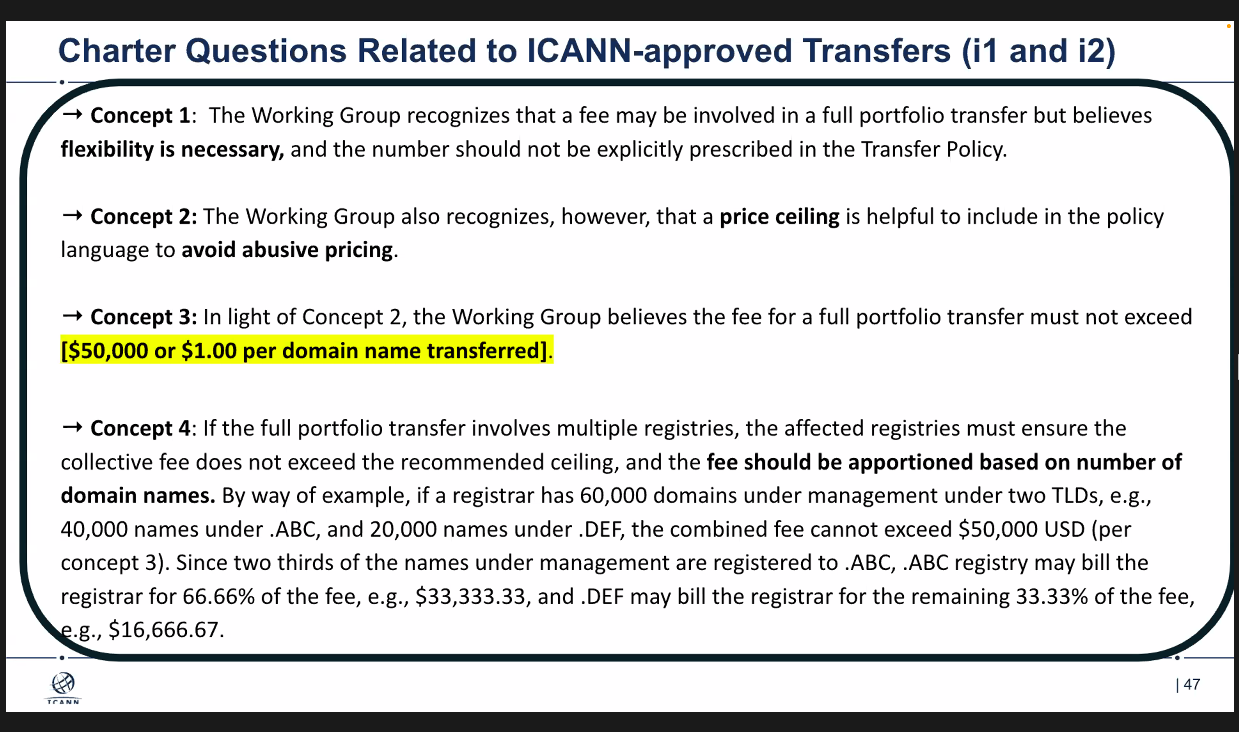

I like Chokri's suggestion that we take prices out of the policy and put them in a separate document referenced by the policy. As we are all quite aware, making changes to an ICANN policy, any policy, is a slow, difficult process. I think we need something more flexible. But, as already pointed out in this conversation, it is not in the interests of end users that pricing be left entirely to the whim of those selling domain names. This approach would allow us to both maintain flexibility and protect our users. Bill Jouris Sent from Yahoo Mail on Android On Mon, Aug 28, 2023 at 4:01 AM, Chokri Ben Romdhane via CPWG<cpwg@icann.org> wrote: _______________________________________________ CPWG mailing list CPWG@icann.org https://mm.icann.org/mailman/listinfo/cpwg _______________________________________________ By submitting your personal data, you consent to the processing of your personal data for purposes of subscribing to this mailing list accordance with the ICANN Privacy Policy (https://www.icann.org/privacy/policy) and the website Terms of Service (https://www.icann.org/privacy/tos). You can visit the Mailman link above to change your membership status or configuration, including unsubscribing, setting digest-style delivery or disabling delivery altogether (e.g., for a vacation), and so on.

Hey all, To be clear, the WG has not decided on anything. We got a couple of suggestions and prices from non ICANN policies. Primarily we focus on the transfer of sponsorship. BTAPPA from Verisign being around for ages is one example. SIDN and other ccTLDs have similar services. I personally do not think there is a magic number here, these services all cost money and depending on the registry those could be lower and higher than others depending on automation and manual labor involved. A transfer of ownership at a registrar level is basically a database change at the registry level, which involves some coding from developers. Again the magic number is hard to guess as we are dealing with many registries, different development costs, different backends, and so on. What the WG is not trying to do is wade ICANN into some discussion about pricing, I think most WG members are aware of some very strict rules and laws. Good reading on the list though, there is certainly some food for thought there for the WG in the next sessions. Thanks, Theo On Mon, Aug 28, 2023, at 3:22 PM, Bill Jouris via CPWG wrote:
I like Chokri's suggestion that we take prices out of the policy and put them in a separate document referenced by the policy.
As we are all quite aware, making changes to an ICANN policy, any policy, is a slow, difficult process. I think we need something more flexible. But, as already pointed out in this conversation, it is not in the interests of end users that pricing be left entirely to the whim of those selling domain names.
This approach would allow us to both maintain flexibility and protect our users.
Bill Jouris
Sent from Yahoo Mail on Android <https://go.onelink.me/107872968?pid=InProduct&c=Global_Internal_YGrowth_Andr...>
On Mon, Aug 28, 2023 at 4:01 AM, Chokri Ben Romdhane via CPWG <cpwg@icann.org> wrote: _______________________________________________ CPWG mailing list CPWG@icann.org https://mm.icann.org/mailman/listinfo/cpwg
_______________________________________________ By submitting your personal data, you consent to the processing of your personal data for purposes of subscribing to this mailing list accordance with the ICANN Privacy Policy (https://www.icann.org/privacy/policy) and the website Terms of Service (https://www.icann.org/privacy/tos). You can visit the Mailman link above to change your membership status or configuration, including unsubscribing, setting digest-style delivery or disabling delivery altogether (e.g., for a vacation), and so on.
CPWG mailing list CPWG@icann.org https://mm.icann.org/mailman/listinfo/cpwg
_______________________________________________ By submitting your personal data, you consent to the processing of your personal data for purposes of subscribing to this mailing list accordance with the ICANN Privacy Policy (https://www.icann.org/privacy/policy) and the website Terms of Service (https://www.icann.org/privacy/tos). You can visit the Mailman link above to change your membership status or configuration, including unsubscribing, setting digest-style delivery or disabling delivery altogether (e.g., for a vacation), and so on.
participants (9)
-
 Bill Jouris
 -
 Carlton Samuels
 -
 Chokri Ben Romdhane
 -
 Evan Leibovitch
 -
 John McCormac
 -
 mike palage.com
 -
 Olivier MJ Crépin-Leblond
 -
 Steinar Grøtterød
 -
 Theo Geurts